AI Medical Transcription: How It Works and What to Check
AI medical transcription turns clinician speech into written notes. Learn how it works, where it helps, where it struggles, and what to check before trusting it.
On this page
Short answer
AI medical transcription is software that converts spoken clinical language into written text for patient records. A clinician dictates or speaks during a visit, a speech-recognition model trained on medical vocabulary produces a draft, and a human reviews and corrects it before it enters the record. It saves typing time, but the draft is not a finished note until someone checks it.
What is AI medical transcription?
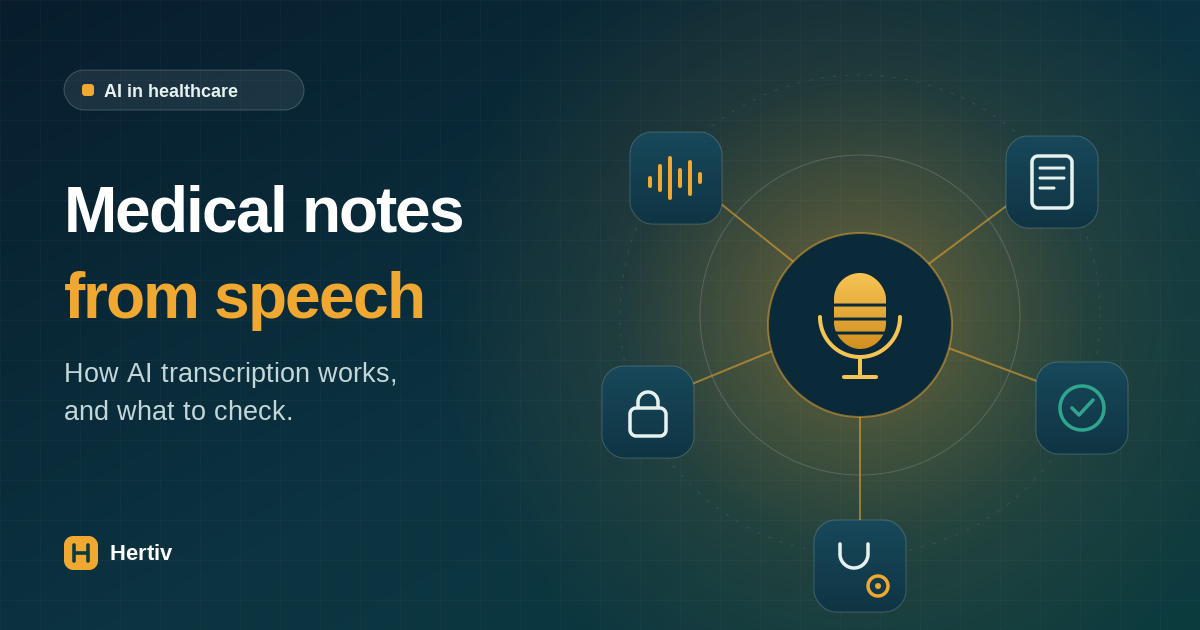
AI medical transcription is software that turns spoken clinical language into written text for the patient record. A clinician speaks, either dictating after a visit or talking naturally during it, and a speech-recognition model converts that speech into a draft note. The model is trained on medical vocabulary, so it recognises drug names, procedures, anatomy and the shorthand clinicians use every day.
It differs from general transcription in one important way: the words matter more. A missed negative, a wrong dose or a swapped side can change what the record says about a patient. That is why every serious medical transcription workflow keeps a human in the loop. The software produces a draft; a clinician or a trained editor checks it before it is signed.
| Input | What the software does | What still needs a human |
|---|---|---|
| Dictation after a visit | Turns speech into a structured note | Checking facts, doses and dates |
| Live visit conversation | Separates speakers and drafts the note | Confirming what was decided |
| Voice notes between visits | Captures follow-ups and phone calls | Linking the note to the right patient |
| Operative and procedure notes | Formats steps and findings | Verifying the clinical detail |
| Referral letters | Drafts from dictation | Reviewing tone and completeness |
For teams weighing whether to build this themselves, AI medical transcription software development cost breaks down what a build involves and what drives the price.
How does AI medical transcription work?
AI medical transcription works in four steps: capture, recognition, formatting and review. First, audio is captured from a microphone, a phone or the room system, and stored securely. Next, a speech-recognition model turns the audio into text, using a medical vocabulary and context from the visit type to pick the right words.
Then the text is shaped into the structure a record needs, such as history, examination, assessment and plan. Finally, a human reads the draft, fixes errors and signs it.
The recognition step is where medical training matters. General speech models often mishear drug names and abbreviations, because those words are rare in everyday speech. Medical models are trained on clinical text and audio, so they are better at distinguishing similar-sounding terms, such as two drugs with near-identical names. Speaker separation also matters in a live visit: the model has to tell the clinician's words from the patient's.
Formatting is often the step teams underestimate. A transcript is a wall of words; a note needs headings, lists and the right fields filled in. Some tools use templates tied to the specialty, so a cardiology note and a dermatology note come out in different shapes. The output still needs review, but a good template removes most of the tidying.
What does it handle well, and where does it struggle?
AI medical transcription handles clear, structured speech well. A clinician dictating a familiar note in a quiet room, using standard terms, will usually get a draft that needs only small fixes. It also handles routine follow-ups, where the visit follows a predictable pattern and the vocabulary is narrow. Teams that dictate in a consistent style see the best results.
It struggles where speech is messy. Overlapping voices, a patient speaking softly, background noise in a busy clinic, strong accents the model has not heard often, and rapid switching between languages all raise the error rate. Abbreviations are another weak point: the same short form can mean different things in different specialties, and the model has to guess from context.
Numbers are the riskiest errors of all. A dose, a lab value or a date that is misheard by one digit can change the meaning of a note entirely. That is why the review step should focus on numbers first. Read the doses, the measurements and the dates before anything else, because those are the errors that carry the most risk if they reach the record.
How accurate is it, and who checks the output?
Accuracy varies with the speaker, the setting and the tool, so there is no single figure that applies to every clinic. A quiet dictation from one clinician will be far more accurate than a noisy two-person conversation.
The honest way to judge a tool is to test it on your own recordings and count the errors that matter, not to trust a vendor's headline figure. Run a pilot on real visits and measure how much editing the drafts need.
Checking is a job, not an afterthought. Some clinics have the clinician review their own drafts, which keeps the person who knows the patient closest to the note. Others use trained editors or a second pass by the software, with the clinician signing off at the end. Either way, the note should not enter the record unreviewed. A draft is a draft until someone with clinical responsibility has read it.
Good tools make review easy by flagging uncertain words and showing the audio alongside the text, so a reviewer can listen to the exact phrase instead of guessing. If a tool hides its uncertainty and presents every word with equal confidence, reviewers have to read everything with the same care, which slows the work down. Ask vendors how their review screen works before you buy.
How do you roll it out in a clinic?
You roll out AI medical transcription by starting small, measuring the editing burden, and only then widening the rollout. A pilot with a few clinicians in one specialty gives you real data on accuracy, time saved and the problems your team actually hits, without changing how the whole clinic works at once.
- Pick one specialty and a few volunteers. Choose a team that dictates a lot and is willing to give honest feedback.
- Set up secure audio capture. Decide where recordings are stored, who can access them and how long they are kept, and check the privacy rules that apply to your patients.
- Connect it to the record system. A draft that has to be copied by hand will be abandoned. The tool should place drafts where clinicians already work.
- Run the pilot for a few weeks. Track how long review takes, what kinds of errors appear, and whether clinicians actually save time.
- Train on the errors you find. Fix templates, add the terms your team uses, and agree on how abbreviations are handled.
- Expand only if the pilot saves time. If review takes as long as typing did, the tool is not ready for your team.
Privacy is part of the setup, not an add-on. Recordings contain patient health information, so the vendor must meet the data rules that apply where you practise, and staff should know what is recorded and why. For the wider picture on protecting patient data, see data security and compliance.
Example (hypothetical): a clinic measures the time saved
Example (hypothetical): a small clinic has 6 clinicians, each seeing 20 patients a day and spending 3 hours a day typing notes. That is 18 hours of typing a day across the team. The clinic trials AI transcription with 2 of the clinicians for a month.
After the pilot, each of the 2 clinicians spends 1 hour a day reviewing drafts instead of 3 hours typing, saving 2 hours each, or 4 hours a day between them. They also report that review takes longer on complex visits, about 90 minutes, and less on routine ones, about 45 minutes. The arithmetic is straightforward: 2 clinicians times 2 hours saved equals 4 hours a day, which is 20 hours across a 5-day week.
The clinic decides to expand to all 6 clinicians. If the same saving holds, that is 12 hours a day, or 60 hours a week, freed for patient care. The decision is based on the pilot's own numbers, not on a vendor promise, and the clinic keeps measuring after the rollout to check the saving holds.
What are the common mistakes?
The most common mistakes are skipping the pilot, trusting drafts without review, and choosing a tool on price alone. Each of these is easy to avoid once you know to look for it.
- Rolling out to everyone at once. A tool that works for one specialty can fail in another. Pilot first.
- Treating the draft as finished. A fluent draft with a wrong dose is worse than a slow note. Review before signing.
- Ignoring the review time. If reviewing takes as long as typing, nothing was saved. Measure it.
- Forgetting consent and privacy. Patients should know when a visit is recorded, and recordings need proper protection.
- Picking a general transcription tool. General tools, like the ones in top AI transcription tools, are built for meetings, not clinics. Medical vocabulary and speaker separation matter.
- Skipping template work. A note in the wrong shape costs as much time to fix as typing it did.
Key takeaways
- AI medical transcription turns speech into a draft note; a human must review it before it enters the record.
- Medical vocabulary and speaker separation are what make a transcription tool clinical rather than general.
- Numbers and negatives are the riskiest errors, so review doses, values and dates first.
- Accuracy varies by speaker, setting and tool, so pilot on your own recordings before deciding.
- A tool only saves time if review is faster than typing; measure that in the pilot.
- Recordings hold patient health information, so privacy and consent are part of the setup.
Frequently asked questions
What is AI medical transcription?
AI medical transcription is software that converts spoken clinical language into written text for patient records. A clinician speaks, a speech-recognition model trained on medical vocabulary produces a draft, and a human reviews and corrects it before it is signed.
Is AI medical transcription accurate enough for patient records?
Accuracy depends on the speaker, the setting and the tool, so there is no single figure. The safe approach is to pilot a tool on your own recordings, count the errors that matter, and keep a human reviewing every draft before it enters the record.
Does AI medical transcription replace human transcriptionists?
It changes the job rather than removing it. The software produces the first draft, and people move to reviewing, correcting and handling the difficult cases the model gets wrong, such as overlapping speech or unusual terms.
How does AI medical transcription handle patient privacy?
Recordings contain patient health information, so they must be stored securely, access must be limited, and patients should know when a visit is recorded. Check the data rules that apply where you practise and confirm the vendor meets them.
What is the difference between AI medical transcription and an AI medical scribe?
Transcription converts speech into text, usually from dictation after a visit. A scribe listens during the visit, separates the speakers and drafts a structured note from the conversation itself. Many scribe tools use transcription as one step inside a larger workflow.
Can AI medical transcription work with our electronic health record system?
It can, but only if the tool is set up to place drafts where clinicians already work. A draft that has to be copied by hand will be abandoned, so check the integration with your record system during the pilot, not after the purchase.