How AI Is Used in Real Estate: What It Does Today
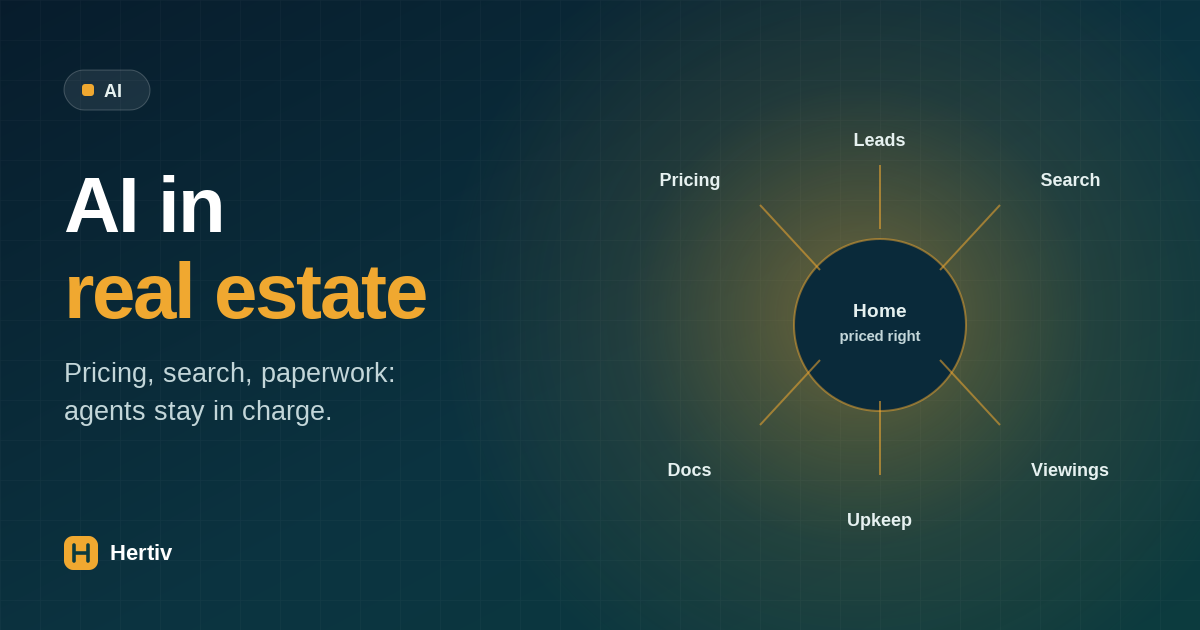
AI in real estate helps with pricing, search, viewings, paperwork and upkeep, but it does not replace agents. Here is where it works and where it falls short.
On this page
Short answer
AI in real estate is used to price homes, match buyers with listings, answer questions, draft documents and spot maintenance issues before they grow. Agents use it to save time on routine work, while buyers use it to search in plain language and shortlist homes faster. The tools work best as help for people, not as a replacement for local knowledge and judgement.
What does AI do in real estate?
AI in real estate is software that reads property data, listings, photos and messages, then helps agents, buyers and owners make faster decisions. It does not buy or sell homes on its own. It reads the data around a deal and points people at the parts that matter.
The work falls into a few clear jobs. Pricing models read past sales and suggest a range. Search tools match plain-language requests to listings. Chat tools answer routine questions at any hour. Document tools draft and check paperwork. The table below shows the main jobs and who gains from each one.
| Job | What AI does | Who benefits |
|---|---|---|
| Pricing | Suggests a price range from past sales | Agents and sellers |
| Search and matching | Matches plain-language requests to listings | Buyers |
| Viewings | Schedules tours and answers questions | Agents and buyers |
| Paperwork | Drafts and checks standard documents | Agents and lawyers |
| Maintenance | Flags faults from sensor and report data | Owners and managers |
| Lead follow-up | Sorts enquiries and drafts replies | Agents |
How does AI help with pricing?
Pricing tools read past sales, listing prices, size, location and condition, then suggest a range for a home. The model learns from homes that sold nearby, so its range is only as good as the sales data behind it. In areas with many recent sales the range is usually tight; where sales are rare, it is wide and needs an agent's judgement.
The useful output is not one number but a range with reasons. A good tool shows which past sales shaped the estimate and which features pushed the price up or down. Agents use that range as a starting point for the conversation with a seller, not as the final word.
Agents should also check the tool's range against their own knowledge of the street. If the tool has never seen a home with a large garden in that area, its range will lean on homes without one. A quick check of three recent sales the agent knows well shows whether the tool understands the area or just the averages.
How does AI change property search?
Search tools let buyers describe what they want in plain words, such as "a quiet flat near a park with two bedrooms", instead of ticking boxes. The system reads the listing text, photos and location data, then ranks homes by how well they match the request. That helps buyers who do not know the area or the right search terms.
The risk is that the system hides homes that match in ways it cannot read, such as a good layout hidden in poor photos. Buyers should still browse the full list for their budget and area, and treat the AI ranking as a shortlist, not the whole market. See AI agents use cases for how these assistants work in other fields.
Where does AI help agents day to day?
Agents spend much of their day on routine work: answering the same questions, chasing documents, scheduling viewings and updating listings. AI tools draft replies, pull documents together and keep the calendar in order, which leaves agents more time for viewings and negotiations.
The tools that save the most time are the least flashy ones. A reply draft that an agent checks and sends beats a chatbot that answers wrongly at 2 a.m. A document check that flags a missing signature beats a system that writes whole contracts. Start with the boring work and measure the hours it saves.
Viewing scheduling is another quiet win. The tool reads the agent's calendar, offers open slots to buyers and sends reminders, which cuts the back-and-forth messages that eat an afternoon. It is a small job, but it is one agents feel every day.
What should buyers and sellers watch out for?
Buyers and sellers should treat AI output as a draft, not a decision. A price range is a guess built on past sales, and it cannot see a leaking roof or a noisy street. A search ranking reflects what the system could read, not the whole market. A document draft still needs a person to check it.
Data is the other limit. Models trained on one city can misread another, and old sales data can misprice a fast-moving market. Ask what data the tool used and how recent it is before trusting its answer. A small proof of concept is the usual way to test a tool; see how to build an AI proof of concept.
Another check is the listing itself. If the photos are old or the description is thin, the system has little to work with, and its ranking will reflect that gap. Buyers should ask the agent for fresh photos and a viewing before trusting any shortlist the tool produced.
Example (hypothetical): a small agency tries AI pricing
A small agency lists 40 homes a month and an agent spends about 2 hours on pricing research for each one, which is 40 x 2 hours, or 80 hours a month. With an AI pricing tool, the agent reviews a draft range and its reasons in about 30 minutes per home, which is 40 x 30 minutes, or 20 hours a month. The agency saves about 60 hours a month on research.
The agency still checks every price before it goes to a seller. On 4 of the 40 homes the tool's range is far off because the homes are unusual, so the agent spends the saved time on those four instead. The tool pays for itself in hours saved, but only because a person stays in charge of the final number.
Common mistakes
The most common mistake is trusting a price range as if it were a valuation. It is a starting point built on past sales, and it cannot see the condition of the home. Another mistake is letting a chatbot answer legal or money questions it was not built for. A third is buying a tool before checking whether your listings data is clean enough to feed it.
A fourth mistake is measuring the wrong thing. Hours saved is a fair measure; deals closed is not, because a tool that drafts replies does not sell homes. Pick one measure, track it for a month, and keep the tool only if the number moves. See AI consulting if your team needs help scoping a first project.
Key takeaways
- AI in real estate prices homes, matches buyers and drafts paperwork.
- Pricing tools suggest a range from past sales; they are not valuations.
- Plain-language search helps buyers shortlist, but it can hide good homes.
- The biggest time savings come from routine work, not from flashy features.
- Keep a person in charge of the final price, the final reply and the final document.
Frequently asked questions
Can AI value a home on its own?
No. AI can suggest a price range from past sales, but it cannot see the condition of the home or the street. An agent still needs to visit the property and set the final price.
How does AI help buyers search?
Buyers can describe what they want in plain words, and the system ranks listings by how well they match. It is a shortlist tool, not a full view of the market.
Does AI replace estate agents?
No. It handles routine work such as drafting replies, scheduling viewings and checking documents, while agents keep the viewings, negotiations and local knowledge. The agent stays in charge of the deal.
What data does real estate AI need?
It needs clean listings data, past sales, photos and location data. If the listings are incomplete or out of date, the output will be wrong in the same ways. Clean the data before you buy a tool.
Is AI pricing accurate?
It is usually close where many similar homes sold recently, and wide where sales are rare. Ask what data the tool used and how recent it is before trusting the range.
Where should an agency start with AI?
Start with one routine job, such as drafting replies or pricing drafts, and measure the hours it saves for a month. Scale only if the number moves. One job at a time is enough.


