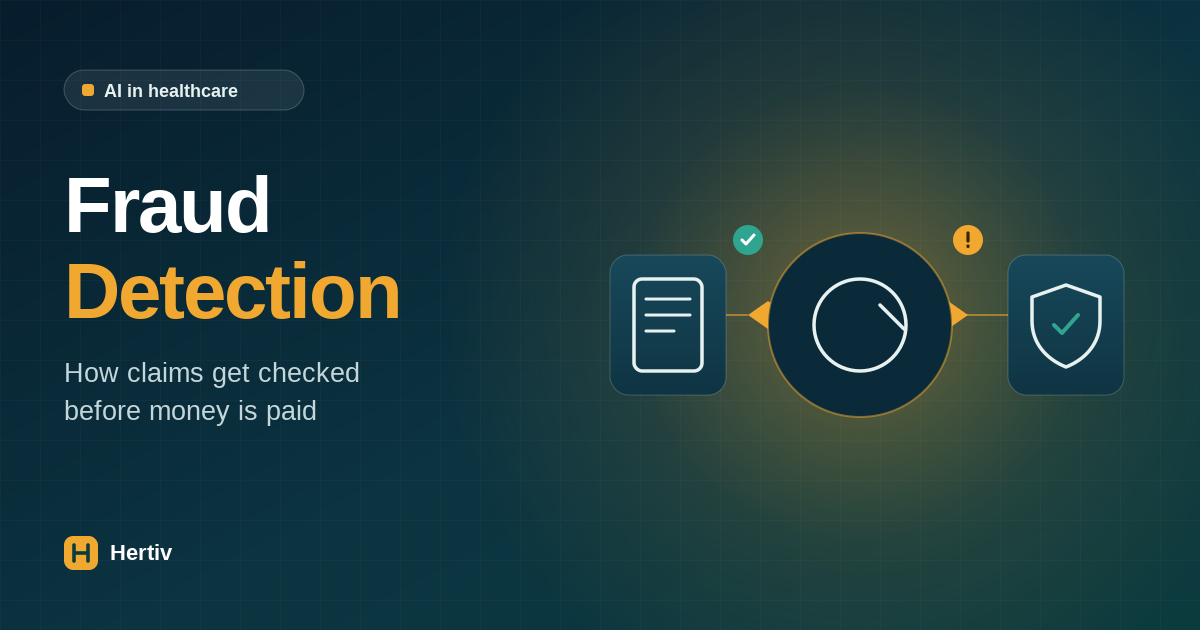
AI in Healthcare Fraud Detection: How Claims Get Checked
AI checks claims for billing errors, fake providers and stolen identities before payment. This guide explains how the checks work and where humans decide.
On this page
Short answer
AI healthcare fraud detection is the use of machine learning to check health insurance claims, bills and provider records for signs of fraud before payment. It looks for billing patterns, identity mismatches and provider behaviour that do not match honest care, then flags suspicious cases for human review.
What is AI healthcare fraud detection?
AI healthcare fraud detection is the use of machine learning to check health insurance claims, bills and provider records for signs of fraud before payment. It looks for billing patterns, identity mismatches and provider behaviour that do not match honest care, then flags suspicious cases for human review.
Health fraud costs payers and patients: wrong bills raise premiums, fake providers drain funds, and stolen identities put wrong records on real patients. Manual review cannot keep up with claim volumes, so payers use AI to rank claims by risk and send only the riskiest to investigators.
| Fraud type | What happens | What AI checks |
|---|---|---|
| Upcoding | Simple care billed as complex care | Codes against notes and history |
| Duplicate billing | The same service billed twice | Matching claims across providers |
| Unbundling | One procedure split into many charges | Code combinations that should be one |
| Phantom billing | Care that never happened is billed | Visits with no matching records |
| Identity theft | Stolen patient or provider identity | Location, device and history mismatches |
The general pattern is the same as in finance: our post on fraud detection using machine learning explains the ranking and scoring ideas behind it.
How does AI check a claim?
AI checks a claim in three passes. First, deterministic rules catch the obvious errors: missing fields, impossible dates, codes that do not match the patient's age or sex, and claims that duplicate an earlier one. These rules are fast and explainable.
Second, models score the claim against what honest care usually looks like. They compare the codes, the provider, the patient history and the amounts with thousands of similar past claims. A claim that is far from the usual pattern gets a higher risk score.
Third, the system looks across claims, not just at one. It links providers, patients and billing patterns to spot rings: groups that bill together, refer to each other and share patients in ways that honest networks do not.
What billing patterns does it catch?
Upcoding is the most common pattern AI catches. A clinic bills a complex consultation when the notes describe a short routine visit, or bills a long procedure when the record shows a brief one. AI compares the code with the notes, the time and the patient's history to flag the mismatch.
Duplicate billing and unbundling are caught by matching. The system checks whether the same service was already billed, and whether a set of codes that should be billed as one procedure was split into many. Both patterns are hard to spot by eye across thousands of claims, and easy for a matching system.
Phantom billing is caught by absence: a claim for a visit with no appointment, no note and no lab order behind it. AI checks the claim against the care record, and a claim with nothing behind it rises to the top of the review queue.
How does it catch identity and provider fraud?
Identity fraud starts with mismatches. A claim comes from a device or location that does not match the patient's history, or a provider bills from two distant clinics on the same day. AI flags these mismatches because honest care has a consistent trail: the same patient, the same clinic, the same devices.
Provider fraud is caught by comparison with peers. A clinic that bills far more of an expensive procedure than similar clinics, or whose patients all receive the same costly treatment, stands out. The model does not accuse anyone: it ranks the provider for review, and an investigator checks the records.
Document checks add another layer. Our post on AI-powered document fraud detection covers how AI spots altered or fake documents behind a claim.
Where does the human fit in?
The human fits in at the end, not the start. AI ranks and flags; people decide. A flagged claim goes to a reviewer who reads the notes, checks the records and talks to the provider before any payment is denied. That review step is what keeps the system fair.
Appeals matter too. A provider whose claim is denied must be able to see why and to correct the record. Systems that deny payment without explanation create disputes and lose in review, even when the flag was right.
False positives are the main cost. Every honest claim that is wrongly flagged wastes reviewer time and delays payment. Good teams track the false positive rate and tune the system so reviewers spend time on real fraud, not on noise.
Example (hypothetical): a payer checks 10,000 claims a month
Example (hypothetical): a health payer receives 10,000 claims a month. Reviewers can check about 400 of them by hand, so most claims are paid without review. The payer adds an AI check that scores every claim and flags the 400 riskiest for review.
Of those 400 flagged claims, reviewers confirm 120 as wrongly billed, with an average overcharge of 250 dollars each. That is 120 times 250 dollars, or 30,000 dollars a month that would otherwise have been paid out.
The other 280 flagged claims turn out to be honest, so the false positive rate on flagged claims is 280 out of 400, or 70 in 100. The team accepts that because reviewing 400 claims to catch 120 bad ones beats reviewing 400 at random, where they would catch far fewer.
How does a payer start with fraud detection AI?
Start with the data you already have: past claims, past decisions and the outcomes of past investigations. These steps keep the first project honest.
- Gather a year of claims with known outcomes: paid, denied and investigated.
- Write down the fraud types you see most, and check the data shows them.
- Build the rule layer first: duplicates, impossible dates and code mismatches.
- Add a risk model on top, and measure it on held-out past claims before it touches live ones.
- Put reviewers in the loop with a clear queue, a time limit per case and an appeal path.
- Track the hit rate and the false positive rate monthly, and retrain when patterns shift.
Agentic checks can help triage, but they need the same oversight: our post on fraud detection AI agents covers where agents fit and where they do not.
What are the common mistakes?
Fraud detection fails when teams trust the model too much or measure the wrong thing. Avoid these.
- Letting the model deny payment without a human review step
- Training only on caught fraud, so new fraud types go unseen
- Ignoring false positives until providers complain and trust breaks
- Checking single claims but never looking across providers for rings
- Keeping no appeal path for providers whose claims are flagged
- Treating a high risk score as proof of fraud instead of a reason to look closer
- Measuring flags raised instead of fraud confirmed and money protected
Insurance teams face the same trade-offs: our AI for insurance page covers the wider fraud and underwriting picture. The goal is not more flags, but more confirmed fraud per reviewer hour, with honest providers paid on time.
Key takeaways
- AI ranks claims by risk; humans decide what happens next.
- Upcoding, duplicates, unbundling and phantom billing are the patterns to watch.
- Cross-claim links catch fraud rings that single claims hide.
- False positives are the main cost; track them, don't ignore them.
- Start with rules and known outcomes before adding a model.
Frequently asked questions
What is healthcare fraud detection?
It is the checking of health insurance claims, bills and provider records for signs of fraud before payment. It covers wrong billing, fake providers and stolen identities, and it is usually done by a mix of rules, models and human reviewers.
Can AI detect healthcare fraud on its own?
No. AI ranks claims by risk and flags the suspicious ones, but people must review the evidence before payment is denied. A model alone cannot prove fraud, and denying payment without review creates disputes.
What is upcoding in healthcare billing?
Upcoding is billing a simple service as if it were a more complex and expensive one. AI catches it by comparing the billed code with the clinical notes, the time spent and the patient's history.
How accurate is AI fraud detection?
Accuracy is measured by hit rate and false positive rate, not by a single number. A good system catches more real fraud per reviewer hour than random checks, while keeping false positives low enough that reviewers trust the queue.
Do small insurers need fraud detection AI?
Small payers see the same fraud types at lower volume. Rules-based checks and shared fraud data often pay off before a custom model does. Start with duplicates and code mismatches, which are cheap to check.
What happens to a provider flagged for fraud?
A flagged provider's claims go to human review, and investigators check the records before any action. Providers can appeal and correct the record. Payment is only denied or recovered after that review.