AI in Ecommerce: The Benefits That Matter Most
AI helps online stores recommend products, answer questions and forecast stock. Here are the benefits that actually move sales, and the ones that do not.
On this page
Short answer
AI benefits ecommerce by helping shoppers find products faster, answering common support questions, and forecasting demand so stores stock the right items. The gains show up as more completed orders, fewer support tickets and less wasted stock, but only when the store's product and order data are clean.
What does AI do in ecommerce?
AI in ecommerce is software that learns from store data, such as browsing, orders and messages, and uses what it learns to recommend products, answer questions and plan stock. It does not replace the store; it makes the parts that repeat every day faster and more accurate.
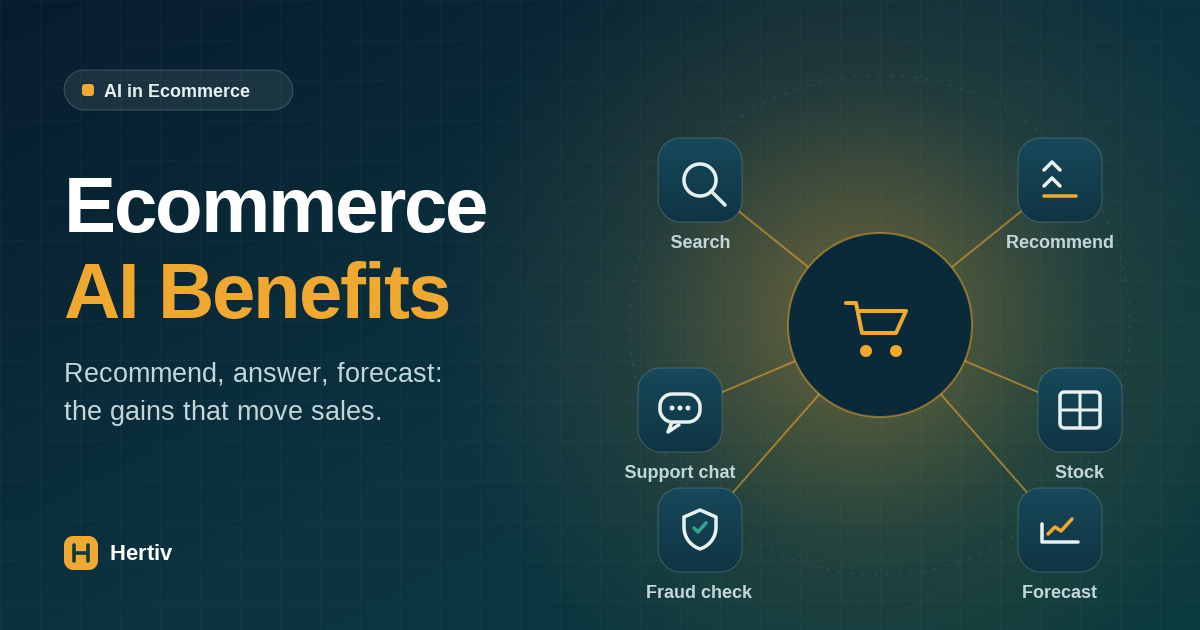
The tools fall into a few groups: recommendations that suggest products, search that understands plain language, chat that answers common questions, and forecasting that predicts what will sell. A store can start with one group and add more later, which keeps the first project small.
| AI use | What it does | Where it helps most |
|---|---|---|
| Product recommendations | Suggests items based on browsing and past orders | Product and checkout pages |
| Search | Matches plain-language queries to products | Stores with large catalogues |
| Customer chat | Answers order, delivery and returns questions | Support inboxes and live chat |
| Demand forecasting | Predicts which items will sell and when | Buying and warehouse planning |
| Fraud checks | Flags orders that look unusual | Checkout and payment review |
The benefit is not the technology itself. It is the time saved and the orders that would have been lost to a bad search result or a slow reply. For the wider picture of where AI is heading in online retail, see AI ecommerce trends.
How does AI lift sales?
AI lifts sales mainly by helping shoppers find the right product sooner. A shopper who types "warm waterproof jacket for hiking" wants one clear answer, not fifty results to sort through. Good search and recommendations shorten that path, and a shorter path means more completed orders.
Recommendations work best when they are specific. "People who bought this also bought" helps, but a suggestion based on size, price range and past returns is stronger. The store should test one placement at a time, such as the product page, and keep the version that sells more.
Personalised emails and home pages can help too, but only if the data behind them is clean. A recommendation built on a wrong size or a gift purchase will annoy the customer it was meant to help. Clean the catalogue data first, then personalise.
How does AI help customer support?
AI helps customer support by answering the questions that repeat every day, such as where an order is, how to return an item and whether a size is in stock. A chatbot or an assistant that drafts replies lets the support team spend its time on the cases that need a person.
The setup matters more than the tool. The assistant needs access to order status, delivery tracking and the returns policy, or it will give vague answers that create more work. Start with the five most common questions, measure how many are resolved without a human, and add more only when the first five work well.
Human handover must be easy. If a customer asks twice or uses words like "complaint" or "refund", the conversation should reach a person quickly. A bot that traps an unhappy customer does more damage than a slow reply. For how AI changes retail more broadly, see the impact of AI in retail.
Can AI improve pricing and stock?
AI can improve pricing and stock by spotting patterns a spreadsheet misses, such as which items sell together, which sizes run out first and which products are returned most. That information helps a store order the right quantities instead of guessing from last month.
For pricing, AI can track how demand changes when a price moves, and suggest smaller, more frequent changes instead of big seasonal sales. The store still sets the rules, such as a minimum margin, and the software works inside them. No price should change without a person being able to see why.
Forecasting is only as good as the data fed into it. A store that records returns, cancellations and out-of-stock days will get better forecasts than one that only records sales. Fix the data before buying a forecasting tool, or the tool will repeat the same blind spots.
What does AI cost to run?
AI costs in ecommerce come from three places: the tool itself, the data work to connect it, and the time to keep it accurate. A ready-made recommendation or chat tool is usually charged monthly, and the price depends on orders or messages, so check the vendor site for current plans before budgeting.
The hidden cost is integration. Connecting a tool to the catalogue, the order system and the support inbox takes developer time, and a tool that is not connected properly will give poor answers. Budget for that work, not just the monthly fee.
Start small and measure one number, such as orders per visitor or support tickets per order. If the number does not move after a few weeks, change the setup before adding a second tool. A single tool that works beats three that are half connected.
Example (hypothetical): a small fashion store adds recommendations
Example (hypothetical): a small fashion store gets 10,000 visitors a month and 200 orders, which is a 2% conversion rate. The average order is $60, so monthly revenue from the store is $12,000. The owner adds product recommendations to the product page and the cart.
After a month, the conversion rate rises to 2.4%, which is 240 orders from the same 10,000 visitors. That is 40 extra orders, and at $60 each it is $2,400 of extra revenue a month. The recommendation tool costs $300 a month, so the store keeps $2,100 before counting the time spent setting it up.
The owner then checks returns. If the extra orders come with more returns, the gain is smaller, so the next step is to look at which recommended items get returned and remove them from the suggestions. The numbers decide the next move, not the tool.
What are the common mistakes?
The most common AI mistakes in ecommerce are buying a tool before fixing the data, automating the wrong conversations, and trusting the software without checking its answers. Each one is avoidable with a small pilot and a weekly review.
- Dirty catalogue data. Wrong sizes, missing colours and duplicate products make recommendations useless.
- Automating angry customers. A bot should hand over quickly when a customer is upset.
- No human review. AI answers and prices should be checked regularly, not left to run alone.
- Too many tools at once. One working tool teaches more than three half-installed ones.
- Measuring the wrong thing. Clicks on a recommendation mean little if orders and returns do not improve.
Run a pilot on one part of the store, measure orders and returns, and only then expand. For the metrics worth tracking from day one, see predictive analytics in retail.
Key takeaways
- Recommendations and search help shoppers find the right product sooner
- Chat tools handle repeat questions so support staff can focus on hard cases
- Forecasting improves stock levels when the underlying data is clean
- Start with one tool, measure orders and returns, then expand
- Keep a human in charge of prices, answers and unhappy customers
Frequently asked questions
What is the biggest benefit of AI in ecommerce?
The biggest benefit is usually better product discovery: search and recommendations that match what the shopper actually wants. That shortens the path to checkout and raises the share of visitors who buy, which is the number most stores should watch first.
Does AI replace customer support staff?
No. AI handles repeat questions such as order status and returns, while staff handle complaints, complex orders and anything the bot cannot resolve. The goal is fewer routine tickets per person, not fewer people, and a fast handover when the customer needs one.
How much does ecommerce AI cost?
It depends on the tool and the volume of orders or messages. Ready-made tools usually charge monthly, with prices listed on the vendor site. The larger cost is often the developer time to connect the tool to the catalogue, orders and support inbox.
Do small stores benefit from AI?
Yes, if they start small. A store with a few hundred products can gain from recommendations and a simple support bot, as long as the catalogue data is accurate. A large catalogue is not a requirement, but clean data is.
Can AI reduce returns?
It can help. Better size guides, clearer product matches and recommendations based on past returns can cut the share of orders sent back. The store should track returns per recommended item and remove the items that come back most often.
What data does ecommerce AI need?
It needs clean product data, order history, returns and support messages. Missing sizes, duplicate products and unrecorded returns all make the results worse. Fixing the catalogue is usually the first job, before any tool is bought.


