AI Grading Tools for Education: What They Do
AI grading tools read student work, suggest marks and give feedback, but a teacher still makes the final call. Learn what they grade well and where they fail.
On this page
Short answer
AI grading tools are software that reads student work, such as essays, short answers or code, and suggests a mark plus feedback. They work by comparing the work with a marking guide and with examples of graded work. They save teachers time on routine marking, but they cannot judge original thought or handle unusual answers, so a teacher should always review the result before it counts.
What are AI grading tools for education?
AI grading tools for education are software that reads student work, such as essays, short answers or code, and suggests a mark and feedback for a teacher to review. They do not replace the teacher. They take the first pass, so the teacher spends time on judgement instead of on routine checks.
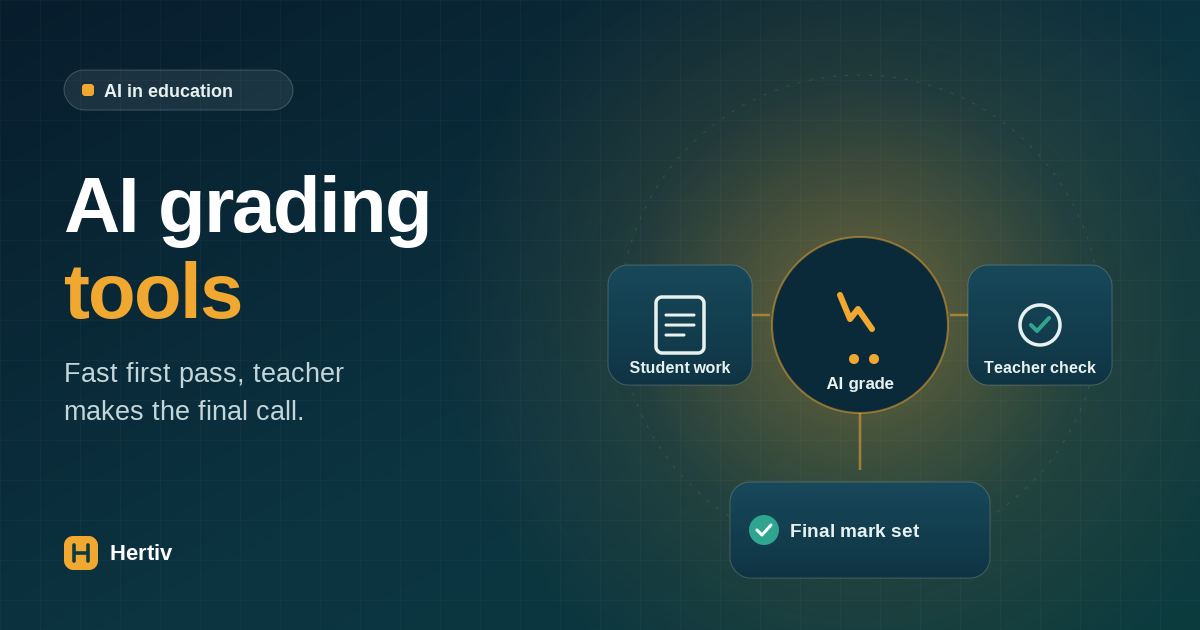
Most tools work the same way: the teacher sets a marking guide, uploads the work, and the tool returns a suggested mark, a short explanation and feedback the student can read. The teacher then accepts, changes or rejects the suggestion. The tool is an assistant, and the mark only counts once a teacher agrees with it.
These tools sit inside a wider set of classroom AI, from lesson planning to attendance. The grading part is the most sensitive, because a wrong mark affects a student directly, which is why the review step matters more than the speed.
What can AI grading tools grade?
AI grading tools handle structured work best and open work worst. The table below shows what each kind of work needs and where the tool struggles.
| Work type | What the tool checks | Where it struggles |
|---|---|---|
| Short answers | Facts, key terms, completeness | Answers worded in an unusual way |
| Essays | Structure, argument, use of evidence | Original ideas, tone, humour |
| Code | Correct output, style, test results | Creative solutions that break the tests |
| Maths | Working, steps, final answer | Partial credit for unusual methods |
| Quizzes | Right and wrong answers | Questions with more than one good answer |
| Language work | Grammar, vocabulary, fluency | Dialect, idiom, cultural references |
Short answers and quizzes are the safest starting point, because the marking guide is clear and the answers are short. Essays are the hardest, because a good essay can break every rule in the guide and still be good. Start where the guide is clearest.
How does AI grading work?
AI grading works in five steps, and each step leaves a record the teacher can check.
- Set the guide. The teacher writes the marking guide, including what earns marks and what loses them.
- Show examples. The teacher gives the tool graded examples, so it learns what a good answer looks like in this subject.
- Read the work. The tool reads each submission and compares it with the guide and the examples.
- Suggest a mark. It returns a mark, a short reason and feedback for the student.
- Teacher review. The teacher checks the suggestion and changes it where it is wrong, before the mark counts.
The examples matter most. A tool shown ten graded essays will grade the eleventh far better than a tool shown none. Spend time on the examples, and the tool will spend less of your time later. Teams that build these tools usually start with a small AI proof of concept on one subject before rolling the tool out across a school.
How accurate are AI grading tools?
AI grading tools are accurate on routine work and unreliable on unusual work. A short answer that matches the guide will be marked right almost every time. An essay with an original argument, a joke or a reference the tool has not seen may be marked down for being different, not for being wrong.
That is why accuracy should be measured on your own students, not on a vendor demo. Mark a set of past work by hand, run the tool on the same set, and compare the two. If the tool agrees with the teacher on most work but disagrees on the unusual answers, that is normal. The review step exists for exactly those cases.
Accuracy also drifts over time. A tool trained on last year's essays may struggle with this year's topics, so re-check it each term with fresh work. Testing an AI model on your own data is the only check that counts, because vendor numbers come from vendor data.
What about privacy and fairness?
Student work is personal data, so privacy comes first. Before choosing a tool, ask where the work is stored, who can read it, how long it is kept, and whether it is used to train the vendor's models. If the answers are unclear, do not upload student work.
Fairness is the second risk. A tool trained mostly on one kind of writing may mark other kinds of writing down, including work by students who write in a different dialect or who are learning the language. Check the tool's marks across groups of students, not just on average, and look for gaps.
Schools should set a clear rule: the tool suggests, the teacher decides. Students should know when AI helped mark their work and how to ask for a human re-check. Document tools that read student work sit in the same risk area as document AI, so the same privacy checks apply.
Example (hypothetical): a school grades 400 essays
Example (hypothetical): a secondary school asks one teacher to grade 400 short essays at the end of term. By hand, each essay takes 12 minutes to read and mark, so 400 essays take 4,800 minutes, which is 80 hours of marking.
With an AI grading tool, the first pass takes about 2 hours of machine time. The teacher then reviews each suggestion, which takes 3 minutes per essay, or 1,200 minutes, which is 20 hours. The total is 22 hours, so the tool saves 58 hours on this batch.
The saving only holds if the review is real. If the teacher accepts every suggestion without reading, the 58 hours saved become 58 hours of unchecked marks. The school in this example keeps the saving by reviewing the unusual answers first and spot-checking the rest.
What are the common mistakes?
The most common mistakes are letting the tool mark without review, trusting vendor accuracy claims, and ignoring privacy.
- No teacher review. A suggested mark is not a final mark until a teacher agrees with it.
- Trusting the demo. Vendor accuracy comes from vendor data; test on your own students.
- Grading essays first. Start with short answers, where the guide is clearest.
- Ignoring privacy. Ask where student work goes and how long it is kept before uploading anything.
- No way to appeal. Students need a clear path to ask a human to re-mark their work.
Start with one subject and one kind of work, measure the tool against your own marking, and keep the teacher in charge of every final mark. That is how a grading tool saves time without costing trust.
Key takeaways
- AI grading tools suggest marks and feedback; teachers make the final call
- They handle short answers and quizzes best, essays worst
- Good examples and a clear marking guide decide the quality
- Measure accuracy on your own students, not on a vendor demo
- Privacy and fairness checks come before any student work is uploaded
Frequently asked questions
Can AI grade essays accurately?
AI can grade essays well when the marking guide is clear and the tool has seen graded examples in that subject. It struggles with original arguments, humour and unusual answers. A teacher should always review the suggested mark before it counts, especially on essays.
Do AI grading tools replace teachers?
No. They take the first pass on routine marking, so teachers spend time on judgement, feedback and the unusual answers. The final mark stays with the teacher, and students should be able to ask a human to re-mark their work.
What subjects work best with AI grading?
Short answers, quizzes, maths and code work best, because the marking guide is clear and the answers are short. Essays and language work are harder, because good answers can break the guide and still be good. Start where the guide is clearest.
Is student data safe with AI grading tools?
It depends on the vendor. Ask where student work is stored, who can read it, how long it is kept and whether it trains the vendor's models. If the answers are unclear or the data leaves your control, do not upload student work.
How much time does AI grading save?
It depends on the subject and the review time. In the worked example in this article, 400 essays took 80 hours by hand and 22 hours with a tool plus teacher review. The saving only holds if the teacher reviews the suggestions properly.
Can students appeal an AI grade?
They should be able to. Schools should set a clear rule that any student can ask a teacher to re-mark their work by hand. The appeal path matters more than the tool, because it is what keeps the marks fair.


