AI Governance Consulting: Guardrails That Actually Hold
AI governance consulting sets the guardrails around your AI: what models may do, what data they may touch, and how you prove it. Here is what consultants do.
On this page
Short answer
AI governance consulting is expert help to set the rules, guardrails and monitoring around an organisation's AI systems. A consultant maps where AI is used, ranks the risks, writes the policies, designs the technical guardrails that enforce them, and sets up observability so you can see what models did, catch failures early, and show auditors a clear record.
What is AI governance consulting?
AI governance consulting is expert help to build the rules, controls and monitoring around an organisation's AI systems. A consultant works out where AI is already used, which uses carry real risk, and what controls are needed before the next system goes live.
The work is part policy and part engineering. Policies say what is allowed: which data a model may see, which decisions need a human, and how long records are kept. Engineering turns those policies into guardrails inside the system, so the rules hold even when nobody is watching. If you need the background first, what AI governance is covers the core ideas.
Consultants are usually brought in for one of three reasons: a regulator or large customer is asking questions, a team wants to ship AI faster without losing control, or something already went wrong and leadership wants it fixed properly. The output is normally a set of written policies, a guardrail design, an observability setup and a plan for keeping them current.
What guardrails do consultants put in place?
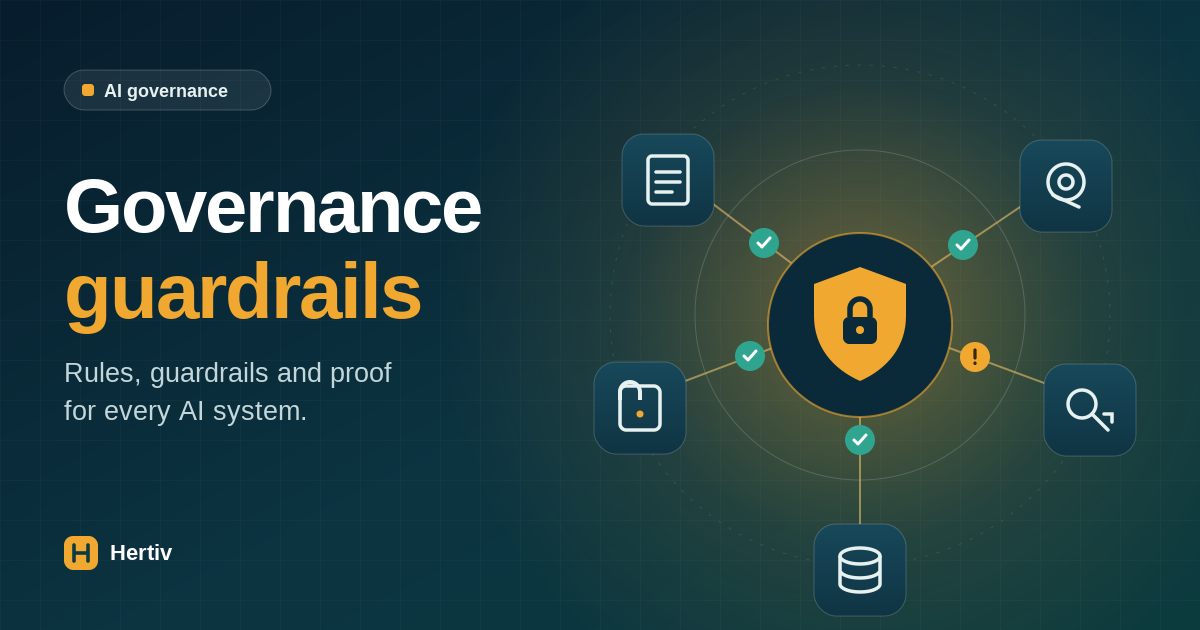
Guardrails are the technical controls that stop an AI system doing something it should not. A consultant picks them from the risks found in the assessment, not from a generic checklist, and each one is tied to a specific policy.
| Guardrail | What it does | Where it sits |
|---|---|---|
| Input filters | Block harmful or out-of-scope requests before they reach the model | At the entry point of the application |
| Output checks | Scan replies for banned content, personal data or invented facts | Between the model and the user |
| Human review gates | Route high-risk outputs to a person before they are sent or acted on | In the workflow, before the decision lands |
| Tool permissions | Limit which systems and actions an agent can reach | On the agent's credentials and API keys |
| Data rules | Control which data a model may read, store or send onward | In the data layer and retrieval setup |
The strongest guardrail is often the simplest: the model cannot reach a system it was never given access to. Consultants spend more time on permissions and data boundaries than on clever filters, because a model that cannot touch a payment system cannot misuse it.
What is AI observability, and why does it matter?
AI observability means keeping a usable record of what your AI systems did, so you can find failures, answer questions and prove compliance. It covers prompts, retrieved sources, model outputs, tool calls, costs and user feedback, stored in a form your team can search.
Without observability, a bad answer is a mystery. With it, you can trace the exact prompt, the documents the model was given, and the output it produced, then fix the cause instead of guessing. That trace is also what an auditor asks for first when they review an AI system.
Good observability has three parts. First, logging: every interaction is recorded with enough detail to replay it. Second, evaluation: a fixed set of test cases is run regularly so quality changes show up as numbers, not anecdotes. Third, alerting: the team is told when error rates, costs or refusal rates move outside the expected range.
Observability is not the same as watching a dashboard. It is the ability to answer, for any single decision the AI made, what went in, what came out, and why. If you cannot answer that for your highest-risk use case, that is where the work starts.
How does a governance consulting engagement run?
A governance consulting engagement usually runs in five stages, and each one produces something your team can keep using after the consultant leaves.
- Map the current state. List every AI system, model, data source and vendor. Most organisations find more AI in use than they expected.
- Rank the risks. Score each use case on harm if it goes wrong, data sensitivity and regulatory exposure, then focus on the top few.
- Write the policies. Short, plain rules for the highest-risk uses: what is allowed, who decides, and what happens when the rules are broken.
- Build the guardrails and observability. Put the technical controls and logging in place for the highest-risk systems first.
- Train and hand over. Show the team how to run the checks, review the logs and update the policies when a new system arrives.
The whole engagement often takes weeks for one product area and longer for a whole company. A useful way to think about it is in the guide to how to implement AI governance, which follows the same sequence your consultant will use.
Example (hypothetical): a bank adds guardrails to a lending copilot
Example (hypothetical): a regional bank uses a copilot to draft replies to loan applicants. The copilot reads application notes and suggests wording, but staff send the final reply. The bank hires a governance consultant after a draft mentions a detail that should never have left the file.
The consultant maps the system and finds the copilot can read the full loan file, including notes marked for internal use only. The fix is a data rule: the copilot only sees the fields the reply actually needs. An output check then scans every draft for account numbers and internal note markers before staff see it.
For observability, the bank logs each draft, the fields the model saw, and whether staff edited it. Each week a human reviews a 10% sample of drafts: 40 drafts out of 400. In one week 4 of the 40 need a correction, so the team estimates about 40 drafts in 400 need fixing, and it watches that share week by week.
The result is not a ban on the copilot. It is a copilot with a smaller data diet, a check before every draft reaches staff, and a record that shows what it did. The consultant's fee is agreed up front, and any ongoing costs are quoted as "see vendor site" where a vendor tool is involved.
What should you ask before hiring a governance consultant?
Before hiring a governance consultant, ask what they will leave behind. A good answer names the policies, the guardrail designs, the logging setup and the training your team gets. A vague answer about "best practice" is a warning sign.
- Have you done this in our sector? Rules differ sharply between finance, health and retail, and sector experience saves time.
- What will you measure? Ask for the checks and numbers that show whether the guardrails are working.
- Who owns the policies afterwards? Your team needs a named owner for each policy, or it goes stale.
- How do you handle our vendors? Most AI risk sits in vendor tools, so the consultant should review those too.
- What does it cost, and what is extra? Get the fee, the timeline and what happens if the scope grows. The cost question is covered in more depth in AI governance cost.
Also ask to see a sample of their output, with client names removed. A policy document that a busy manager can actually read is worth more than a long report nobody opens.
What are the common mistakes?
The most common governance consulting mistakes are buying a thick policy document nobody uses, guarding the wrong risks, and treating the work as a one-off project.
- Policies without teeth. A rule that no system enforces is decoration. Every policy needs a guardrail or a check behind it.
- Guarding the demo, not the risk. Teams protect the chatbot everyone sees and miss the internal tool that touches customer data.
- No owner after handover. If nobody owns the policies, they are out of date within months.
- Logging everything, reviewing nothing. Logs nobody reads are storage costs, not observability.
- One-off thinking. New models, vendors and rules arrive constantly, so governance needs a review rhythm, not a single project.
Key takeaways
- Governance consulting turns AI rules into guardrails that hold without constant watching
- The highest-risk uses get the strongest controls, not the most visible ones
- Observability means being able to replay any AI decision: what went in, what came out, and why
- Every policy needs an owner and a review rhythm, or it goes stale within months
- Ask a consultant what they leave behind before you ask what they charge
Frequently asked questions
What does an AI governance consultant actually do?
A consultant maps where AI is used, ranks the risks, writes the policies, designs the technical guardrails that enforce them, and sets up logging and evaluation so the team can see what models did. The work usually ends with a handover: named policy owners, a review rhythm and training for the team.
What is the difference between a guardrail and a policy?
A policy is a written rule, such as a model must not share account numbers. A guardrail is the technical control that enforces it, such as an output check that blocks replies containing account numbers. A policy without a guardrail or a check behind it is hard to enforce.
What is AI observability in simple terms?
AI observability is keeping a searchable record of what your AI systems did: prompts, sources, outputs, tool calls and costs. It lets you trace a bad answer back to its cause, spot quality drift over time, and show an auditor exactly what happened for any single decision.
How long does a governance consulting engagement take?
A focused engagement for one product area often takes a few weeks, covering the map, the risk ranking, policies for the top risks, guardrails and logging. A company-wide programme takes longer, because it covers more systems, vendors and teams, and needs a handover plan.
Do small companies need AI governance consulting?
Small companies usually need a lighter version: a short list of AI uses, policies for the risky ones, basic logging and one named owner. A consultant is most useful when a regulator or a large customer asks for evidence, or when the team is about to ship AI into a high-risk workflow.
How much does AI governance consulting cost?
Fees vary with scope, sector and the number of systems reviewed, so there is no standard price. Ask for a fixed fee for the agreed scope, a clear list of deliverables, and what counts as extra work before you sign.


