AI for Manufacturing Quotations: Faster, More Accurate Quotes
AI quoting reads RFQs and drawings, prices parts from past jobs and drafts quotes in minutes. Here is how it works and how to pilot it safely.
On this page
Short answer
AI for manufacturing quotations is software that reads a request for quotation, drawings and past job records, then drafts a priced quote for a human to check. It cuts the hours spent on manual take-offs and price lookups, and it makes quotes more consistent, because every draft starts from the same cost data instead of one person's memory.
What is AI for manufacturing quotations?
AI for manufacturing quotations is software that turns a request for quotation, or RFQ, into a priced quote with far less manual work. It reads the customer's drawings, specifications and quantities, compares them with past jobs, and drafts a price that a human estimator checks before it goes out.
A manual quote starts with an estimator reading drawings, counting features, looking up material prices and guessing machine time. That work is slow, and two estimators can price the same part very differently. AI does the repetitive reading and matching, so the estimator spends time on judgement: the tricky tolerances, the risky materials and the margins.
| Quoting step | What AI does | What stays human |
|---|---|---|
| Read RFQ and drawings | Extracts dimensions, materials, quantities | Confirms unclear specs with the customer |
| Find similar past jobs | Matches part features to job history | Judges whether the match really fits |
| Estimate cost | Calculates material, machine and labour cost | Sets margins and risk allowances |
| Draft the quote | Writes the priced document | Reviews and signs off before sending |
The goal is not to remove the estimator. It is to give the estimator a first draft in minutes instead of hours, so more RFQs get answered and fewer slip past the deadline. For teams already using quoting software, CPQ software for manufacturing covers the structured side of the same problem.
How does AI read an RFQ and a drawing?
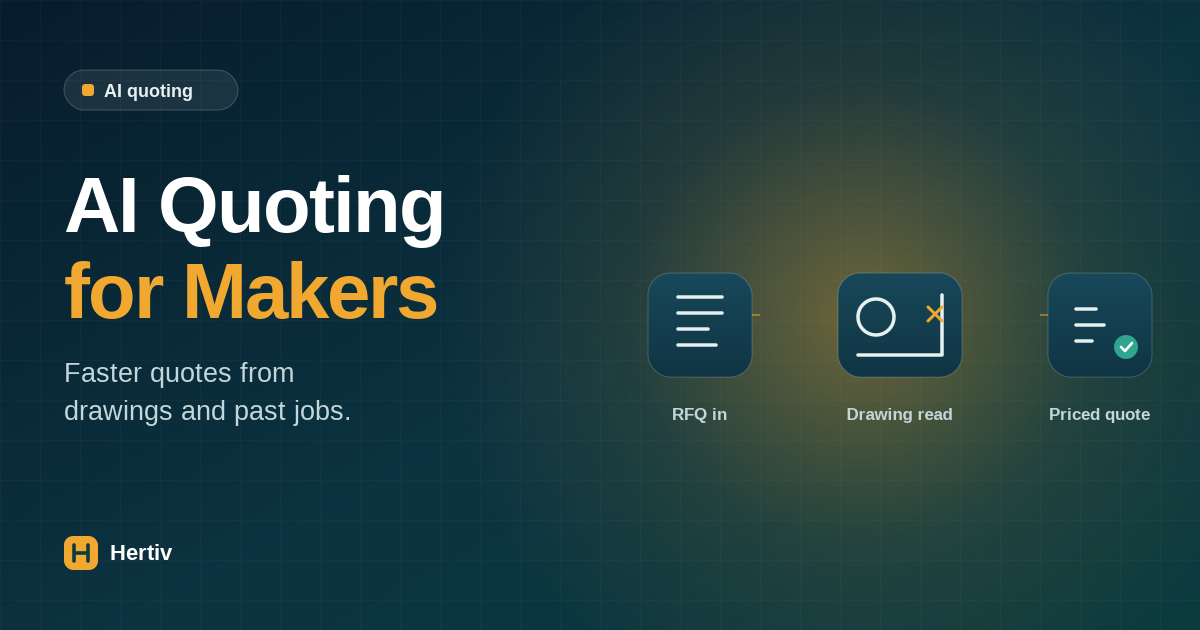
AI reads an RFQ by pulling structured facts out of unstructured files: part numbers, quantities, materials, tolerances, delivery dates and payment terms. It handles PDFs, spreadsheets, emails and CAD drawings, and it puts the facts into a single list the estimator can check.
Drawings are the hard part. A model trained on technical drawings can recognise views, dimensions, surface finish marks and tolerance callouts, and it can count features such as holes, bends and welds. It does not need a perfect drawing. It flags what it could not read, so a human looks at those items instead of re-reading the whole sheet.
The quality of the read depends on the quality of the input. Scanned drawings with hand-written notes, mixed units or missing revisions will produce more flags. Most teams start by feeding the system clean, recent RFQs, then widen the range as the model proves itself on the easy cases first.
One practical check is to run the AI read next to a manual read on the same ten RFQs and compare the extracted facts. If the lists match on quantities and materials, the system is ready for live use with a human review step.
How does AI work out cost and price?
AI works out cost by matching the new part to similar past jobs and adjusting for what is different. It looks at material type and weight, machine time, setup time, finish and inspection, then builds the cost from those parts rather than from a single guessed rate.
The match matters more than the model. A part that looks like a past job but uses a harder alloy or a tighter tolerance will cost more, and a good system shows which past job it matched and what it adjusted. That trace is what lets an estimator trust the number or correct it.
Material prices change, so the system should pull current prices from the supplier list or the ERP rather than from a fixed table. Machine rates come from the shop's own records: what a machine hour actually costs once labour, power and upkeep are counted.
Price is cost plus margin, and margin is a business decision, not a model output. The estimator sets the margin based on the customer, the workload and the risk, and the AI quote shows the cost breakdown so that decision is visible. The same cost data feeds other uses too, such as predictive analytics in manufacturing, which forecasts machine failures before they stop a job.
How do you check an AI quote before sending it?
You check an AI quote the same way you would check a junior estimator's draft: against the drawing, against a similar past job, and against the customer's terms. The check is quick because the draft already shows its sources and its arithmetic.
Start with the quantities and the material. If the drawing says 200 parts in stainless steel and the quote says 20 parts in aluminium, the read went wrong and nothing else in the draft can be trusted. Next, look at the closest past job the system matched. If the match is weak, the cost is a guess and needs a manual review.
Then check the terms: delivery date, payment terms, packaging and any special inspection the customer asked for. These are the items most often missed by a first draft, and they are the ones that cause losses when they are wrong.
Many shops use a simple rule: quotes under a set value with a strong past-job match go out after a short check, while large or unusual quotes get a full review. That split keeps the speed gain without giving up control where it matters.
How to pilot AI quoting in six steps
You pilot AI quoting by starting with one product line, one estimator and a fixed review rule, then widening the scope only when the drafts hold up against manual quotes.
- Pick one product line. Choose parts you quote often, with clean drawings and good job history.
- Gather the cost data. Pull material prices, machine rates and past job records into one place the system can read.
- Run ten quotes in parallel. Draft with AI and quote by hand, then compare the two and log every difference.
- Fix the biggest errors first. A wrong material read or a missing tolerance matters more than a tidy format.
- Set the review rule. Decide which quotes need a full check and which need a short one, and write it down.
- Measure win rate and margin. Track whether faster quotes win more work and whether margins hold, then decide whether to expand.
A pilot that runs for four to six weeks on real RFQs gives a fair verdict. A demo on hand-picked drawings does not. The point of the pilot is to learn where the drafts fail, not to prove the tool works. For the wider picture, the role of AI in manufacturing shows where quoting fits alongside the other factory uses.
Example (hypothetical): a metal parts maker quotes faster
Example (hypothetical): a metal parts maker with 12 staff receives about 40 RFQs a month. Quoting by hand takes about 3 hours per RFQ, which adds up to 120 hours a month, or most of one estimator's time.
The shop pilots AI quoting on its bracket and housing parts. An AI draft takes about 20 minutes to produce, and the estimator spends about 40 minutes checking it, so each quote takes about 1 hour instead of 3. Across 40 RFQs, that is 40 hours a month, saving about 80 hours.
The saved time goes to the RFQs that used to be ignored. The shop answers 12 more RFQs a month that it previously let lapse, and wins 3 of them. The pilot also catches a pattern: quotes for parts with tight flatness tolerances were underpriced, because the AI matched them to looser jobs. The team adds a tolerance check to the review rule.
After six weeks the shop expands the pilot to a second product line, keeping the same review rule and the same weekly check of win rate and margin.
What are the common mistakes?
The most common AI quoting mistakes are trusting the draft without a review rule, feeding the system messy cost data, and judging the pilot on speed alone.
- No review rule. If nobody checks the draft, the first wrong material or quantity reaches the customer.
- Stale cost data. A model trained on last year's material prices will underprice every quote until the data is refreshed.
- Weak past-job matches. Accepting a cost from a job that only looks similar hides real differences in tolerance or finish.
- Measuring speed only. Faster quotes that lose margin or miss terms are worse than slow ones.
- Skipping the customer check. An RFQ with unclear specs needs a question to the customer, not a guessed answer from the model.
Key takeaways
- AI quoting drafts a priced quote from drawings and past jobs; a human still checks it
- Cost comes from matching the part to similar past jobs, then adjusting for material, tolerance and finish
- Material prices and machine rates must come from current records, not from a fixed table
- Set a review rule: short check for small quotes with a strong match, full review for large or unusual ones
- Pilot on one product line with ten parallel quotes before widening the scope
- Track win rate and margin, not just speed, to judge whether the pilot worked
Frequently asked questions
Does AI quoting replace the estimator?
No. It drafts the quote and does the reading and matching, but the estimator still checks the quantities, the material and the margin, and answers the customer. The role shifts from typing numbers to judging the draft and handling the unusual cases.
What data does AI quoting need?
It needs past job records with costs, current material prices, machine rates and clean drawings. Without past jobs to match against, the system has nothing to price from, so shops with thin records should start by organising their job history first.
Can AI read hand-drawn or scanned drawings?
It can read clean scans, but hand-written notes, mixed units and missing revisions cause more flags and errors. Most teams start with digital drawings and recent RFQs, then add messier inputs once the system proves itself on the easy cases.
How accurate are AI quotes?
Accuracy depends on the past-job match and the cost data. A strong match with current prices is usually close to a manual quote. A weak match is a guess. The review rule is what keeps accuracy high, because it routes weak matches to a full human check.
How long does a pilot take?
Four to six weeks on real RFQs is enough to judge the drafts, the review rule and the win rate. The setup work, gathering cost data and past jobs, usually takes longer than the pilot itself, so plan for that before the clock starts.
What does AI quoting cost?
Pricing varies by vendor and by how much of the workflow is covered, so check the vendor site for current plans. The cost to compare is the full setup and review time, not just the subscription, because a cheap tool with a heavy review burden saves nothing.


