AI for Customer Success: What It Does and Where to Start
AI helps customer success teams spot at-risk accounts early, answer routine questions faster and focus human time on the accounts that need it most.
On this page
Short answer
AI for customer success uses machine learning to help a success team keep accounts healthy, spot trouble early and spend human time where it matters most. It turns data the company already holds, such as product usage, support tickets and billing history, into signals the team can act on.
What is AI for customer success?
AI for customer success is the use of machine learning models to help a customer success team keep accounts healthy, spot trouble early and spend human time where it matters most. It turns the data a company already holds, such as product usage, support tickets, billing history and survey answers, into signals a team can act on.
The work is mostly prediction and triage, not conversation. A model can flag an account whose usage has fallen for three weeks, while a person decides what to do about it. Generative tools can draft the follow-up message, but the decision to reach out stays with the team.
| AI job | What it does | Data it needs |
|---|---|---|
| Churn prediction | Flags accounts likely to leave | Usage, billing, support history |
| Health scoring | Ranks accounts by risk and opportunity | Usage, tickets, surveys, payments |
| Ticket triage | Routes tickets and drafts replies | Ticket text, product docs |
| Sentiment tracking | Spots frustration in messages | Support chats, call notes, reviews |
| Renewal forecasting | Estimates which renewals need attention | Contract dates, usage trends, contacts |
Start with one job, not all five. A health score that your team trusts is worth more than five models nobody checks. For the conversational side of this work, see AI agents for customer support.
How does AI spot customers at risk?
AI spots at-risk customers by comparing current behaviour with the patterns that came before cancellations or downgrades. A sudden drop in logins, a run of failed payments, or a support thread that goes quiet after a complaint are all signals a model can weigh together.
No single signal is enough on its own. A customer who stops logging in during a holiday period is not at risk, while one who files three billing tickets in a week probably is. The model looks at combinations, and the team sets the threshold for when a human should step in.
The signals worth tracking depend on your product. Usage frequency, feature adoption, ticket volume and sentiment, invoice delays and the number of active users on an account all matter. A predictive analytics approach works when these signals are stored in one place and updated often.
- Usage drops. Logins, active users or key actions fall for several weeks.
- Support friction. Ticket volume rises, or tickets stay open longer than usual.
- Billing trouble. Failed payments, late invoices or downgrade requests appear.
- Silence. A normally active account stops replying to messages or attending calls.
What goes into a customer health score?
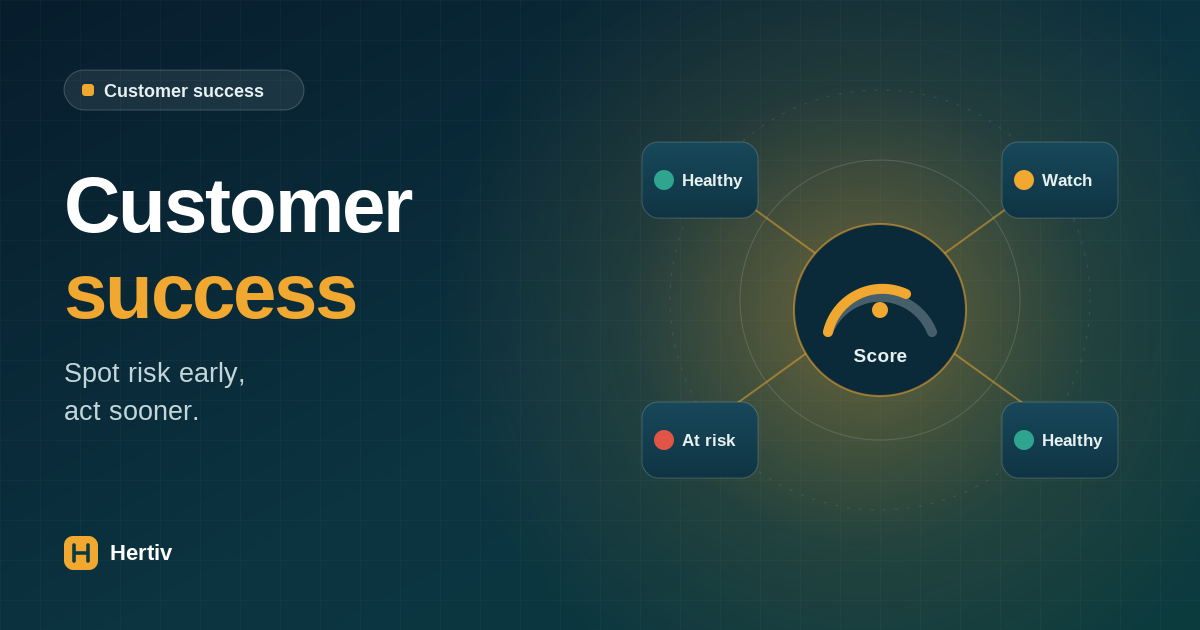
A customer health score combines several signals into one number or label, such as green, amber or red, so a team can sort accounts and act on the riskiest ones first. The score is a sorting tool, not a verdict: a red account still needs a human to find out why.
Common inputs are product usage, support history, billing health, survey feedback and engagement with training or onboarding. Each input gets a weight, and the weights should reflect what actually predicted churn in your own history, not a template copied from another company.
Review the score every month against what really happened. If accounts scored red stayed and accounts scored green left, the weights are wrong. A score that nobody questions is a score nobody is checking.
How to start with AI in customer success
You start with AI in customer success by picking one outcome, gathering the data you already have, and testing a simple score before adding any model. The goal is a list of accounts to call this week, not a new platform.
- Pick one outcome. Fewer churned accounts, faster first replies, or earlier risk flags.
- Gather the data you already have. Usage, tickets, billing and survey results in one table.
- Build a simple score first. Use rules, such as usage down for three weeks, before adding a model.
- Test the score on past accounts. Check whether it would have flagged the ones that left.
- Give the team a weekly list. Flagged accounts with a clear next action for each one.
A short AI proof of concept is the usual way to test a health score before rolling it out to the whole team.
Example (hypothetical): a support team triages 400 accounts
Example (hypothetical): a software company has 400 customer accounts and five success managers. Reviewing every account by hand takes about 15 minutes each, which is 100 hours a month, far more time than the team has.
An AI health score flags 60 accounts as at risk. Reviewing only those takes 60 times 15 minutes, or 15 hours, which frees 85 hours a month for actual calls and fixes. The team also finds that 12 of the flagged accounts share the same onboarding gap, so it fixes the onboarding step once instead of rescuing accounts one by one.
The saving is real only if the flagged list is accurate. In the first month the team checks every flag by hand and records which ones were right, so the score improves instead of quietly going stale.
What are the common mistakes?
The most common mistakes in AI for customer success are trusting a score nobody checks, automating outreach to frustrated customers, and measuring model accuracy instead of accounts saved.
- Scoring accounts on data nobody updates. A stale score is worse than no score.
- Treating the score as a verdict. A red label is a prompt to call, not a reason to write an account off.
- Automating replies to at-risk customers. A frustrated customer wants a person who knows their history, not a generic message.
- Measuring model accuracy instead of accounts saved. A 95% accurate model that nobody acts on is worthless.
- Rolling out to every account before testing. Start with one segment and prove the list is useful.
- Letting the score go stale. When the product changes, the signals that predict churn change too.
Use AI to decide who to call, and let people do the calling. That division of labour is where the value sits.
How do you measure whether it is working?
Measure outcomes, not model scores. The numbers that matter are churn among flagged accounts, time from the first warning sign to first contact, and the share of flagged accounts that recover within a quarter.
Track a simple comparison: accounts the team contacted early versus similar accounts it did not. If early contact does not change the outcome, the playbook needs work, not the model.
| Metric | What it shows | Review |
|---|---|---|
| Churn among flagged accounts | Whether early flags lead to saves | Monthly |
| Time to first contact | Whether the team acts on flags fast | Weekly |
| Recovery rate | Share of flagged accounts back to healthy | Quarterly |
| False flag rate | Share of flags that were not real risks | Monthly |
Generative tools add a second set of measures, such as draft acceptance rate and time saved per reply. For that side of the work, see generative AI for customer success.
Key takeaways
- AI for customer success is mostly prediction and triage, not conversation
- A health score sorts accounts so humans spend time on the riskiest ones
- Start with one outcome and data you already hold
- Test the score against past churn before trusting it
- Measure accounts saved, not model accuracy
Frequently asked questions
What is AI for customer success?
AI for customer success means using machine learning to help a success team keep accounts healthy. It predicts which accounts are at risk, scores account health, triages support tickets and forecasts renewals, using data the company already holds such as usage, billing and ticket history.
Do we need a data science team to start?
No. A simple rules-based health score built from usage, tickets and billing is a good start and needs no machine learning. Add a model later, once the team trusts the score and the data is clean and stored in one place.
How is this different from generative AI for customer success?
Generative AI drafts messages, summaries and replies. Predictive AI flags risk, scores health and forecasts renewals. Most teams need the predictive side first, then add generative tools for drafting. The two work best together, with humans deciding what to do.
What data does AI for customer success need?
Product usage, support ticket history, billing and payment records, survey answers and contract dates cover most cases. The data must be current and linked to the right account. If usage and billing live in separate systems, join them before building a score.
Can AI replace customer success managers?
No. AI can sort accounts, flag risk and draft messages, but it cannot run a difficult renewal call or rebuild trust with a frustrated customer. The value is in pointing managers at the right accounts sooner, not in replacing the conversation.
How long before we see results?
A simple health score can be tested on past data within weeks. Real results, such as fewer churned accounts, take one to three months of acting on the flags. Judge the pilot on accounts saved, not on how accurate the score looks on paper.


