AI-Driven Digital Twins: How Prediction Changes the Model
AI-driven digital twins add prediction to a live digital copy of a machine, building or process, so teams can test changes and spot failures before they happen.
On this page
Short answer
An AI-driven digital twin is a live digital copy of a physical asset, such as a machine, a building or a production line, that uses models to predict what will happen next, not just to show what is happening now. Sensor data keeps the copy in step with the real asset, while the models forecast wear, test changes in simulation and flag problems early.
What is an AI-driven digital twin?
An AI-driven digital twin is a digital copy of a physical thing that stays linked to the real thing through sensors and data feeds, and uses models to predict its future behaviour. A plain twin mirrors the present: it shows temperatures, speeds and states as they are. An AI-driven twin goes further by forecasting what will break, how a change will play out, and which action is cheapest.
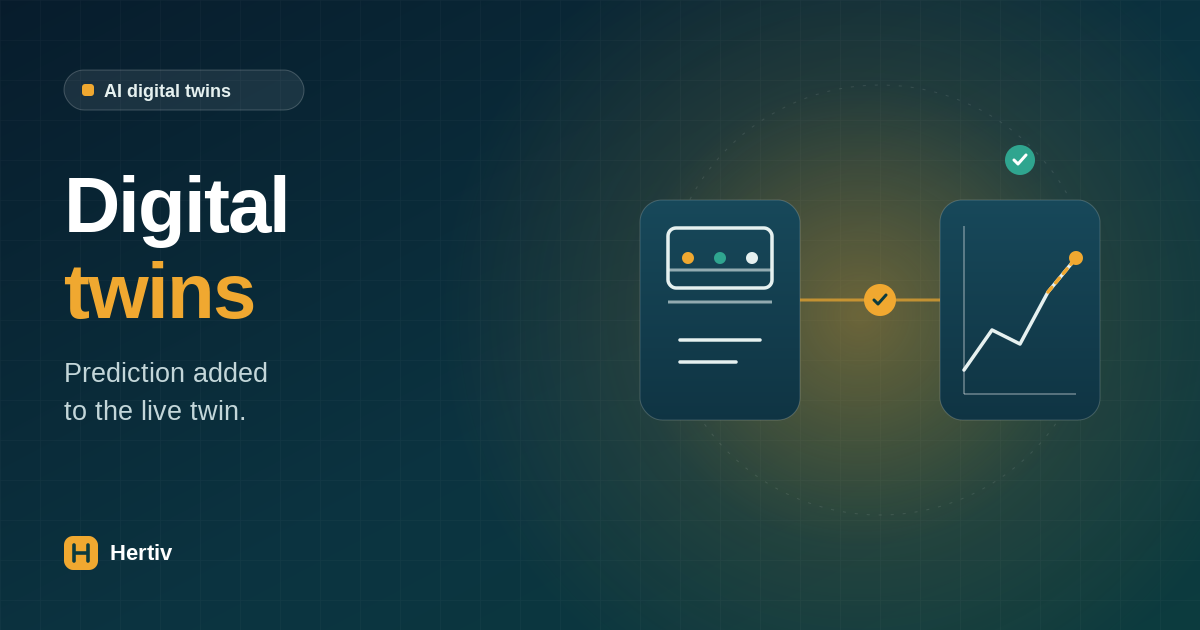
The twin has three parts. First, the model of the asset: its shape, its parts and how they connect. Second, the live data: sensor readings, operating settings and maintenance records flowing in. Third, the prediction layer: models trained on past behaviour that spot patterns a person watching a dashboard would miss.
The value is in the questions it answers. Instead of asking what the machine is doing now, a team can ask when it will need service, what happens if the line runs 10 percent faster, or which of two fixes lasts longer. Those answers come from running the twin forward in simulation, not from guessing.
How does AI change what a twin can do?
AI changes a twin from a mirror into a testing ground, because models can run the twin forward in time and try changes that would be too costly or risky on the real asset.
| Capability | Plain twin | AI-driven twin |
|---|---|---|
| Current state | Shows live readings | Shows live readings plus health scores |
| Failure warning | Alarms when a limit is crossed | Predicts wear days or weeks ahead |
| What-if tests | Manual scenarios | Simulates many changes at once |
| Optimisation | Fixed settings | Suggests settings that cut waste |
| Learning | Static model | Improves as more data arrives |
The biggest practical change is early warning. A plain twin alarms when a bearing is already hot. An AI-driven twin notices the vibration pattern that usually precedes heat, and raises the flag while there is still time to plan the repair.
Simulation is the second change. Teams can test a new layout, a faster speed or a different material in the twin and see the predicted result, instead of stopping the line to try it for real.
Where do AI-driven twins work best?
AI-driven twins work best where the asset is expensive to stop, hard to reach, or costly when it fails, and where enough history exists to train a useful model.
Manufacturing is the clearest case: production lines, pumps, motors and ovens where an unplanned stop costs real money. Buildings are close behind, with heating, cooling and lifts as the usual targets. Energy, logistics and healthcare equipment follow the same pattern, with assets that run all day and fail expensively.
The twin earns its place fastest when the same failure has happened before and the data to spot it exists. If a machine has failed in the same way three times, and the sensor readings from before each failure are on file, a model has something real to learn from.
Twins are a poor fit where the asset changes constantly, where sensor data is thin, or where the main problem is a lack of staff rather than a lack of foresight. A twin cannot fix a broken maintenance rota.
For teams weighing where prediction pays off, predictive analytics covers the same forecasting idea without the full twin.
What data does an AI twin need?
An AI twin needs steady sensor data, a record of past failures and repairs, and the operating settings that were in force when each reading was taken.
Sensor data is the foundation: temperatures, vibration, pressure, current draw and run hours, sampled often enough to catch change. Gaps and bad readings are normal, so the pipeline needs simple checks that flag missing or impossible values before they reach the model.
Failure history is what turns data into prediction. For each past failure, the twin needs the date, the part, the symptom and the fix. Without that history, the model can describe the present but cannot say what usually comes next.
Operating settings matter because a machine behaves differently at different speeds and loads. A reading that looks like a fault at full speed may be normal at half speed. The twin needs the settings alongside the readings, or it will raise false alarms.
Start with the data you already collect. Most plants already log far more than they use, and the first twin can often be built from existing records.
How do you check whether the twin is right?
You check a twin by comparing its predictions with what actually happened, on a fixed set of past cases, before trusting it on live decisions.
The simplest test is backtesting: feed the twin data from six months ago and ask what it would have predicted, then compare with the failures that really occurred. A twin that would have flagged most real failures, with few false alarms, is worth piloting. One that misses half the failures is not ready.
Once live, track two numbers: how many real failures the twin flagged in advance, and how many of its flags turned out to be nothing. Both matter. A twin that flags everything is useless, and a twin that flags nothing is worse.
Keep a human in the loop for action. The twin can recommend a repair date, but a person should confirm it, especially while the track record is short. Trust should grow with evidence, not with enthusiasm.
The basic twin concept is covered in digital twin technology for business, which explains the model and data setup without the prediction layer.
How do you run a first twin pilot?
You run a first pilot by picking one asset with good history, building a narrow twin for it, and judging the twin on whether it predicts real failures.
- Pick one asset. Choose a machine with past failures on record and sensors already fitted.
- Gather the history. Collect sensor data, failure records and settings for the last year.
- Build the narrow twin. Model the one or two failure modes that cost most, not every possible fault.
- Backtest it. Check what it would have predicted on past data before going live.
- Run it alongside the team. Let operators see its flags for a month without acting on them alone.
- Review and decide. Compare flags with real outcomes, then extend or stop.
Resist the urge to twin a whole factory at once. One asset, one or two failure modes, and a clear test will teach you more than a broad rollout that nobody can evaluate.
Manufacturing teams often start with a single line, as in digital twins in manufacturing, and add assets only after the first twin earns trust.
Example (hypothetical): a packaging plant twin
Example (hypothetical): a packaging plant runs one filling line with a history of seal failures. Over the past year the line stopped 18 times for seal problems, each stop costing about 2 hours of lost output.
The team builds a twin for the sealer only, using temperature, pressure and vibration readings plus the maintenance log. Backtesting shows the twin would have flagged 14 of the 18 failures at least a day ahead, with 5 false flags in the same period.
During a one-month live trial, the twin flags 3 real problems early. Each is fixed during a planned stop instead of an unplanned one. The team saves roughly 6 hours of unplanned downtime in that month, against about 2 hours spent checking the 2 false flags.
The result is good enough to extend the twin to the next machine on the line, and the team now has a concrete record: 14 of 18 past failures caught in backtesting, and 3 of 3 real flags correct in the live month.
What are the common mistakes?
The most common mistakes are twinning too much at once, training on thin failure history, and acting on the twin before it has earned trust.
- Twinning a whole plant first. A broad twin is hard to build and harder to check. Start with one asset and one failure mode.
- Thin failure history. With only one or two past failures, a model has little to learn from and its predictions are guesses.
- Ignoring false alarms. A twin that cries wolf will be switched off. Track false flags and fix the causes.
- Skipping backtesting. Going live without checking past predictions means trusting the twin on faith.
- Forgetting the settings. Readings without their operating context produce false alarms at different speeds and loads.
Key takeaways
- An AI-driven twin predicts what happens next, not just what is happening now
- Early warning and simulation are the two changes that pay for the twin
- Good failure history matters more than model choice
- Backtest on past data before trusting live predictions
- Start with one asset and one failure mode, then extend
Frequently asked questions
How is an AI-driven twin different from a normal digital twin?
A normal twin mirrors the present: it shows live readings from the asset. An AI-driven twin adds models that forecast wear, simulate changes and flag problems before they happen. The mirror tells you what is wrong now; the prediction tells you what to do about it next.
Do you need a lot of sensors to build an AI twin?
You need the sensors that cover the failure modes you care about, not every possible sensor. Temperature, vibration and run hours cover many machine failures. Start with the readings you already collect and add sensors only where a gap blocks a specific prediction.
How accurate do twin predictions need to be?
Accurate enough to act on, which depends on the cost of being wrong. A flag that is right 8 times out of 10 is useful if checking it costs an hour and a missed failure costs a day. Track both missed failures and false flags, and judge the twin on the balance.
Can a twin work without past failure data?
Poorly. Without a record of past failures, the model can describe normal behaviour and spot odd readings, but it cannot say what usually follows. If failure history is missing, start by logging failures properly for a few months before building the prediction layer.
What does an AI twin pilot cost?
Mostly staff time: gathering history, building the narrow model and running the trial alongside operators. Sensor costs are usually small because the target asset already has the key sensors. The expensive mistake is building a broad twin before the narrow one proves itself.
Where can I learn how to build the twin itself?
Look for a guide that covers choosing the asset, wiring up sensors, building the model and testing it on past data. The build steps are the same whether or not you add prediction, so start with the basic twin and add the AI layer once the mirror is accurate.