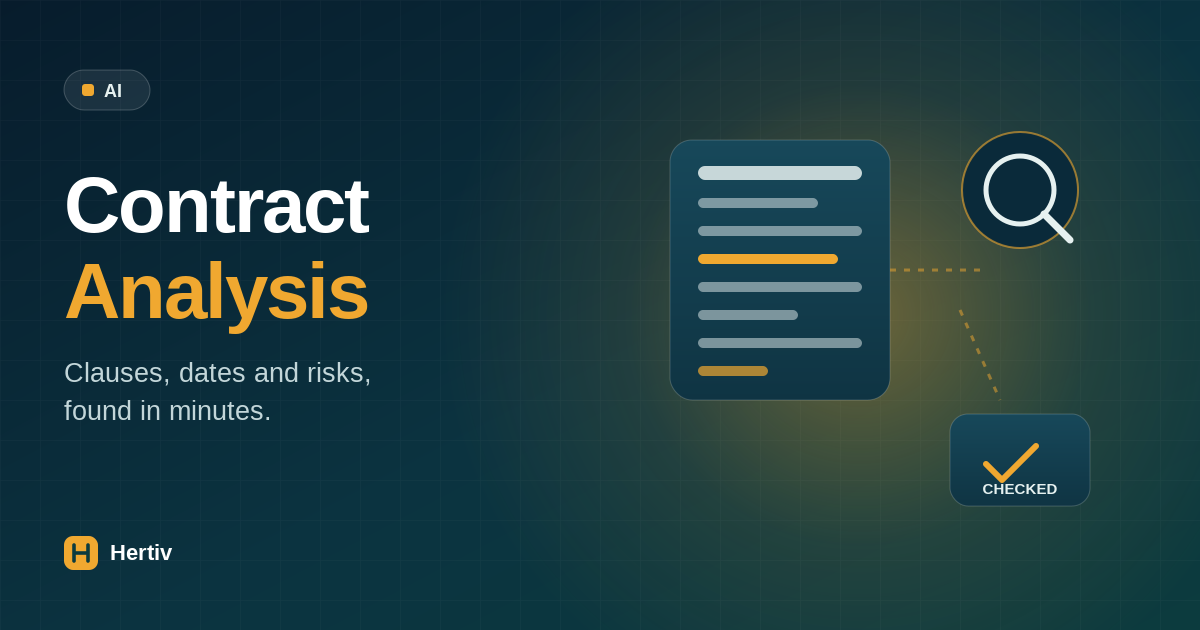
AI-Driven Contract Analysis: Read Contracts Faster
AI-driven contract analysis reads a contract, pulls out the clauses that matter and flags the risks a reviewer might miss. Here is what it does and where it helps.
On this page
Short answer
AI-driven contract analysis uses software to read contracts, extract key clauses such as payment terms, renewal dates and liability caps, and flag anything that differs from the team's standard position. A reviewer then checks the flagged items before any decision is made.
What is AI-driven contract analysis?
AI-driven contract analysis is the use of software to read a contract, pull out the clauses, dates and obligations it contains, and flag the parts that need a human decision. It turns a long document into a short, structured summary that a reviewer can check in minutes instead of hours.
It works on the files teams already have: PDFs, scanned pages, Word documents and signed copies stored in a shared drive. The software reads the text, finds the clauses that matter for the deal, and compares them against the rules the team has set.
This is not the same as keyword search. Keyword search finds a word; contract analysis understands what a clause does, such as setting a payment deadline, limiting liability or allowing early termination. That difference is what makes the output useful for decisions.
The output always goes to a person. The model prepares the analysis, and a reviewer confirms the findings before anything is signed or sent. For teams that also manage the full contract lifecycle, generative AI in contract management covers how the two fit together.
What does AI pull out of a contract?
AI contract analysis pulls out the clauses that carry money, risk or deadlines. A good setup names these clauses in advance, so the model knows what to look for in every document.
| Clause type | What the model finds | Why it matters |
|---|---|---|
| Payment terms | Amounts, due dates, late fees | Cash flow and billing disputes |
| Term and renewal | Start, end and auto-renewal dates | Missed renewals and lock-in |
| Termination rights | Notice periods and exit conditions | Cost of leaving a bad deal |
| Liability and caps | Caps, exclusions and indemnities | Worst-case exposure |
| Confidentiality | Scope, duration and carve-outs | What can be shared and with whom |
| Service levels | Uptime, response times, credits | Whether the service is enforceable |
The model also pulls out dates, names, governing law and any clause that differs from the team's standard wording. Unusual clauses are the most valuable find, because a standard review often skims past them.
How does the analysis workflow work?
The analysis workflow has the same shape in most teams: the contract goes in, the model reads it, and a reviewer checks the flagged items. The steps below are the usual order.
- Collect the contracts. Gather the signed copies and the drafts under review into one folder, with the latest version clearly marked.
- Extract the text. The software reads PDFs and scans, including text from images, so older signed copies are usable.
- Classify the clauses. The model labels each clause by type, such as payment, termination or liability, and pulls out the key values.
- Compare against the playbook. Each clause is checked against the team's standard position, and anything outside it is flagged.
- Review the flags. A person reads the flagged clauses in full and decides what to accept, push back on or escalate.
- Store the result. The summary, the flags and the decisions are saved with the contract, so the next review starts from the same record.
Most of the time goes into steps five and six. The model does the reading; the reviewer does the deciding. Finance teams that need the same treatment for loan and credit agreements can see how AI in financial contract analysis handles that narrower set.
Where does contract analysis help most?
Contract analysis helps most where the volume of contracts is high and the terms repeat. Procurement teams use it to check supplier agreements, sales teams use it for customer contracts, and legal teams use it to clear backlogs before a deadline.
It also helps in due diligence, where a buyer needs to read hundreds of contracts in a short window. The model can pull the change-of-control, assignment and termination clauses from every agreement, so the buyer sees the risks before signing.
Renewals are a quieter win. Many teams lose money on contracts that auto-renew at a higher price because nobody tracked the date. An analysis pass that lists every renewal date and notice deadline turns that into a planned decision instead of a surprise.
The pattern is the same in each case: the model reads everything, the reviewer reads the exceptions. That division of labour is what makes the time saving real.
How accurate is it, and where does a human fit?
Accuracy depends on the documents. Clean, typed contracts with standard wording are read well; old scans, handwritten notes and unusual clause structures are read less well. A team that measures accuracy on its own contracts will know where the model can be trusted.
The model can miss a clause that is worded in an unusual way, and it can misread a number in a poor scan. It also cannot judge whether a term is commercially fair, only whether it differs from the playbook. Those judgements stay with people.
The practical rule is to let the model prepare and the person decide. A reviewer should always read the flagged clauses in full, and should spot-check a sample of the clauses the model marked as fine. If the spot checks keep coming back clean, the team can widen the scope.
For legal research questions that sit around a contract, such as finding the right precedent or statute, AI for legal research covers a different task with its own checks.
Example (hypothetical): a team clears 300 supplier contracts
Example (hypothetical): a procurement team has 300 supplier contracts to review before a renewal round, and two reviewers available for the work.
Reading each contract by hand takes about 45 minutes, so the full set would take 300 times 45 minutes, which is 225 hours. That is more than five weeks of full-time work for one person, and the renewal dates do not wait.
With AI analysis, the model reads each contract in about 10 minutes of processing time, so the full set takes 300 times 10 minutes, which is 50 hours of machine time. The reviewers then read the 60 contracts the model flagged, at about 30 minutes each, which is 30 hours of human review.
The total is 50 hours of machine time plus 30 hours of review, against 225 hours by hand. The team saves about 145 hours and, more importantly, meets the renewal dates with the risky clauses already flagged.
What are the common mistakes?
The most common contract analysis mistakes are trusting the output without checking it, skipping the playbook, and feeding the model poor documents.
- Signing off on model output unchecked. The model prepares; a person decides. Skipping the review step removes the safety net.
- No playbook. Without a written standard position, the model has nothing to compare against, so its flags are guesswork.
- Poor scans and mixed versions. Old scans and draft copies produce wrong readings. Clean the set before analysing it.
- Reviewing everything twice. If reviewers re-read every clause by hand, the time saving disappears. Check the flags and spot-check the rest.
- Ignoring the flagged items. A flag that nobody acts on is wasted work. Track flags to a decision.
How do you start using AI contract analysis?
You start by picking one contract type and one clear question, such as which supplier contracts renew in the next six months. A narrow pilot teaches the team more than a broad rollout.
- Pick one contract type. Supplier agreements, customer contracts or NDAs are good first choices because the clauses repeat.
- Gather 20 to 30 examples. Use real contracts, including a few difficult ones, so the pilot reflects the real work.
- Write the playbook. List the standard position for each clause type and what counts as a flag.
- Run the pilot. Analyse the set, have a reviewer check every flag, and record what the model got right and wrong.
- Measure and expand. Compare review time against the old method, fix the playbook gaps, then add the next contract type.
Keep the pilot small and the playbook written down. A team that can show the time saved on one contract type will find it easy to get approval for the next.
Key takeaways
- Contract analysis turns a long document into a short, checkable summary of clauses, dates and risks
- Payment terms, renewals, termination rights and liability caps are the clauses that carry the most risk
- The model reads and flags; a person decides. Reviewing the flagged clauses is the safety net
- A written playbook is what makes the model's flags useful instead of guesswork
- Start with one contract type, a small pilot set and a measured time saving before expanding
Frequently asked questions
What is the difference between contract analysis and contract management?
Contract analysis is about reading and understanding a contract: extracting clauses, spotting risks and comparing terms. Contract management is the wider lifecycle: storing, tracking renewals, approvals and signatures. Analysis is one step inside management, and the two work best together.
Can AI contract analysis read scanned contracts?
Yes, if the scan is clear enough for text extraction. Clean scans read well, but faded pages, handwriting and poor image quality cause errors. Teams usually clean the document set first and treat scanned copies with extra review.
How long does it take to analyse a contract?
The model pass usually takes minutes per contract, depending on length and document quality. The reviewer then spends time only on the flagged clauses, so a full review of a standard contract often drops from an hour to about half an hour or less.
Does AI contract analysis replace lawyers?
No. It prepares the analysis and flags the risks, but legal judgement stays with people. A lawyer still reads the flagged clauses, weighs the commercial context and decides what to accept or push back on.
What is a contract playbook?
A playbook is a written list of the team's standard position for each clause type: what is acceptable, what needs approval and what must be flagged. The model compares each clause against the playbook, so the flags reflect the team's own rules.
Which contracts should you analyse first?
Start with the type that repeats most: supplier agreements, customer contracts or NDAs. High volume and similar wording make the pilot easier to measure, and the time saved is visible quickly.