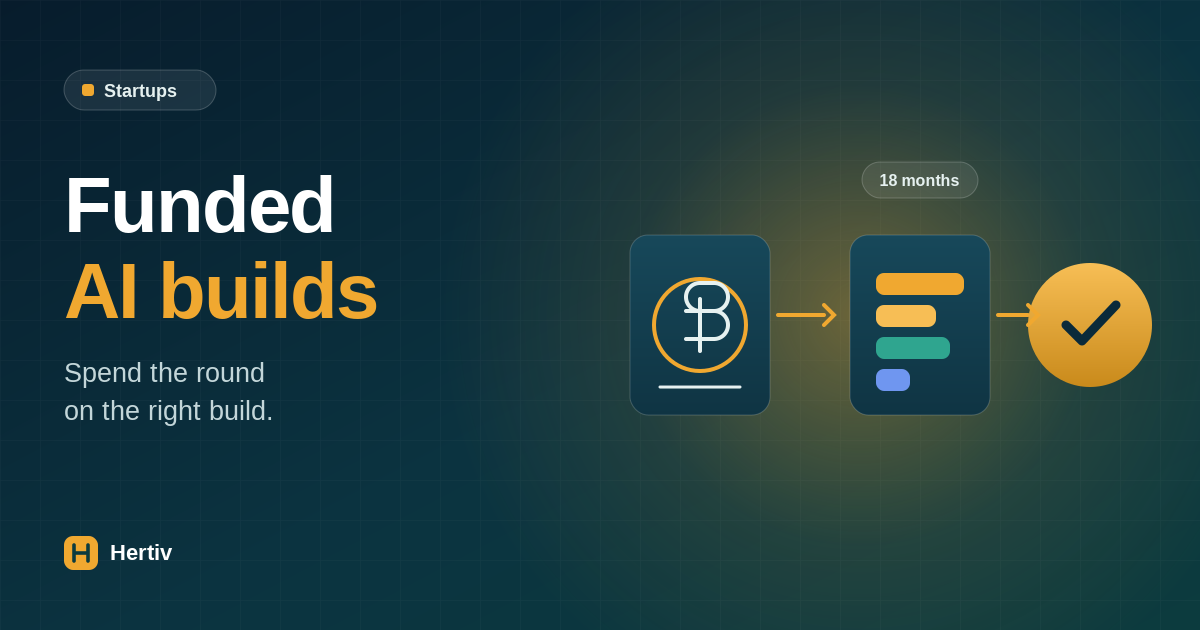
AI Development for Funded Startups: Spend the Round Well
A funding round buys time, not answers. Funded startups should pick one AI use case, split the budget across people, data and testing, and keep a reserve.
On this page
Short answer
AI development for funded startups means turning raised money into a working AI product: choosing one use case first, then hiring or buying the team, and shipping a first version before the runway runs out. The budget should split across people, data and tools, testing and a reserve, and the team should build only what makes the product different, buying everything else.
What is AI development for funded startups?
AI development for funded startups is the work of turning raised money into a working AI product: choosing what to build, hiring or buying the team, and shipping the first version before the runway runs out.
Funding changes the question. An unfunded team asks what it can build for free; a funded team asks what to spend on, in what order, and what proof the next raise will need.
The risk is also different. A funded startup can hire fast and build big, which makes it easy to spend the round on an AI product nobody asked for. AI for startups covers where small teams get value first; this article covers how to plan the spend after the money lands.
What changes after a startup raises money?
Three things change once money lands: the team can hire, the timeline gets a deadline, and investors expect milestones. The first product version is no longer a side project; it is the proof the next raise depends on.
The trap is hiring before deciding what to build. A team of six engineers with no clear first use case will build the infrastructure for a product that does not exist yet.
Start with the use case, then hire for it. A funded team that ships a small working product in three months learns more than one that spends six months building a platform.
The first hire matters more than the fifth. A lead engineer who has shipped an AI feature before will spot the data gaps and the testing needs that a larger, greener team will miss until month four.
How should a funded startup split its AI budget?
A simple split keeps the money honest: most of it on people and product, a smaller share on data and tools, and a reserve for the things that go wrong. The table below shows one shape for a first AI build.
| Budget item | Share of AI budget | What it covers |
|---|---|---|
| People | 55-65% | Engineers, data work, product time |
| Data and tools | 15-20% | Data cleaning, model APIs, hosting |
| Testing and review | 10-15% | Evaluation, human review, fixes |
| Reserve | 10% | Delays, price changes, rework |
The reserve matters most. Model APIs change price, data cleaning takes longer than planned, and the first version always needs rework. Teams without a reserve cut testing first, which is the worst place to cut.
Write the split down and share it with the team. A budget that lives only in the founder’s head gets renegotiated every week, while a written split gives every hire and vendor a clear limit.
Should a funded startup hire, outsource or buy?
Hiring suits a product that is the company's core advantage and needs a team that stays. It is slow and expensive, but the knowledge stays inside the company.
Outsourcing suits a first version with a clear scope and a deadline. A vendor ships faster than a new hire, and the startup learns what it needs before committing to full-time roles. AI development companies for startups lists the kinds of vendors that do this work.
Buying suits everything that is not the advantage: hosting, model APIs, support tooling and analytics. Building those in-house is the most common way funded teams burn their runway.
Outsourcing also caps the risk. A fixed-scope build with a vendor has a price and a date, while a hire is an open-ended cost that keeps running whether the product ships or not.
Build or buy: how do funded teams decide?
The rule is simple: build what makes the product different, buy everything else. A support-drafting feature that saves agents time is worth building; the chat widget that delivers it is worth buying.
Ask three questions before building anything. Does it change what the customer pays for? Does it need our data to work? Would a vendor's version be good enough? Two noes mean buy.
Revisit the decision every quarter. A tool that was worth buying in month one may be worth building in month nine, once the team knows exactly what it needs.
The sign to switch is volume. When the monthly bill for a bought tool passes the cost of one engineer, and the tool still lacks a feature the product needs, building it in-house starts to pay.
What milestones do investors check?
Investors check three things: a working product with real users, numbers that show it helps, and a team that can keep shipping. Demos and decks do not count after the first raise.
Good milestones are specific: ten paying customers using the AI feature weekly, a measured time saving per task, or a support queue that shrinks by a stated amount. Vague milestones hide a product nobody uses.
Report the numbers honestly, including the ones that look bad. Investors fund teams that find problems early, not teams that hide them until the money runs out.
Milestones also shape hiring. A team that must show ten paying users in three months hires support and sales help, while a team with a year of runway hires engineers first.
Example (hypothetical): a startup plans a $2,000,000 round
Example (hypothetical): a funded startup raises $2,000,000 and plans 18 months of runway. Core burn, salaries, rent and tools for the existing team, runs $90,000 a month, which is $1,080,000 over 12 months.
The AI build gets $420,000 over 12 months, or $35,000 a month, covering two engineers, model APIs and testing. The remaining $500,000 stays as a reserve for hiring, marketing and delays. The three parts add up: $1,080,000 plus $420,000 plus $500,000 equals $2,000,000.
At month six the team checks the plan: the AI feature has 12 paying users, each saving about 3 hours a week, and the reserve is untouched. The numbers are small, but they are real, and they are the proof the next raise will need.
What are the common mistakes?
The most common mistake is spending the round on building before talking to users. A funded team can afford to build for six months without feedback, which is exactly how it ends up with a product nobody wants.
- Hiring six engineers before choosing the first use case
- Building hosting, tooling and analytics in-house instead of buying them
- Cutting testing and human review when the budget gets tight
- Setting vague milestones that hide a product nobody uses
- Spending the reserve on features instead of keeping it for delays
- Reporting good numbers only and hiding the ones that look bad
A raise buys time, not answers. The teams that use it well spend the first month deciding what to build, not building. How to hire an AI developer covers the hiring side of that decision.
Key takeaways
- Funding changes the question from what you can build for free to what to spend on, in what order.
- Start with one use case, then hire for it, never hire six engineers first.
- Split the AI budget across people, data and tools, testing, and a 10% reserve.
- Build only what makes the product different; buy hosting, model APIs and tooling.
- Set specific milestones with real users and report the bad numbers too.
Frequently asked questions
How much of a funding round should go to AI development?
There is no fixed share, because it depends on whether AI is the product or a feature. A useful shape is 55 to 65 percent of the AI budget on people, 15 to 20 percent on data and tools, 10 to 15 percent on testing, and 10 percent held as a reserve.
Should a funded startup hire AI engineers or outsource?
Hire when the AI product is the company's core advantage and the team needs to stay. Outsource a first version with a clear scope and deadline. Buy hosted tools for everything that is not the advantage.
How long does a first AI version take to build?
A small first version with one use case usually takes two to four months with a focused team. Six months or more without users usually means the scope was too big or the use case was never clear.
What do investors want to see after funding AI development?
A working product with real users, numbers that show it helps, and a team that keeps shipping. Specific milestones, such as ten paying customers using the feature weekly, count far more than demos.
What is the biggest risk for funded AI startups?
Building for months without user feedback. Funding makes it possible to build a large product nobody asked for, so the first month should go to choosing the use case and talking to users, not to building.
When should a funded startup raise again?
When the current product has real users and clear numbers, and the next raise has a specific job, such as scaling sales or adding a second use case. Raising to cover a budget overrun is the weakest reason.