AI Data Management: How to Keep Training Data Ready
AI data management is collecting, cleaning, labelling, storing and governing the data that feeds AI, so models train on data you can trust. Here is how it works.
On this page
Short answer
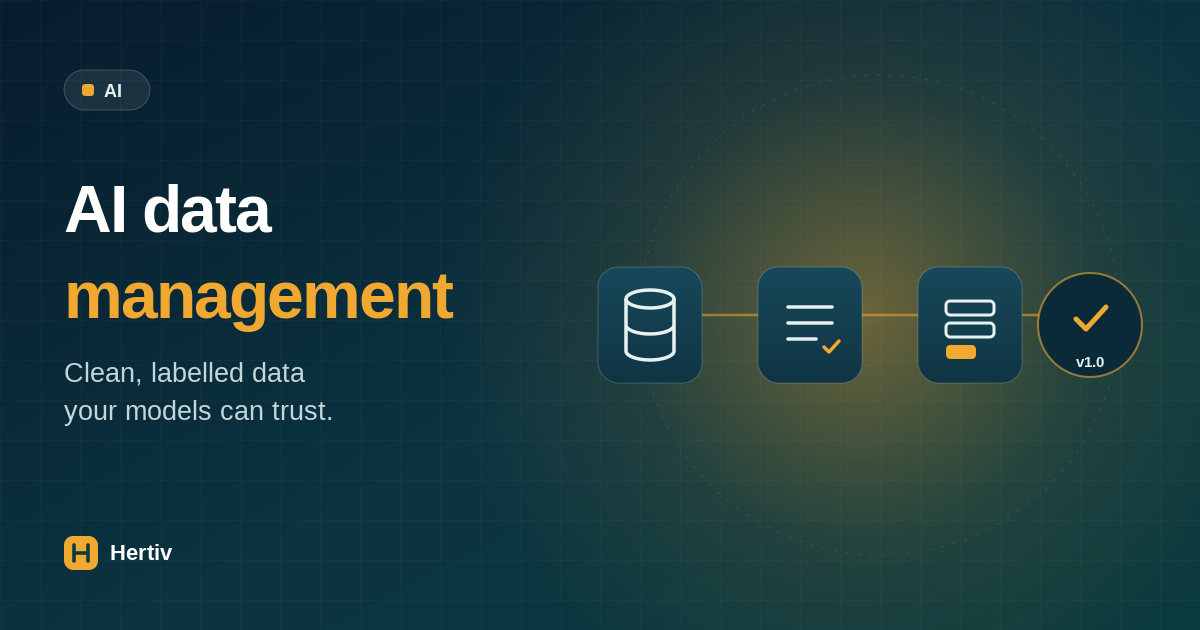
AI data management is the work of collecting, cleaning, labelling, storing and governing the data that feeds an AI system. It turns raw records from databases, documents, images and sensors into versioned datasets with known quality and known owners, so models train on data the team can trust and every training run can be traced back to its source.
What is AI data management?
AI data management is the set of practices that keeps the data behind an AI system collected, clean, labelled, stored and governed, so models train and run on data the team can trust. It covers everything from the first raw record to the versioned dataset a model trains on, and it continues while the model is live. Without it, teams spend more time fixing data than improving models.
The work sits between raw sources and the model. Sources include databases, documents, images, sensor feeds, support tickets and web logs. Data management turns that mix into datasets with known contents, known quality and known owners.
It also covers the rules around data: who may use it, how long it is kept, and what must be removed when consent changes. Those rules matter because AI systems reuse the same data many times, so a single bad record can affect every answer a model gives.
What kinds of data does AI need?
AI systems use several kinds of data, and each kind needs different handling. The table below shows the common kinds, where they come from and what they feed.
| Data kind | Where it comes from | What it feeds |
|---|---|---|
| Text | Documents, tickets, chat logs | Chatbots, search, summaries |
| Images and video | Cameras, scans, product photos | Vision models, inspection |
| Structured records | Databases, spreadsheets, CRM | Predictions, scoring, recommendations |
| Audio | Calls, meetings, voice notes | Transcription, voice agents |
| Sensor and log data | Machines, apps, devices | Monitoring, anomaly detection |
Most teams start with the data they already hold. The mistake is to collect new data before checking what exists: duplicates, old formats and missing fields are common in data that was never built for AI. A short audit of existing sources usually finds enough to start, and it shows which gaps are real. See collecting data for machine learning for how to judge a source before you use it.
How do you collect and label training data?
Collecting training data means gathering examples that show the model what good output looks like. For a support chatbot, that means past tickets with their correct answers; for an image model, it means photos with the right labels attached.
Labelling is where most of the effort goes. A label is the correct answer attached to an example: the category of a ticket, the fault in a photo, the intent behind a message. Labels usually come from staff who know the work, not from the model itself.
Keep labelling consistent. Write short rules for each label, give examples of edge cases, and check a sample of labelled items every week. If two labellers disagree often, the rule is unclear, not the data. Fix the rule, relabel the disputed items, and keep the rules next to the dataset so new staff label the same way.
How do you keep data quality high?
Data quality means the data is complete, correct, current and in the right format. A model trained on stale prices or mislabelled photos will repeat those errors at scale, and the errors are hard to spot once the model is live.
Use checks that run automatically: missing values, out-of-range numbers, duplicate records, and formats that do not match the schema. Run these checks when data arrives and again before each training run, and send failures to a review queue instead of letting them through.
Track quality over time. A simple weekly report showing how many records failed each check tells you whether a source is getting worse. Fix the source, not just the failed records, or the same errors will return with the next batch.
How do you store and version AI data?
AI data needs storage that keeps the raw source, the cleaned copy and the exact version used for each training run. When a model behaves oddly, the first question is usually which data it trained on, and versioning gives the answer.
Store raw data unchanged, then record every cleaning step as a repeatable process. That way a dataset can be rebuilt from the raw source, and a change in cleaning can be traced to a change in model behaviour. The article on AI data pipelines shows how those steps fit together.
Version datasets like code. Give each training dataset a version number and keep the list of files, labels and rules that produced it. If a new version performs worse, you can go back to the old one instead of guessing what changed.
What does data governance cover for AI?
Governance covers consent, access, retention and removal. It answers who may use a dataset, for which purpose, and what happens when consent is withdrawn or a law changes.
Start with a register: every dataset, its source, its owner, and the purpose it may be used for. Add access rules so only the people and systems that need a dataset can reach it, and log who used it. This is narrower than master data work, which is about one trusted record per entity — see AI in master data management for that angle.
Plan for removal. When a customer asks for their data to be deleted, you need to find every copy, including copies in training sets and backups. If you cannot find copies, you cannot honour the request, and that is a governance failure.
Example (hypothetical): a retailer prepares product data
Example (hypothetical): a 120-person retailer wants a chatbot that answers product questions from its catalogue, manuals and past support tickets. The team starts by listing sources: a product database, PDF manuals, and 40,000 past tickets.
Cleaning takes three weeks. The team finds 6,000 duplicate tickets, 1,200 manuals in an old format, and product descriptions missing sizes for 800 of 5,000 items. It fixes the descriptions, converts the manuals, and drops the duplicates.
Labelling takes two more weeks. Support staff label 2,000 tickets with the correct product and answer type, and the team checks 200 of them: 184 are right and 16 need a clearer rule. The cleaned, labelled set becomes version 1 of the training data, and the chatbot trains on that version only.
What are the common mistakes?
The most common AI data management mistakes are collecting before defining the question, trusting labels nobody checked, and losing track of which data trained which model.
- Collecting without a question. Gathering data before you know what the model must do produces a pile nobody can use.
- Skipping label checks. Labels made in a hurry, with no sample review, teach the model the wrong answers.
- No versioning. Retraining on a changed dataset with no version number makes failures impossible to trace.
- Ignoring consent and retention. Data collected for one purpose is reused for another with no record of who agreed to what.
- Cleaning once and stopping. Sources change, formats drift, and quality falls unless checks run on every batch.
Key takeaways
- AI data management covers the whole path from raw record to versioned training dataset
- Labels and quality checks decide how well a model learns, not the size of the pile
- Store raw data unchanged and version every dataset like code
- Governance means a register, access rules and a plan for removal
- Clean once is not enough: run checks on every batch
Frequently asked questions
What is the difference between AI data management and data management?
Data management covers all company data. AI data management is the part that prepares data for models: labelling, training-set versions, quality checks tuned to model needs, and rules about which data may be used to train. The two overlap, but AI work adds labelling and versioning that general data work rarely needs.
How much data do you need before starting an AI project?
It depends on the task. A chatbot can start with a few hundred help articles and a few thousand past tickets. An image model needs labelled examples for each category it must recognise. Start with what you hold, check its quality, and collect more only for the gaps you can name.
Who should own AI data in a company?
Each dataset needs one named owner who answers for its quality, its source and its allowed uses. In small teams that is often the person who runs the process the data comes from. Without an owner, nobody fixes errors and nobody decides when data may be deleted.
Do you need special tools for AI data management?
Not at first. A spreadsheet register, versioned folders and scheduled quality checks cover most early work. Tools help as volume grows, especially for labelling, lineage and access control, but they do not replace clear rules and an owner.
How do you handle personal data in training sets?
Only use personal data with a lawful basis and a recorded purpose, limit access to the people who need it, and keep a way to find and remove a person's records from every copy, including training sets and backups. When in doubt, remove the data or get advice before training.
What is the first step for a team starting AI data management?
List the datasets you already hold, with source, owner and purpose, then run a quality check on the one dataset your first AI use case needs. Fix what that check finds before collecting anything new.