AI Customer Experience: What It Is and How It Works
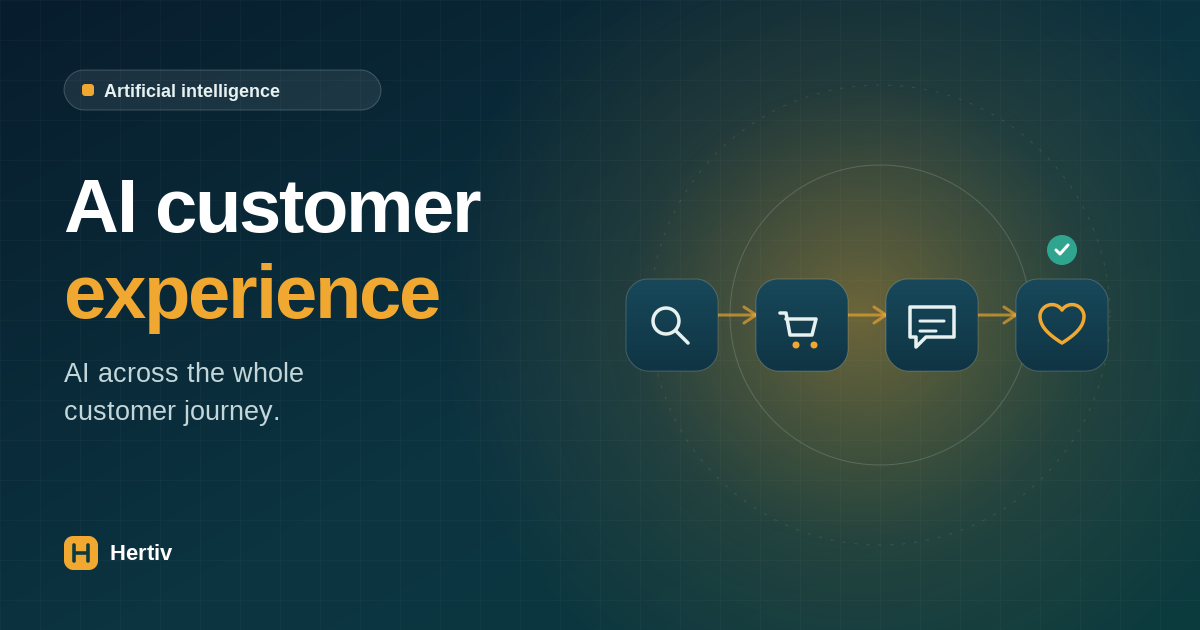
AI customer experience means using AI across the whole customer journey, from first search to support after purchase. Here is where it helps and how to measure it.
On this page
Short answer
AI customer experience is the use of artificial intelligence across the customer journey to make each step faster, more personal and easier to complete. It covers search and recommendations before purchase, checkout help, onboarding, support and follow-up, and it works best when a human can step in. It is broader than AI customer service, which covers support alone.
What is AI customer experience?
AI customer experience is the use of artificial intelligence to improve how a customer finds, buys, uses and gets help with a product. It covers the whole journey, not one channel: search results and recommendations, checkout, onboarding, support chats and follow-up messages after a purchase.
The idea is simple. A customer should get the right answer, the right product or the right next step without waiting and without repeating themselves. AI helps by reading what the customer has already done, guessing what they need next and drafting or delivering the response.
It differs from a single chatbot. A chatbot answers questions in one place. AI customer experience joins up several touchpoints, so the support agent can see the order history, the recommendation engine can see past purchases and the follow-up email can reflect what actually happened.
Where does AI show up in the customer journey?
AI shows up at nearly every stage of the journey, though the job changes at each step. The table below shows the common pattern.
| Stage | What AI does | What the customer notices |
|---|---|---|
| Discovery | Ranks search results and suggests products | Relevant results on the first try |
| Buying | Answers questions and checks stock | Faster checkout with fewer doubts |
| Onboarding | Guides setup and flags stuck users | Short setup with help when needed |
| Support | Drafts replies and routes tickets | Faster first answers, fewer repeats |
| Follow-up | Times reminders and asks for feedback | Messages that match the purchase |
Most teams start with support, because the volume is visible and the result is easy to measure. Discovery and follow-up usually come later, once the data is joined up. The software side of this is covered in our guide to AI customer experience software.
How is it different from AI customer service?
AI customer service covers support: answering tickets, routing chats and resolving problems after something goes wrong. AI customer experience covers the full journey, including the steps before a purchase and the follow-up after one.
The two overlap in support, which is where most customers meet AI first. A support agent that drafts replies is both customer service and customer experience. The difference is scope: service fixes problems, while experience also shapes discovery, buying and onboarding.
Agentic systems sit at the far end of this scale, acting on the customer's behalf across several steps. Our guide to agentic AI in customer experience explains where that approach fits and where it does not.
Chatbots are part of the picture but not the whole of it. A chatbot can answer a question in the moment, yet it cannot change what the customer sees in search, what the checkout suggests or what the follow-up email says. Customer experience work connects those pieces, so the customer feels known at each step instead of starting over in every channel.
What does personalization actually mean here?
Personalization in customer experience means using what you already know about a customer to make the next step easier. That can be as simple as remembering a size, a language or a delivery address, or as involved as ranking products by past behaviour.
Good personalization is quiet. The customer notices that the search results fit, the offer matches the last order and the support agent already knows the context. Bad personalization is loud: wrong guesses, repeated questions and offers for things the customer just returned.
The data behind it must be handled with care. Customers accept personalization when it clearly helps them and when they can see what is stored. Hidden tracking and unexplained changes in price or availability break trust fast, and trust is hard to rebuild.
How do teams measure whether it is working?
Measure the journey, not the model. The numbers that matter are first-response time, resolution time, the share of contacts resolved without a handoff, customer effort scores and repeat purchase rates. Pick one primary metric per stage and track it weekly. A metric that moves slowly is still useful if it moves in the right direction.
Also track what AI gets wrong. Count the share of AI drafts that agents rewrite, the share of customers who ask for a human and the complaints that mention an AI answer. Those failure rates tell you more about quality than any usage chart.
Generative models add one more check: whether answers stay grounded in your own content. Our guide to generative AI customer experience covers the evaluation and fallback patterns that keep answers accurate.
What are the limits of AI in customer experience?
AI handles routine, high-volume steps well and struggles with the rest. It cannot read a customer's mood reliably, it cannot take responsibility for a mistake and it cannot invent a fix for a problem your product does not solve.
Edge cases are the weak point. A customer with an unusual order, a damaged delivery and a changed address in one message will confuse most automated flows. Those cases need a human with full context, not a longer script.
Privacy is the other limit. Some customers do not want their behaviour tracked across channels, and some regions restrict what can be stored. Build the experience so it still works when a customer opts out of personalization. A journey that breaks without tracking was built on the wrong foundation.
Example: a retailer cuts first-response time with AI
Example (hypothetical): a 40-person online retailer gets 2,000 support messages a week. AI resolves 600 of them outright, drafts replies for 800 more and routes the remaining 600 to agents. Agents accept 500 drafts as written and edit 300.
First response falls from 6 hours to 2 hours. The 600 resolved messages each save about 8 minutes of agent time, which is 80 hours a week across the team. The edited drafts save less, about 3 minutes each, or 15 hours a week.
The team keeps one rule: any message about a refund, a damaged item or a complaint goes straight to a human. AI handles the routine questions, and agents spend their time on the cases where judgement matters.
What are the common mistakes?
The most common mistakes are launching AI on every channel at once, measuring usage instead of outcomes, and hiding the handoff to a human.
- Starting everywhere at once, so no single journey gets good
- Letting AI answer billing and refund questions without a human check
- Personalizing from stale or incomplete data
- No fallback when the model is unsure, so wrong answers reach customers
- Tracking clicks and chats instead of resolution and repeat purchase
The fix is to start small and measure one stage at a time. Pick the journey step with the most volume, ship AI there with a clear metric and a human fallback, then move to the next step only when the first one holds up.
Key takeaways
- AI customer experience covers the whole journey, not just support
- Start with support, where volume and results are easy to measure
- Good personalization is quiet; the customer notices the fit, not the model
- Track failure rates, not just usage, to judge quality
- Keep a visible human handoff for refunds, complaints and edge cases
Frequently asked questions
What is AI customer experience?
It is the use of artificial intelligence across the customer journey, from search and recommendations to checkout, onboarding, support and follow-up. The aim is to make each step faster and more personal, with a human available when the customer needs one.
Is AI customer experience the same as a chatbot?
No. A chatbot is one tool inside one channel. AI customer experience joins up several touchpoints, so search, recommendations, checkout help and support share context about the same customer and the same order.
How much does AI customer experience cost?
Costs vary by scope, so start with one journey stage and one metric. A single support flow with drafted replies is the usual first step, and the savings show up in first-response time and agent hours before you expand.
Does AI customer experience replace support agents?
No. It takes the routine questions and drafts, so agents spend their time on complaints, refunds and unusual cases. Teams that remove the human handoff usually see satisfaction fall, not rise.
What data does AI customer experience need?
It needs order history, past conversations and product data, joined up across channels. If that data is split across systems or out of date, fix the data first; the model can only work with what it can see.
How do you keep AI customer experience private?
Collect only the data the experience needs, tell customers what is stored, and let them opt out of personalization. The journey should still work for a customer who declines tracking, even if it is less tailored.