Generative AI for Customer Experience: Where It Actually Helps
Generative AI improves customer experience through support agents, smarter search, personalisation and post-call summaries. Here is where it works and how to ship it safely.
On this page
Short answer
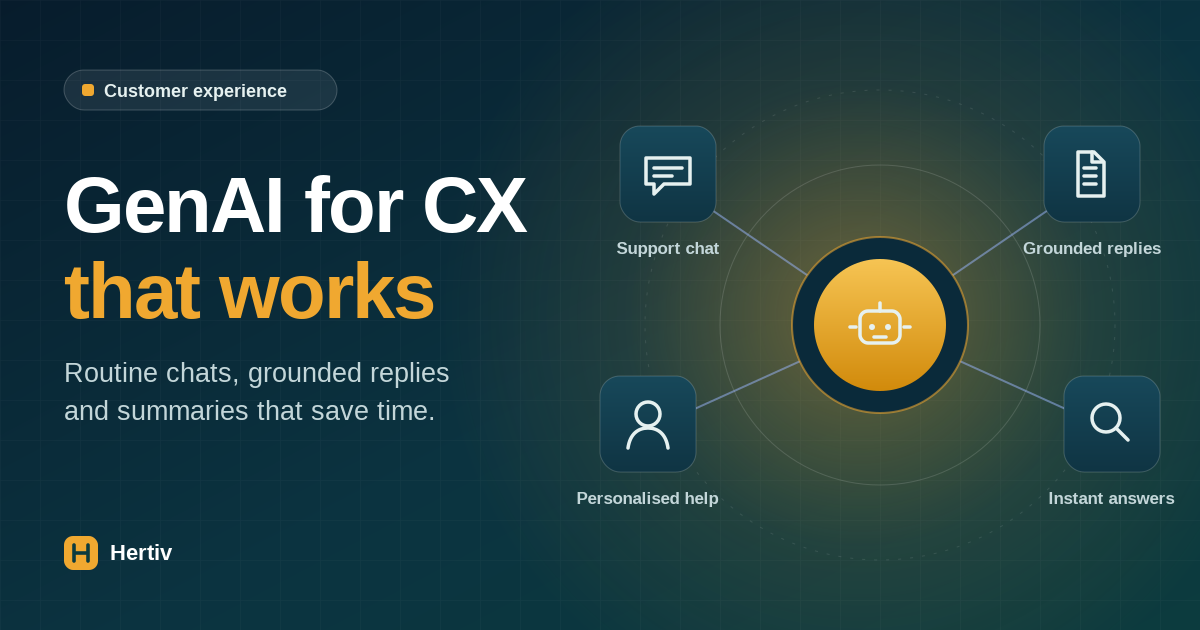
Generative AI improves customer experience by handling routine support conversations, drafting replies grounded in your own content, summarising interactions and personalising recommendations. The gains come from pairing models with retrieval, clean data and human escalation rules, not from the model alone.
What does generative AI actually change in customer experience?
Generative AI changes customer experience by letting software hold a useful conversation, draft content and read unstructured text at scale, rather than only routing tickets by keyword. It does not replace your CRM or helpdesk; it sits on top of them and uses their data.
The practical shift is in three areas:
- Conversation: chatbots that answer questions in natural language instead of forcing customers through rigid menus.
- Content: drafts for replies, help articles and product descriptions that a person reviews and approves.
- Comprehension: turning calls, chats and emails into structured summaries, intent tags and next actions.
The model is the smallest part of the work. Most of the effort goes into retrieval, data quality, guardrails and evaluation, which is why teams that treat this as a data project rather than a model project get further. A generative AI consultant can help scope which journeys are worth automating first.
One rule helps set expectations: generative AI is strong at language, weak at facts it has not been given. Design every experience assuming the model knows nothing about your customer until you hand it context.
Which customer experience use cases are worth building first?
The use cases worth building first are the ones with high volume, short conversations and clear success criteria. Those are where you can measure a result quickly and where mistakes are recoverable.
| Use case | What it does | Typical data needed | Effort |
|---|---|---|---|
| Support chatbot | Answers routine questions end to end | Help centre articles, order and account APIs | Medium |
| Agent assist | Drafts replies inside the helpdesk | Past tickets, macros, knowledge base | Medium |
| Post-interaction summary | Turns calls and chats into notes and tags | Transcripts, CRM schema | Low |
| Search and discovery | Understands intent and returns relevant products or articles | Catalogue, search logs, embeddings | Medium |
| Voice agent | Handles calls for status, booking or routing | Telephony, IVR flows, policy rules | High |
| Personalised outreach | Adapts messaging to segment and history | Consent records, customer profile | Medium |
| Feedback analysis | Groups complaints and sentiment into themes | Survey and review text | Low |
| Sales copilot | Prepares briefs and follow-ups for account teams | CRM, email, call notes | Medium |
Order and status questions usually deliver value first because the answer format is predictable and the data lives in systems that already have APIs. Sentiment analysis and summaries are low-effort projects that make other work easier. Voice remains the hardest because latency, accents and interruption handling all matter.
How do you keep AI answers accurate and on brand?
Accuracy comes from retrieval and guardrails, not from a bigger model. The assistant should fetch approved content and verified customer data, then answer only from what it retrieved, and say plainly when it does not know.
The core pattern is retrieval-augmented generation: the customer question is matched against your help centre, policies and product data, and the selected passages are passed to the model with instructions. This keeps answers anchored to what you have published and makes them easy to audit.
Essential guardrails include:
- Scope limits: the assistant declines topics outside its remit and hands over.
- Freshness checks: stale articles are flagged, not used silently.
- Policy filtering: refund and cancellation rules are enforced by code, not by prompt wording.
- Human review: new answer types are approved before they go live to customers.
- Logging: every answer stores the sources it used, so you can trace a bad reply.
Brand voice matters too. Give the model a short, written tone guide with examples of good and bad replies. Test the output across accents, languages and difficult customer phrasing before launch; retail and airline complaints read differently from calm subscription queries.
What does a good rollout look like, step by step?
A good rollout starts narrow, measures honestly and expands only where the numbers hold. Most teams can move from a scoped idea to a controlled pilot in weeks if the content is ready.
- Pick one journey. For example, order status and returns for one product line or region. Write down what a good outcome looks like.
- Audit the source content. Remove outdated articles, rewrite ambiguous policies and fill gaps. This work improves the human service too.
- Connect the systems. Give the assistant read-only API access to the data it needs, and nothing more.
- Build the retrieval layer and prompts. Define the tone, refusal rules and escalation triggers in writing.
- Run a limited pilot. Route a share of traffic to the assistant, keep staff reviewing transcripts, and compare against a control group.
- Review weekly. Look at deflection, resolution time, escalation rate, complaints and CSAT together, not one metric alone.
- Expand or stop. Add the next journey only when the first one is stable and staff trust it.
Example (hypothetical): a pilot handles 1,000 conversations a month, and 450 are fully resolved without a person. That is a 45 percent resolution rate. If half of the remaining conversations still needed only a small agent edit, the real gain is larger than the headline number suggests.
How should you measure whether it works?
Measure whether generative AI works by comparing against your current baseline on resolution, speed, cost and satisfaction at the same time. A single metric will flatter the project.
Useful measures:
- Containment: share of conversations resolved without a person, and whether customers come back with the same issue.
- Time to resolution: for the whole journey, not only the AI part.
- Escalation quality: how often the assistant hands over correctly, and how often it fails to.
- Answer groundedness: share of replies fully supported by retrieved sources, checked by sampling.
- Customer satisfaction: post-conversation rating, compared with the human-only baseline.
- Agent workload: how much time staff save on summaries, drafting and research.
Beware of measuring containment alone. An assistant that refuses to help can look contained by pushing customers to give up. Track repeat contacts and complaints alongside it, and review transcripts monthly to catch drift as products and policies change. Teams that plan for ongoing evaluation, not a one-off launch, keep quality steady over time.
What are the common mistakes?
The common mistakes are organisational as much as technical, and most of them are visible early if someone looks for them.
- Automating a broken process. If the returns policy is confusing to staff, the assistant will amplify the confusion.
- Skipping the content clean-up. Poor knowledge articles produce confident wrong answers.
- Letting the model act without limits. Refunds, account changes and legal topics need code-level constraints.
- No escalation path. Customers who cannot reach a person escalate in public instead.
- Measuring only deflection. Cheap containment can hide unhappy customers.
- Ignoring privacy. Customer data in prompts and logs needs the same controls as any other personal data.
- No owner after launch. Models, prompts and content drift; someone must own review.
Security deserves a separate review. Prompt injection, data leakage through retrieval and over-permissive tool access are real risks when an assistant can read customer records or trigger actions.
How do you choose where to start?
Choose where to start by ranking journeys on volume, clarity and risk, and pick the highest-scoring low-risk option. That gives you a visible win without betting the customer relationship on it.
- List the top ten contact reasons from your helpdesk and rank by volume.
- Score each on documentation quality. If the answer is not written down, the model cannot learn it reliably.
- Score on risk. Payments, complaints and legal topics go later; status, hours and how-to come first.
- Check data access. Confirm the APIs and permissions exist before committing.
- Set a decision date and success threshold. Agree in advance what result continues the project and what stops it.
For organisations that need to align technology, data and operating model first, an AI readiness assessment is often the faster route than a direct build. Where the goal is a working assistant rather than a strategy, a focused proof of concept gives you evidence in weeks. Teams planning a broader program can review the wider set of AI agents by department before committing budget.
Where does generative AI fit with agents and human teams?
Generative AI fits best as a layer inside a service operation, with agents handling multi-step tasks and people owning judgement. The model answers and drafts; workflows decide what is allowed to happen.
A mature setup usually combines three things:
- An assistant for customers, answering questions and collecting details.
- Agentic workflows that perform bounded actions such as checking an order, booking a slot or issuing a standard credit within limits.
- Human staff handling exceptions, complaints and anything with legal or reputational weight.
This combination is where AI agents for customer support typically live in practice. The same building blocks extend to internal teams, for example drafting replies to suppliers or preparing sales follow-ups, which keeps prompts and evaluation consistent across departments.
The operating model matters as much as the technology. Publish who owns the assistant, how answers are reviewed, and how customers can reach a human. That clarity is what makes the experience feel reliable rather than clever.
Key takeaways
- Start with one high-volume, well-documented journey such as order status or returns
- Ground every answer in retrieved company content so replies stay accurate
- Keep a human escalation path with clear triggers for refunds, legal and complaints
- Measure deflection, resolution time, escalation rate and CSAT together
- Summaries and agent-assist usually pay back faster than fully automated chat
Frequently asked questions
Is generative AI the same as a traditional chatbot?
No. A traditional chatbot follows scripted flows and menus, while a generative AI assistant understands free-text questions and composes answers. It still needs retrieval and rules to stay accurate, so most production systems combine scripted flows for common tasks with generative answers for the rest.
How long does it take to launch a customer-facing AI assistant?
A scoped pilot on one journey often takes a few weeks once the source content is clean and the APIs are available. The slower part is usually content clean-up, security review and agreeing escalation rules. Wider rollout depends on how the pilot performs and how many systems need integration.
Will generative AI replace support staff?
In most service operations it changes their work rather than removing it. Automation absorbs routine status and how-to questions, while staff handle exceptions, complaints and emotional situations. Many teams see the largest early gains from agent-assist tools that make existing staff faster.
What data do you need to start?
You need your help centre or policy content, access to customer and order data through read-only APIs, and a sample of past conversations for testing. Consent and privacy rules must be applied to any personal data used in prompts or logs. Clean, current content matters more than volume.
How do you prevent the AI from giving wrong or unsafe answers?
Ground answers in retrieved company content, restrict what the assistant is allowed to discuss, and enforce sensitive actions in code rather than prompt wording. Log the sources behind each answer, sample transcripts regularly, and route anything uncertain to a person.
Does this work across multiple languages?
Modern models handle many languages reasonably well, but quality varies by language and by how well your source content is translated. Test each language with real customer phrasing, keep a native speaker in review, and start with the languages that carry the most contact volume.


