AI Consulting for Startups: What It Covers and When to Hire
AI consulting helps a startup pick the right use case, prove it fast and ship it safely. This guide explains what consultants do, what it costs and when to hire one.
On this page
Short answer
AI consulting for startups is a service where an outside team helps a young company find the right AI use case, test it with a small pilot and put it into production. It covers strategy, data, model choice and the handover to your own team — and it is worth hiring when the cost of guessing wrong is higher than the cost of the advice.
What is AI consulting for startups?
AI consulting for startups is a service in which an outside team helps a young company use artificial intelligence in a practical way. The consultant's job is not to sell a model, but to find a use case that matters, test it quickly and leave the startup able to run it.
A typical engagement starts with the business problem, not the technology. The consultant interviews the team, looks at the data the startup already has, and picks one or two use cases where AI can save time, cut cost or create a feature customers will pay for.
That is different from hiring a contractor to build a feature. A consultant is expected to challenge the idea, say no to weak use cases, and set up the measurement that proves whether the pilot worked. For the service itself, see AI consulting.
What does an AI consultant actually do?
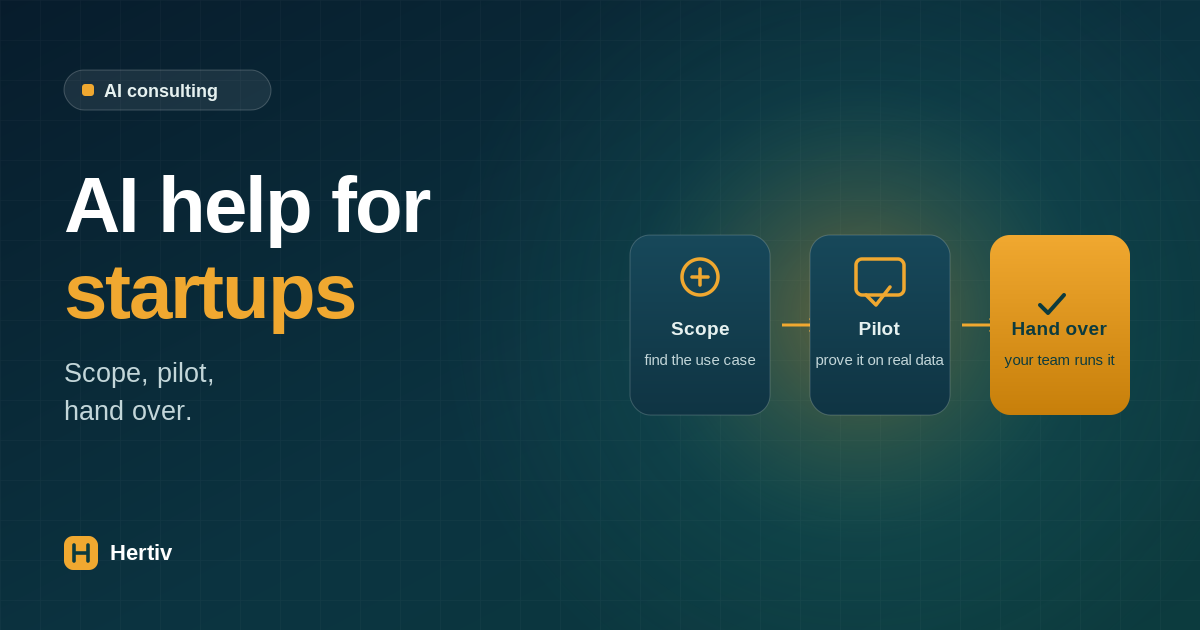
An AI consultant does four things in order: find the use case, check the data, run a pilot and hand the work over. Each stage has a clear output, so the startup can stop at any point without losing what was built.
- Find the use case. Map where the team spends time, where errors happen and where customers ask for help, then rank the candidates by value and risk.
- Check the data. Look at what data exists, how clean it is and whether it covers the cases the model must handle.
- Run a pilot. Build a small version with real data and real users, and measure it against a clear target.
- Hand it over. Document the system, train the team and set up monitoring so the startup can run it without the consultant.
Some consultants also help with vendor choice, hiring and governance. The best ones write down what they will not do — for example, they will not promise a result the data cannot support.
How do AI consulting engagements work?
AI consulting engagements usually follow one of a few models, and the right one depends on how much the startup already knows and how fast it needs to move.
| Model | What you get | Typical length | Best when |
|---|---|---|---|
| Discovery sprint | Ranked use cases and a plan | 2-4 weeks | You need direction |
| Proof of concept | Working pilot on real data | 4-8 weeks | You need proof it works |
| Build and handover | Production system plus docs | 2-4 months | You need it shipped |
| Advisory retainer | Regular reviews and guidance | Ongoing | You have a team already |
Costs vary widely by scope and region. A discovery sprint is the cheapest way to start, while a build engagement costs far more. For a sense of the numbers, read what AI consulting costs — and always ask for a fixed price for a fixed scope.
When should a startup hire an AI consultant?
A startup should hire an AI consultant when the team knows the business problem but not the AI trade-offs, and when a wrong choice would cost more than the advice. Three signs point that way.
First, the team has data but no clear use case. Second, a pilot failed once already and nobody can explain why. Third, the product needs AI to work reliably — in support, finance or health — where a bad answer has real consequences.
Do not hire a consultant to write a strategy deck you will not act on, or to add AI to a product that customers have not asked for. And if the startup already has strong ML engineers and a tested use case, the money is better spent on those engineers. A short proof of concept is the usual way to test the fit — see how to build an AI PoC for the steps.
Example (hypothetical): a startup tests AI support
Example (hypothetical): a startup with 12 staff handles 400 support messages a day, and each message takes about 6 minutes to answer. That is 400 times 6 minutes, or 40 hours of staff time every day — more than the team has.
The startup hires a consultant for a four-week discovery sprint. The consultant reads 500 past messages, finds that 180 of them are password resets and order-status questions, and proposes a pilot that answers only those two kinds of question, with a human reviewing every reply for the first two weeks.
The pilot answers 150 of the 180 simple questions correctly, and the team checks the arithmetic: 150 correct answers times 6 minutes is 15 hours a day saved, minus 2 hours a day of review, leaving about 13 hours a day freed. The startup then funds a build engagement with a fixed scope, a named owner on its own team and a written handover plan.
How do you choose an AI consultant?
Choose an AI consultant by their past work, their honesty about limits and the clarity of their proposal. Five checks cover most of the risk.
- Ask for similar work. A consultant who has built support pilots should show one, not just talk about AI in general.
- Ask what they would not do. A good consultant will name use cases they would refuse.
- Ask how they measure success. The proposal should name the metric, the test set and the target before work starts.
- Ask who does the work. Confirm whether senior people or juniors will run the pilot.
- Ask about handover. The proposal should say what documents, training and monitoring you get at the end.
Be wary of a proposal that promises a result without seeing your data, or that quotes a price without a scope. Both are signs the consultant is selling, not advising.
What are the common mistakes?
The most common mistakes with AI consulting are hiring too early, hiring for the wrong job and accepting a vague proposal.
- Hiring before the problem is clear. If you cannot name the decision the AI should improve, a consultant cannot help yet.
- Asking for a strategy, not a pilot. A deck does not prove anything; a small pilot on real data does.
- Accepting a vague scope. 'Explore AI opportunities' is not a scope — name the use case, the metric and the deliverable.
- No handover plan. If the consultant leaves and nobody can run the system, the money is wasted.
- Judging by the demo. Demos use clean data; ask to see results on messy, real data instead.
Key takeaways
- AI consulting for startups finds the use case, tests it and hands it over — it is not just advice
- Start with a discovery sprint or a small pilot, not a long strategy project
- Hire when a wrong AI choice would cost more than the advice
- Judge a consultant by past pilots, honest limits and a written handover plan
- Fix the scope, the metric and the price before work starts
Frequently asked questions
How much does AI consulting cost for a startup?
It varies by scope and region. A short discovery sprint costs far less than a build engagement, and many consultants price a pilot as a fixed fee. Ask for a fixed price for a fixed scope, and read our guide to AI consulting costs for the ranges.
Should a startup hire a consultant or an engineer?
Hire a consultant when you need to choose the use case and prove it fast. Hire an engineer when the use case is proven and you need someone to build and run it full time. Many startups do the consultant first, then hire.
How long does an AI pilot take?
A focused pilot usually takes four to eight weeks on real data with real users. Shorter pilots can work for simple use cases, but a pilot that skips real users rarely proves anything.
What should a consultant deliver at the end?
At minimum: the working pilot, the test results against the agreed metric, documentation of the system and data, and training for your team. A handover plan should be in the proposal from the start.
Can a consultant build the whole product?
Some can, under a build engagement with a fixed scope. But a startup should still own the product decisions, the data and the handover — a consultant should not become a permanent dependency.
What is the biggest risk in AI consulting?
The biggest risk is building the wrong thing well: a polished pilot for a use case nobody needs. A good consultant prevents that by starting from the business problem and measuring against a clear target.


