How Much Does AI Consulting Cost?
AI consulting usually costs from a few thousand dollars for a short assessment to six figures for a full build, depending on scope, seniority and length.
On this page
Short answer
AI consulting cost is the fee an outside team charges to plan, test or build an AI solution, usually billed by the day, by the project or as a monthly retainer. A short assessment can cost a few thousand dollars, while a full build running for months can reach six figures. The price depends on scope, seniority, data quality and how long the work runs.
What is AI consulting cost?
AI consulting cost is what a business pays an outside team to plan, test or build an AI solution, usually charged by the day, by the project or as a monthly retainer. It covers the consultants' time, not the software licences or cloud bills that come with the finished system, which are usually billed separately.
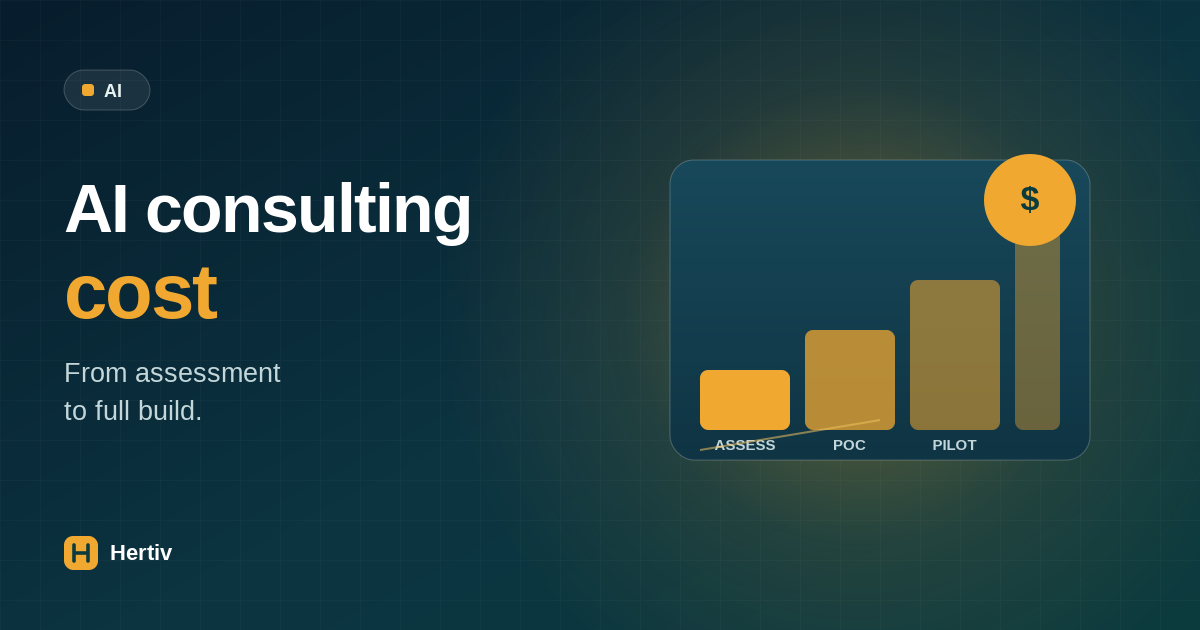
The total varies widely because engagements vary widely. A short readiness assessment for one team can cost a few thousand dollars, while a full build that runs for months can reach six figures. The scope, the seniority of the people involved and the length of the work are the three factors that move the price most.
| Engagement | What it covers | Typical length |
|---|---|---|
| Readiness assessment | Current systems, data and use cases | 2-4 weeks |
| Proof of concept | One working model on real data | 4-8 weeks |
| Pilot | A model in use with one team | 2-4 months |
| Full build | A product running in production | 3-12 months |
Consulting cost is not the same as implementation cost. A consultant's fee pays for advice, design and delivery help, while implementation cost also covers licences, infrastructure and your own staff's time. For the wider picture, see what it costs to implement AI.
What drives the price of AI consulting?
Scope is the biggest driver. An assessment that reviews one workflow costs far less than a programme that covers several departments, because each extra workflow needs more interviews, more data checks and more testing. Narrow the scope and the price falls; widen it and the price rises with it.
Seniority is the second driver. A senior architect who has shipped production AI systems charges more than a junior analyst, and most engagements mix both. The third driver is data: messy, scattered or restricted data takes longer to prepare, and that preparation time is billed.
Location and timing matter too. Teams in high-cost markets charge higher day rates, and a rushed deadline can add cost because the consultancy must staff the work faster. A clear brief with a fixed scope is the simplest way to keep the price down, and a look at AI consulting services shows what a typical engagement covers.
How do AI consultants charge?
AI consultants usually charge in one of four ways: a fixed price for a defined scope, a day rate for time spent, a monthly retainer for ongoing help, or a success fee tied to a result. Each model suits a different kind of work, and the right one depends on how certain the scope is.
| Model | How it works | Best for |
|---|---|---|
| Fixed price | One price for a defined scope | Assessments and proofs of concept |
| Day rate | Paid per consultant day | Short advice and reviews |
| Retainer | Monthly fee for ongoing help | Long programmes |
| Success fee | Part of the fee tied to a result | Measurable savings or revenue |
Fixed prices protect the buyer when the scope is clear, because the fee does not move if the work takes longer. Day rates suit open-ended advice, but the total is harder to predict. Retainers suit teams that need help over months rather than a single project.
What does a typical engagement include?
A typical engagement starts with discovery: interviews with staff, a review of the data and a shortlist of use cases worth testing. This phase usually takes one to three weeks and ends with a written plan that names the use case, the data needed and the expected effort.
The next phase is a proof of concept, where the team builds a working model on real data and tests it with real users. If the test works, the engagement moves to a pilot in one team, then to a wider rollout. Each phase has its own price, so a team can stop after any phase without paying for the rest.
Good engagements also include documentation and handover. The consultants should leave the team able to run, monitor and change the system without them. If handover is missing, the business stays dependent on the consultancy, and that dependence costs more over time.
How do you budget for AI consulting?
Budgeting for AI consulting works best in five steps, starting with the problem rather than the technology.
- Name one problem worth solving and how you will know it is solved.
- Ask two or three consultancies for a written proposal with the same scope.
- Compare the proposals on scope and seniority, not only on price.
- Reserve 10 to 15 percent of the budget for data work and changes.
- Agree in writing what each phase delivers and what happens if it fails.
Comparing proposals on the same scope is the step most teams skip. Two quotes can differ by half, yet cover different work, so ask each consultancy to list exactly what is included. A cheaper quote that leaves out data preparation is often the more expensive one in the end.
Keep a reserve for surprises. Data is rarely as clean as the first review suggests, and a reserve of 10 to 15 percent covers the extra cleaning and testing without a new approval round. For how a first test is usually run, see how to build an AI proof of concept.
Example (hypothetical): a six-week discovery engagement
Example (hypothetical): a mid-size retailer asks a consultancy to assess where AI could help its support team. The engagement runs for six weeks with two consultants working three days a week, which is 2 times 6 times 3, or 36 consultant days.
At 1,200 dollars a day, the fee is 36 times 1,200, or 43,200 dollars. The team also budgets 5,000 dollars for data cleaning tools and 3,000 dollars for staff time in interviews, bringing the total to 51,200 dollars. A 10 percent reserve adds 5,120 dollars, giving a planned budget of 56,320 dollars.
The reserve matters because the data review often finds gaps that were not visible in the first meeting. A budget without a reserve forces the team to cut scope or ask for more money halfway through, and both outcomes slow the work down.
What are the common mistakes?
The most common AI consulting mistakes are buying before scoping, comparing quotes on price alone, and skipping the handover.
- Buying before scoping. A team that hires a consultancy without a written problem ends up paying for discovery twice.
- Comparing on price alone. The cheapest quote often leaves out data work, testing or documentation.
- No handover plan. The system works, but only the consultancy can run it.
- Skipping the reserve. Data surprises then force a mid-project budget request.
- No success measure. Without a target, nobody can tell whether the money was well spent.
Key takeaways
- Consulting cost pays for advice, design and delivery help, not licences or cloud bills
- Scope, seniority and the state of your data are the three biggest price drivers
- Fixed prices suit clear scopes; day rates suit open-ended advice
- Each phase has its own price, so you can stop after any phase
- Reserve 10 to 15 percent of the budget for data work and changes
Frequently asked questions
How much does a short AI assessment cost?
A short assessment usually costs a few thousand dollars, depending on how many workflows are reviewed and how senior the team is. Ask for a fixed price with a written list of what the assessment covers, so you can compare quotes on the same scope.
Do consultants charge by the hour or by the project?
Both are common. Fixed prices suit work with a clear scope, such as an assessment or a proof of concept. Day rates suit open-ended advice, such as a review of an existing system. Retainers suit help that runs over several months.
What is included in an AI consulting fee?
The fee usually covers the consultants' time: interviews, data review, design, building and testing. Licences, cloud bills and your own staff's time are usually separate, so check the proposal to see what is included and what is not.
Is AI consulting worth it for a small business?
It can be, if the problem is narrow and the success measure is clear. A short, fixed-price assessment is the lowest-risk way to find out, because it ends with a plan you can act on with or without the same consultancy.
How do I compare two consulting quotes?
Ask both firms to quote the same written scope, then compare what is included: the use cases, the data work, the testing and the handover. A cheaper quote that leaves out data preparation or documentation is often the more expensive one in the end.
What happens if the proof of concept fails?
A failed proof of concept is a useful result if the engagement was phased, because you learn the idea does not work before spending on a full build. Agree in writing what each phase delivers and what happens if the test fails.


