AI Automation for Banking Compliance Reporting: How It Works
AI automation reads bank transactions, checks them against the rules and drafts the compliance reports regulators require. People review the exceptions and sign off.
On this page
Short answer
AI automation for banking compliance reporting uses software to read transactions, check them against rules and draft the reports that regulators require. It pulls data from bank systems, flags unusual activity, fills in report fields and keeps an audit trail. People still review flagged cases and sign off the final report, but the routine reading and copying is done by the machine.
What is AI automation for banking compliance reporting?
AI automation for banking compliance reporting is software that prepares the reports banks must send to regulators, using AI to read data and check it against the rules. Instead of staff copying figures from several systems into a spreadsheet, the software pulls the data, runs the checks and drafts the report.
Compliance reporting covers a lot of ground: transaction monitoring, customer checks, suspicious activity reports, risk returns and audit trails. Each report has its own rules, deadlines and format. The work is repetitive and detail-heavy, which is why it is a good fit for automation, and it is also high-stakes, which is why people stay in charge of the final decision.
| Report area | What the AI does | What a person does |
|---|---|---|
| Transaction monitoring | Scans transactions and flags unusual patterns | Reviews flagged cases and decides |
| Customer checks | Reads documents and matches names and dates | Handles unclear or conflicting records |
| Suspicious activity | Drafts the report from the flagged facts | Writes the judgement and files it |
| Regulatory returns | Fills fields from source systems | Checks totals and signs off |
| Audit trails | Logs every check and decision | Answers auditor questions |
The goal is not to remove people. It is to move them from copying data to judging cases. For the wider risk picture, see what AI risk management is.
How does the automation work?
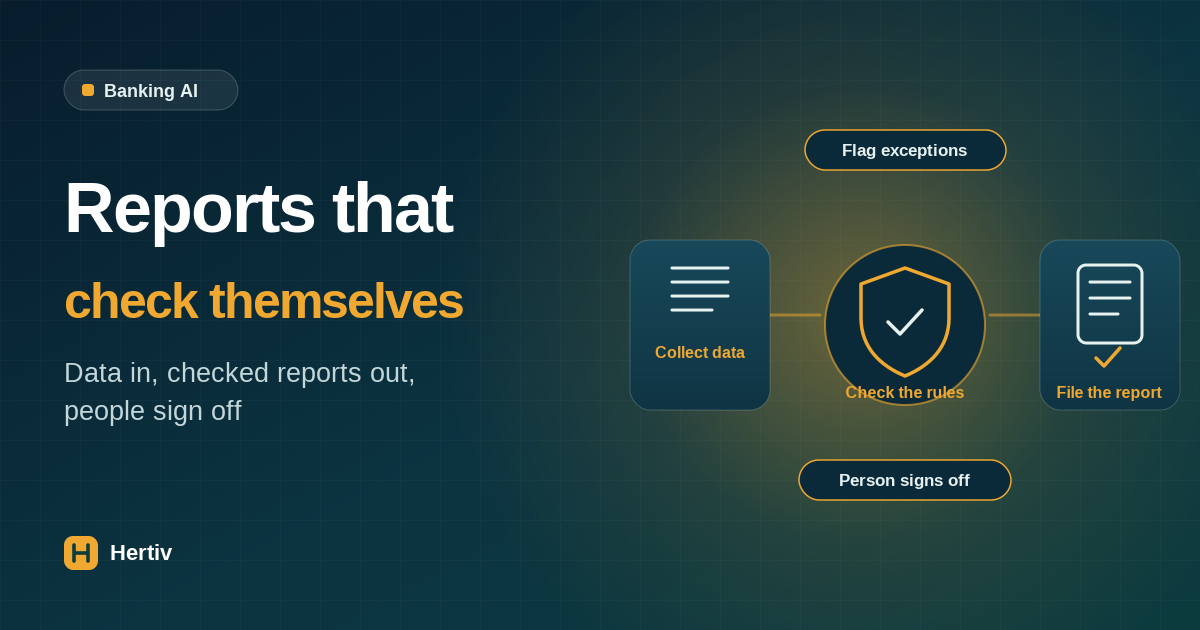
AI automation for compliance reporting works as a short pipeline: collect, check, draft, review, file. Each step is simple on its own, and the value comes from linking them so nothing is retyped by hand.
First the software collects data from the bank systems: accounts, transactions, customer records and past reports. It normalises the data, so the same customer is spelled the same way everywhere. Then it runs checks: does this transaction break a limit, does this customer record match the documents, does this pattern look like one the bank has seen before.
Next it drafts the report, filling each field from the checked data and noting the source of every figure. Cases that fail a check are set aside with a short explanation of why they were flagged. Finally a person reviews the exceptions, approves the draft, and the report is filed with a full log of what was checked and by whom.
What data does the system need?
A compliance reporting system needs clean, complete data before it can do useful work. The main sources are transaction records, customer records, account documents and past reports. If the same customer appears under two spellings, or an account is missing a date of birth, the checks will produce false alarms.
Data quality work comes first. Teams usually spend the first weeks matching customer records, filling gaps and agreeing on one definition for each field. That work is unglamorous, but it decides whether the automation is trusted. A system that flags hundreds of false alarms will be ignored, however good its models are.
Access rules matter too. Compliance data is sensitive, so the system must log who looked at what, and only show each person the cases they are allowed to see. That log is itself part of the audit trail the regulators expect.
Where do humans still decide?
Humans still decide on the cases that matter: flagged transactions, unclear customer records and the final sign-off. AI can say "this looks unusual" but it cannot say "this is fraud" with the certainty a regulator expects. That judgement needs a person who understands the customer and the context.
The review habit is simple: the AI presents the facts, the rule that was broken and the similar cases it found, and the reviewer decides. The decision and the reason are logged. Over time, the log shows which rules produce useful flags and which ones waste time, so the team can tune them.
Sign-off is also a human job. The person who files the report is accountable for it, so they need to see the totals, the exceptions and the checks that ran. A report that nobody can explain is a risk, even if every figure is correct.
How to start automating compliance reports
You start automating compliance reports by picking one report, proving the system on real data, and only then widening the scope. A small, measured pilot beats a broad rollout that nobody trusts.
- Pick one report. Choose a report with clear rules and enough volume to matter, such as a monthly transaction summary.
- Fix the data first. Match customer records, fill the gaps and agree on one definition per field before building anything.
- Write the checks as rules. Turn each regulatory rule into a check the software can run, with a clear pass and fail.
- Build the smallest version. Automate the main path only. Send every exception to a person from day one.
- Test on real cases. Run at least a month of real reports through it and record accuracy, time saved and false alarms. This is where how to build an AI proof of concept helps.
- Put an owner on it. Name the person who updates the rules when regulations change and checks the system each month.
Measure the pilot against the manual process: time per report, error rate and number of exceptions. If the numbers do not improve, fix the data and the rules first.
Example: monthly compliance reporting
Example (hypothetical): a small bank files 120 compliance reports a month. Two compliance officers spend most of their time reading transactions, copying figures into templates and checking totals by hand.
Before automation, each report takes 45 minutes. For 120 reports that is 5,400 minutes, which is 90 hours a month, or more than half of two full-time jobs.
The bank builds an automated flow. The software pulls the data, runs the checks and drafts all 120 reports. Of those, 100 pass every check and need only a quick glance, while 20 are flagged and each takes a reviewer 30 minutes to check properly. That is 20 times 30 minutes, which is 600 minutes, or 10 hours a month.
The saving is 90 hours minus 10 hours, which is 80 hours a month. The team spends the saved time on the flagged cases and on keeping the rules up to date. The bank also tracks two numbers: reports filed with a wrong figure, and flagged cases that turned out to be fine. Those two numbers decide whether the pilot is a success.
What are the common mistakes?
The most common mistakes in compliance automation are starting with messy data, trusting the AI without checks, and treating the rules as finished.
- Automating on messy data. If customer records do not match, the system will flag the wrong cases and the team will stop trusting it.
- No human check on flagged cases. A plausible-looking draft can hide a wrong figure. High-value reports need a person in the loop.
- Rules that never change. Regulations change, and so do customer patterns. Review the rules every month and update them.
- Measuring speed only. Faster reports are worthless if they contain errors. Track accuracy and false alarms as well as time saved.
- Starting too broad. Five reports at once means five half-finished flows and no clear result. Prove one first.
Key takeaways
- AI reads and checks the data; people judge the exceptions and sign off the report
- Clean, matched data decides whether the automation is trusted or ignored
- Start with one report, test on a month of real cases, then widen the scope
- Track accuracy and false alarms, not just the hours saved
- Name an owner who updates the rules when regulations change
Frequently asked questions
What is AI automation for banking compliance reporting?
AI automation for banking compliance reporting is software that reads bank data, checks it against the rules and drafts the reports regulators require. It pulls transactions and customer records from bank systems, flags unusual activity, fills in report fields and keeps a log of every check. People review the exceptions and sign off the final report.
Can AI file a compliance report on its own?
No. AI can draft the report and flag the cases that need attention, but a person must review the exceptions and sign it off. The person who files the report is accountable for it, so they need to see the totals, the checks that ran and the reason each case was flagged.
Which compliance reports can be automated first?
Start with a report that has clear rules and high volume, such as a monthly transaction summary or a regular customer check. Reports with fixed fields and fixed deadlines are the easiest to automate. Complex judgement reports, where the answer depends on context, should stay manual until the simple ones are proven.
How accurate is AI at spotting suspicious transactions?
Accuracy depends on the data and the rules, not on the software alone. A system trained on clean, well-labelled history will flag the right cases; one fed messy data will produce false alarms. That is why pilots measure accuracy and false alarms on real cases before the system is trusted with live reports.
Does automation replace compliance officers?
No. It moves them from copying data to judging cases. Officers spend their time on flagged transactions, unclear customer records and keeping the rules up to date. In most pilots the team still reviews every exception, fixes data problems and answers auditor questions.
What does a compliance automation pilot cost?
Cost depends on the number of reports, the state of the data and the systems involved, so there is no fixed figure. The honest way to judge it is a pilot: measure time per report, error rate and false alarms for one report, then compare that with the manual process before deciding to widen the scope.


