Ahrefs API Alternatives: 6 Tools Worth Comparing
Ahrefs API alternatives range from full SEO suites to focused data providers. Compare six options on data coverage, pricing model and ease of integration.
On this page
Short answer
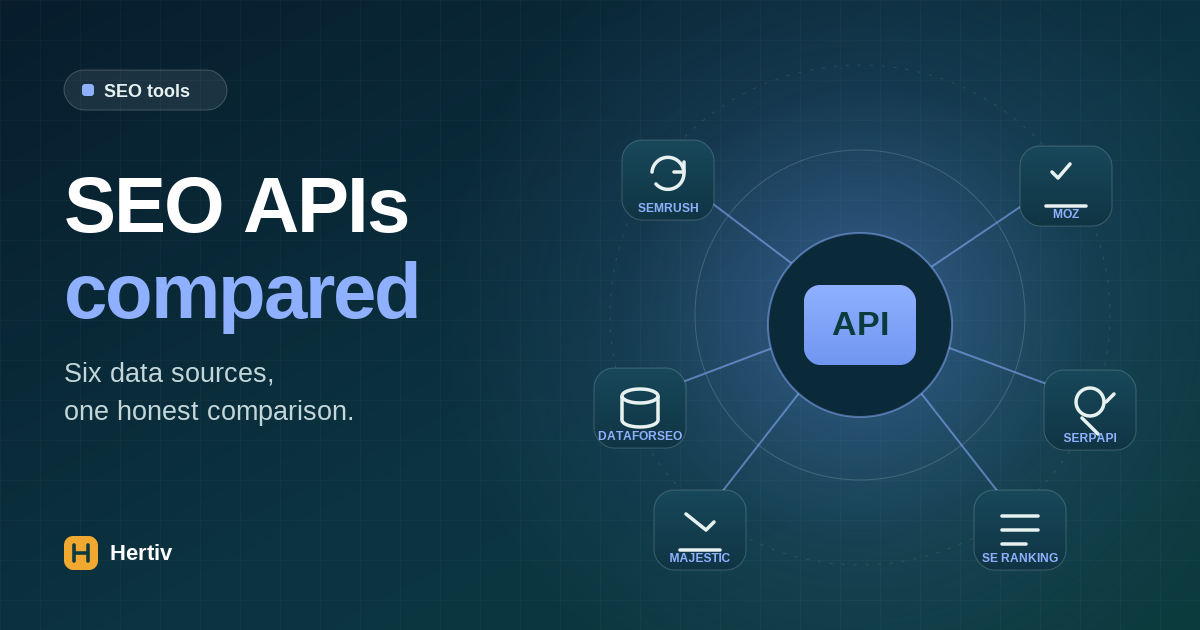
The best Ahrefs API alternatives are Semrush, Moz, DataForSEO, SerpApi, Majestic and SE Ranking. Semrush and Moz suit teams that want a full SEO suite, DataForSEO suits developers building custom tools, and SerpApi suits teams that need search results data rather than backlink data.
Which Ahrefs API alternatives are worth comparing?
The alternatives worth comparing depend on what you use the Ahrefs API for. If you pull backlink and keyword data into reports, a full SEO suite with an API is the closest match. If you only need search results or rank tracking, a focused data provider can be cheaper and simpler.
Compare the options on three things: which data they cover, how they charge, and how easy the API is to use. A cheap API with poor documentation costs more in developer time than a pricier one that works first time.
| Tool | Data strength | Pricing model | Best for |
|---|---|---|---|
| Semrush API | Keywords, backlinks, traffic | By API units, plan-based | Full SEO suite replacement |
| Moz API | Domain authority, links | By rows, plan-based | Link metrics in your own tools |
| DataForSEO | SERP, keywords, backlinks | Pay per use | Developers building custom tools |
| SerpApi | Search results data | Pay per search | Rank tracking and SERP data |
| Majestic API | Backlink index, trust flow | By rows, plan-based | Deep backlink analysis |
| SE Ranking API | Rank tracking, keywords | Plan-based with API limits | Small teams on a budget |
Semrush API
1. Semrush API: best for a full SEO suite replacement
Semrush is a large SEO platform with an API that covers keyword research, backlink analysis, traffic data and site audits. It is the closest like-for-like replacement for the Ahrefs API, because it offers a similar range of data through a similar set of endpoints.
The API is sold as an add-on to a Semrush plan and charged by API units, so teams need to plan their usage. It suits agencies and in-house teams that already use Semrush or want one platform for reporting, research and tracking.
Pros
- Wide data coverage: keywords, links, traffic and audits.
- Well documented, with client libraries for common languages.
Cons
- API access is an add-on, so the total cost can be high.
- Unit-based pricing needs careful usage planning.
Moz API
2. Moz API: best for link metrics in your own tools
Moz offers an API built around its link index and domain authority metrics. It suits teams that want to pull domain authority, page authority and link counts into their own dashboards or lead-scoring tools, rather than a full SEO suite.
The API charges by rows returned, and it is included in some Moz plans or sold as a separate product. Its metrics are widely used in the industry, which makes them easy to explain to clients.
Pros
- Domain authority and page authority are familiar to clients.
- Simple endpoints for link and domain data.
Cons
- Narrower data than a full suite: no keyword or traffic API of the same depth.
- Row-based pricing can grow fast with large lists.
DataForSEO
3. DataForSEO: best for developers building custom tools
DataForSEO is a data provider with APIs for search results, keywords, backlinks and business data. It is built for developers: you pay per use, there is no large monthly plan to start, and the API covers many small endpoints that combine into custom workflows.
It suits teams building their own SEO tools, rank trackers or research products, because the pricing follows actual usage and the data is returned in a consistent format across endpoints.
Pros
- Pay per use, with no large plan needed to start.
- Many endpoints, so you can build exactly what you need.
Cons
- No built-in dashboard: you must build your own interface.
- Costs can spike with heavy or careless usage.
SerpApi
4. SerpApi: best for rank tracking and SERP data
SerpApi returns structured search results from Google, Bing and other engines. It suits teams that need to track rankings, watch search features or collect SERP data at scale, rather than backlink data.
Pricing is per search, with monthly plans that include a set number of searches. It is a good fit when your main need is knowing where pages rank and what the results page looks like, not who links to whom.
Pros
- Structured SERP data from many engines and locations.
- Simple pricing per search, easy to forecast.
Cons
- No backlink index, so it does not replace Ahrefs link data.
- Heavy usage needs a higher plan.
Majestic API
5. Majestic API: best for deep backlink analysis
Majestic runs one of the oldest backlink indexes and offers an API for link data, trust flow and citation flow. It suits teams whose main need is backlink analysis: checking a site's link profile, finding new links, or comparing competitors link by link.
The API is available on Majestic plans and charged by rows, with a sandbox for testing. Its trust flow metric is widely used as a quick read on link quality.
Pros
- Deep backlink index with trust and citation flow.
- Good for link audits and competitor comparison.
Cons
- Little keyword or traffic data compared with a full suite.
- Interface and docs feel dated next to newer tools.
SE Ranking API
6. SE Ranking API: best for small teams on a budget
SE Ranking is an SEO platform with rank tracking, keyword research and backlink tools, plus an API for pulling that data into reports. It suits small teams and agencies that want API access without the price of the largest suites.
The API is included in higher plans, with limits on how much data you can pull. It covers the basics well: rankings, keywords and backlink summaries, which is enough for most client reporting.
Pros
- Lower cost than the largest SEO suites.
- Covers rank tracking, keywords and links in one API.
Cons
- Smaller index than the biggest providers.
- API limits can be tight on lower plans.
How to choose an Ahrefs API alternative
Choosing starts with the data you actually pull from the Ahrefs API today. List the endpoints you call, how often, and what the data feeds: a client report, a rank tracker, or a research tool. That list is your requirement, and any replacement must cover it.
- Map your current usage. Write down every endpoint and how much data you pull each month.
- Test data quality. Run the same queries on two candidates and compare the results.
- Check the pricing model. Compare cost at your real usage, not at the cheapest tier.
- Read the docs. Try a test call before buying; poor docs cost developer hours.
- Plan the migration. Allow time to remap fields, since metric names differ between providers.
For related comparisons, see Semrush API alternatives to compare pricing and data models.
Also see Serp API alternatives for search results data.
And scraper API alternatives for a cheaper way to collect SERP data.
Common mistakes when switching SEO APIs
The most common mistake is assuming metrics match across providers. Domain authority, trust flow and keyword difficulty are calculated differently by each tool, so a score of 60 in one system is not the same as 60 in another. Re-baseline your thresholds after switching.
Another mistake is underestimating migration time. Field names, rate limits and pagination differ, and a report that took a day to build on one API can take a week to rebuild on another. Budget for that work before you cancel the old plan.
Finally, teams forget to check data freshness. Some providers update their indexes weekly, others daily. If your reports need fresh data, test the update cycle before you commit, and keep the old API running in parallel for a month.
Key takeaways
- Semrush and Moz are the closest full-suite replacements for the Ahrefs API.
- DataForSEO suits developers building custom tools on pay-per-use pricing.
- SerpApi covers search results data; Majestic covers deep backlink data.
- Metric names differ between providers, so re-baseline your thresholds.
- Test data quality and docs before buying, and migrate in parallel.
Frequently asked questions
Is there a free Ahrefs API alternative?
There is no free equivalent with the same data depth. Some providers offer free tiers or trials with limited calls, which are enough to test data quality. For ongoing use, expect to pay, and compare the cost at your real monthly usage before choosing.
What is the cheapest Ahrefs API alternative?
It depends on your usage. Pay-per-use providers such as DataForSEO can be cheapest for light, irregular use. For steady monthly volume, a plan-based tool such as SE Ranking often costs less. Work out your monthly call volume first, then compare.
Can I replace Ahrefs backlink data with another API?
Yes, for most uses. Majestic has a deep backlink index, and Semrush and Moz also cover backlinks well. The numbers will differ from Ahrefs, because each provider crawls differently, so re-baseline any thresholds you use in reports or scoring.
Which API is best for rank tracking?
SerpApi and SE Ranking are strong choices for rank tracking, because they return structured search results and ranking data directly. If you also need backlinks and keywords in the same tool, a full suite such as Semrush may be simpler.
How long does it take to switch SEO APIs?
A simple report migration can take a few days; a full tool rebuild can take weeks. The work is in remapping fields, handling different rate limits and re-testing thresholds. Keep the old API running in parallel until the new reports match.
Do SEO APIs include historical data?
Most providers include some historical data, but the depth varies. Semrush and Moz keep longer histories for keywords and rankings, while pay-per-use providers may only return current data. Check the history window for the endpoints you need before you buy.


