Agentic vs Non-Agentic Chatbots: What Changes?
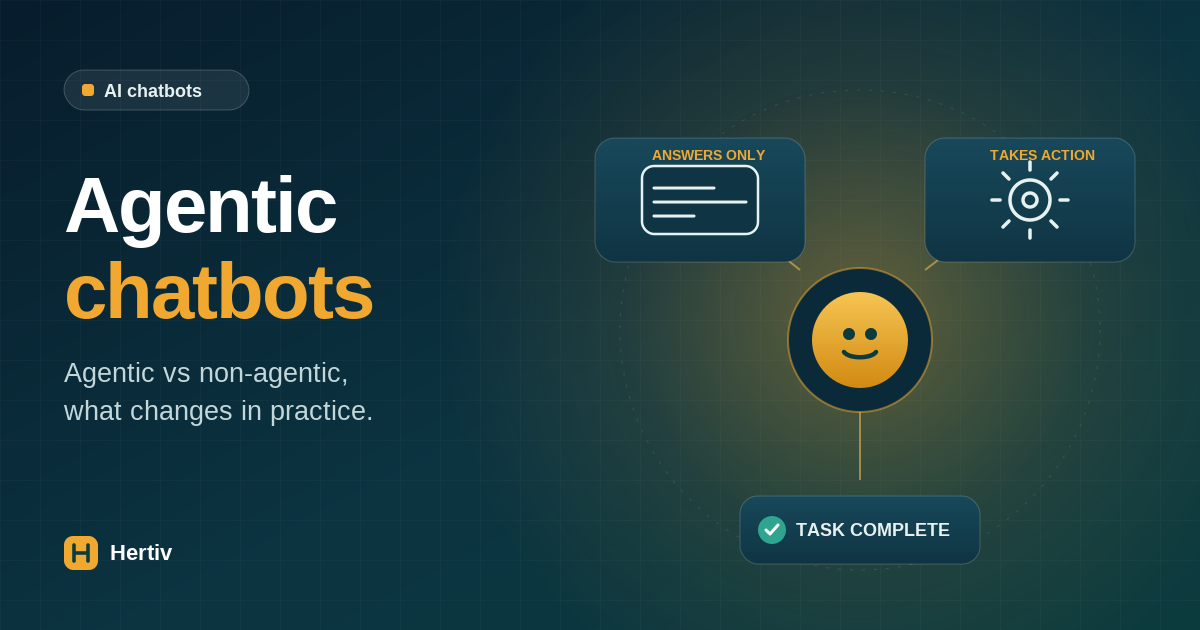
An agentic chatbot can take actions on its own, while a non-agentic chatbot only answers. Here is how they differ, what each does well, and how to choose.
On this page
Short answer
An agentic chatbot can plan steps, call tools and complete tasks such as booking, ordering or updating a record, while a non-agentic chatbot only answers questions from a fixed set of replies or retrieved text. Agentic chatbots suit tasks with a clear end state and a safe way to undo mistakes; non-agentic chatbots suit questions where the answer is information and nothing needs to change.
What is the difference between agentic and non-agentic chatbots?
An agentic chatbot is a chatbot that can take actions on its own: it plans the steps, calls tools or systems, and finishes a task without a person driving each step. A non-agentic chatbot only responds: it reads the question, finds an answer in its replies or documents, and sends it back.
The difference is not how smart the model is, but what the chatbot is allowed to do after it understands the request. A non-agentic chatbot answers and stops. An agentic chatbot answers, then acts: it checks a calendar, books the slot, updates the record and confirms the result.
Both kinds use language models, and both can sound fluent. The table below sets out what actually changes between them:
| Area | Non-agentic chatbot | Agentic chatbot |
|---|---|---|
| Main job | Answer questions | Answer and complete tasks |
| Tools and systems | Reads documents only | Reads and writes in systems |
| Planning | One reply per question | Several steps in a row |
| Memory | Forgets after the chat | Remembers the task and context |
| Cost of a mistake | A wrong or unhelpful answer | A wrong booking, order or record |
| Best for | FAQs and simple lookups | Tasks with a clear end state |
If you are scoping a first chatbot, chatbot development for support covers the design choices that matter most.
What can a non-agentic chatbot do well?
A non-agentic chatbot does well at questions with a known answer: opening hours, prices, delivery status, policy details and how-to steps. The answer already exists somewhere, so the chatbot's job is to find it and present it clearly.
Its strength is safety and predictability. Because it cannot change anything, the worst outcome is a wrong or incomplete answer, which a person can correct. That makes it a good first step for teams that are new to chatbots, and for topics where a wrong action would be costly.
It also works well when the user only wants information. A student asking about a course deadline, a customer checking a return window, or a member of staff asking about the expenses policy all want an answer, not a transaction. A non-agentic chatbot gives that answer in seconds, at any hour, without needing access to live systems.
The limit is clear: as soon as the user wants something done, the chatbot has to hand over. It can explain how to change a booking, but it cannot change it. For many support teams that is enough, because most incoming questions are information requests. For the wider picture, what a chatbot is sets out the basic types.
What can an agentic chatbot do well?
An agentic chatbot does well at tasks that follow a pattern and end with a checkable result: booking an appointment, reordering a product, resetting access, raising a ticket, or updating an address. The user states the goal, the chatbot works out the steps, and each step can be checked before the next one runs.
Its strength is finishing the job inside the conversation. The user does not have to open another app, fill in a form, or wait for a person to pick up the task. That saves time on both sides, and it removes the handoff where requests usually get lost.
It also handles follow-ups that a simple chatbot cannot. If a slot is full, it can offer the next one. If a product is out of stock, it can suggest the nearest match and ask before ordering. If a step fails, it can explain what went wrong and offer a different path, rather than stopping with an error.
The limit is trust and control. Because the chatbot writes to real systems, it needs scoped permissions, a way to undo mistakes, and a human approval step for anything that cannot be reversed. For how teams build this safely, agentic AI development covers the guardrail patterns.
Where do the two overlap, and where do they not?
The two overlap in the first half of the conversation: understanding the request, asking for missing details, and explaining what will happen next. A good non-agentic chatbot and a good agentic chatbot both need clear language, good source material and a graceful way to say they do not know.
They also share the same failure modes. Both can misunderstand a vague request, both can give an answer that sounds confident but is wrong, and both need logs and a sample of real conversations reviewed each week. The work of keeping answers accurate is the same on both sides.
Where they do not overlap is after the answer. The non-agentic chatbot stops; the agentic chatbot continues into systems. That is why the decision between them is really a decision about permissions: which systems the chatbot may touch, what it may change, and who is responsible when it gets a step wrong.
A common pattern is to start non-agentic and add actions one at a time. A support chatbot that answers questions well can later be given the ability to book, then to cancel, then to refund, with each new action tested and watched before the next one is added.
How do you choose between them?
You choose by looking at what the user wants at the end of the conversation: information, or a completed task. That answer, plus the cost of a mistake, usually settles the choice.
- List the top requests. Count the questions and tasks your team handles each week, and mark which ones end with an action in a system.
- Score the cost of a mistake. A wrong answer is cheap to fix; a wrong booking, payment or record is not. Start agentic only where mistakes are fixable.
- Check system access. An agentic chatbot needs clean APIs and scoped permissions. If the system has no safe API, start non-agentic.
- Decide the approval rule. Choose which actions the chatbot may do alone and which need a person to approve, before you build anything.
- Run one small pilot. Pick one task, one team and four to six weeks, with a person checking the output and a clear measure of success.
If most requests are questions, build the non-agentic chatbot first and add actions later. If most requests are tasks, build the agentic chatbot, but start with the tasks that are easiest to undo. For a first project, an AI proof of concept is a useful way to test one workflow before committing to a wider rollout.
Example (hypothetical): a clinic booking bot
Example (hypothetical): a clinic receives 400 appointment requests a week by chat. Half are questions about opening hours and locations; half are people wanting to book, move or cancel an appointment.
The team first builds a non-agentic chatbot that answers the questions. It handles 200 requests a week, and a person handles the rest. If each question takes a person 3 minutes, the chatbot saves 200 x 3 = 600 minutes a week, which is 10 hours.
Next the team adds booking as an agentic action, with a rule that the chatbot may only book slots that are free and may only cancel with confirmation. It books 120 of the 200 booking requests, and a person handles the 80 that need judgement. If each booking takes a person 4 minutes, the agent saves 120 x 4 = 480 minutes a week, which is 8 hours.
Together the two stages save 18 hours a week. The lesson is the order: the team proved the chatbot could answer well before giving it the power to change bookings, so when the agentic step went live, the team already trusted the conversation part.
What are the common mistakes?
The most common mistakes are giving an agent too much freedom too soon, skipping the approval rule, and building an agentic chatbot for a job that is mostly questions. All three come from starting with the technology instead of the request.
- Letting the agent act without a check. An unchecked agent can book, order or update the wrong thing. Keep a person approving irreversible actions until the checks have proved themselves.
- No undo path. If a booking or record cannot be reversed easily, the agent should not be allowed to make it alone.
- Building agentic for a FAQ job. If most requests are questions, a non-agentic chatbot is cheaper, safer and faster to ship.
- Skipping the logs. Without a record of every step, prompt and tool call, you cannot tell why the agent made a wrong choice.
- One shared account for everything. Give the agent its own scoped credentials, so a mistake is limited to what that agent can reach.
For the wider picture of building agents, AI agent development covers how teams move from a pilot to a system they can rely on.
Key takeaways
- Agentic chatbots act in systems; non-agentic chatbots only answer
- Non-agentic chatbots are safer and cheaper for questions with a known answer
- Agentic chatbots suit tasks with a clear end state and a checkable result
- The decision is really about permissions: what the chatbot may change
- Start non-agentic, then add one action at a time with checks
Frequently asked questions
Is an agentic chatbot the same as an AI agent?
Not exactly. An AI agent is the broader idea: software that works towards a goal using tools and data. An agentic chatbot is one form of it, where the goal is reached inside a conversation. A chatbot that only answers questions is not agentic, even if it uses a language model.
Can a non-agentic chatbot become agentic later?
Yes. Many teams start with a chatbot that answers questions, then add one action at a time, such as booking or ordering. Each new action needs scoped permissions, a test set and a person checking the output, so the chatbot grows more capable without becoming risky.
What is the biggest risk of an agentic chatbot?
A wrong action in a real system, such as a booking, payment or record change. The fix is scoped permissions, an approval step for irreversible actions, a clear undo path, and logs of every step so mistakes can be traced and fixed.
Do agentic chatbots cost more to build?
Usually yes, because they need system integrations, permission design, evaluation and monitoring, not just a knowledge base. The extra cost is worth it only when the tasks they complete save real time; for questions alone, a non-agentic chatbot is the cheaper choice.
When should a team pick a non-agentic chatbot?
When most requests are questions with a known answer, when the systems have no safe API, or when the team is new to chatbots. A non-agentic chatbot ships faster, is easier to test, and can gain actions later once the team trusts it.
How do you test an agentic chatbot before launch?
Build a set of real requests with known correct outcomes, run the chatbot against them, and check every step, not just the final answer. Then run a small pilot with a person checking the output, and only widen access once the error rate stays low.


