Agentic Analytics Use Cases: From Forecasts to Actions
Agentic analytics uses AI agents to run analysis, explain what will happen and recommend the next action. Here are the use cases where that loop works in practice.
On this page
Short answer
Agentic analytics is analytics run by AI agents that do more than report numbers: they gather data, forecast what is likely to happen, recommend a specific action and, where safe, carry it out. It builds on predictive analytics, which forecasts outcomes, and prescriptive analytics, which suggests what to do. The agent closes the loop between insight and action, with a human review step for decisions that carry real cost.
What is agentic analytics?
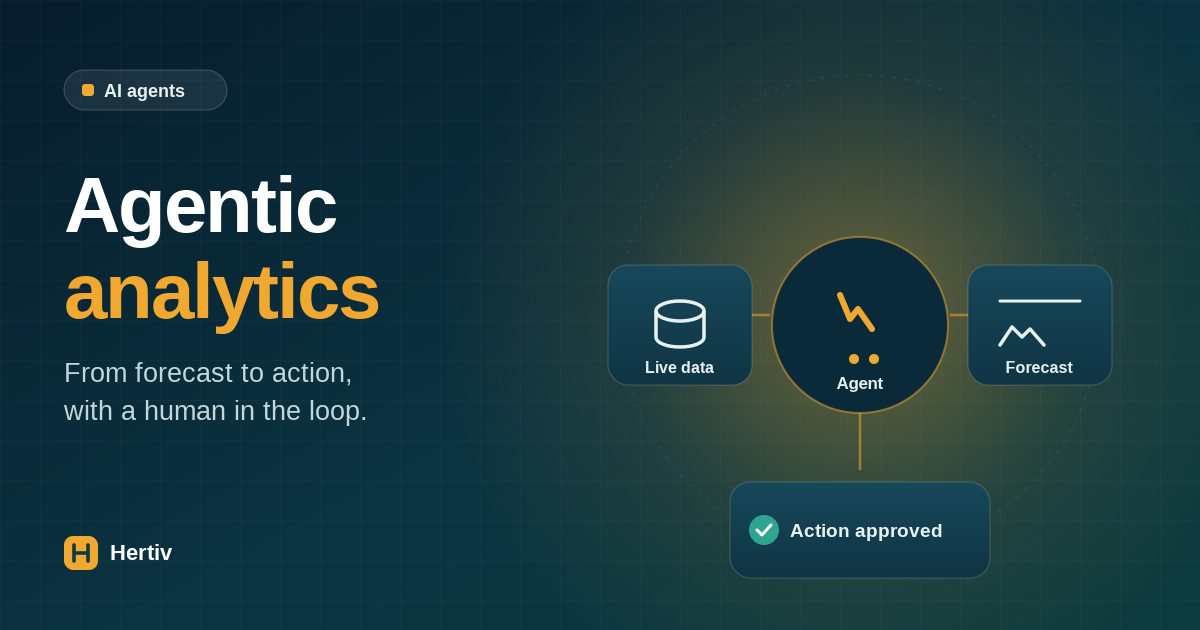
Agentic analytics is analytics run by AI agents that do more than report numbers. An agent gathers data from your systems, forecasts what is likely to happen, recommends a specific action, and, where the action is safe, carries it out. The loop runs on its own and stops for human review when a decision carries real cost.
It builds on two older kinds of analytics. Predictive analytics forecasts what will happen next, such as which customers may cancel or which parts may run out. Prescriptive analytics goes one step further and recommends what to do about it. Agentic analytics adds the agent, which runs the analysis, makes the recommendation and takes the next step without waiting for a meeting.
The difference from a dashboard is the action. A dashboard tells a manager that stock will run out in six days. An agentic system drafts the reorder, checks the budget and supplier terms, and asks for approval, or places the order if the rules allow it. That is why teams already using agents elsewhere find the same design pattern, which is covered in AI agent use cases across the business.
Predictive vs prescriptive: where do agents fit?
Predictive and prescriptive analytics answer different questions, and the agent uses both. The table below shows what each one does, what it needs and where the agent adds value.
| Type | Question it answers | What the agent adds |
|---|---|---|
| Descriptive | What happened? | Drafts the summary |
| Diagnostic | Why did it happen? | Traces the likely cause |
| Predictive | What will happen next? | Runs the forecast on schedule |
| Prescriptive | What should we do? | Ranks the options by cost and impact |
| Agentic | Who acts on it? | Carries out the safe actions itself |
The agent's job starts where prescriptive analytics stops. A prescriptive model can say 'reorder 400 units'; the agent checks the supplier, the budget and the warehouse, then acts. Without that step, the recommendation waits for someone with time to read it.
How does an agentic analytics loop work?
An agentic analytics loop runs in five steps, and each step leaves a record so a person can check what happened and why.
- Gather. The agent pulls the data it needs from sales, stock, finance or support systems.
- Forecast. It runs the predictive model and produces a forecast with a confidence range.
- Recommend. It compares the forecast with costs and rules and picks the best action.
- Act. It carries out safe actions itself and sends the rest to a human for approval.
- Review. It logs the forecast, the action and the result, so the next forecast can be checked against reality.
The review step is what keeps the loop safe. Low-risk actions, such as drafting a report or flagging a trend, can run on their own. Actions that spend money, contact customers or change prices need a human approval. That boundary should be written down, not left to the agent to guess.
Where do agentic analytics use cases work best?
Agentic analytics works best where the data already exists, the decision repeats often, and a wrong action is cheap to undo. The use cases below are the ones that hold up in practice.
| Use case | What the agent does | Why it fits |
|---|---|---|
| Demand forecasting and reordering | Forecasts stock-outs and drafts orders | Repeats weekly, easy to measure |
| Customer churn rescue | Flags at-risk accounts and drafts offers | Clear signal, human approves the offer |
| Fraud and anomaly triage | Ranks suspicious cases for review | High volume, humans decide |
| Pricing and promotions | Suggests price changes per segment | Forecast plus margin rules |
| Maintenance scheduling | Predicts failures and books service | Sensor data already collected |
| Cash flow forecasting | Projects receipts and flags shortfalls | Repeats monthly, low risk |
Demand and churn usually come first, because the data is already collected and the result is easy to measure. Maintenance and pricing follow once the team trusts the agent's forecasts.
What data and guardrails does it need?
An agent is only as reliable as the data it reads. It needs clean, current records from the systems it acts on, a history long enough to forecast from, and a clear definition of what 'good' looks like for each decision.
Guardrails matter as much as data. The agent needs scoped permissions, so it can read the systems it needs and write only where approved. It needs spending limits per action and per day, a full log of every step, and a way to stop it at once. A predictive analytics build usually starts with these controls, because they are cheaper to add at the start than after a bad action.
Privacy is part of the design too. If the agent reads customer or staff data, it should see only the fields it needs, and sensitive fields should be masked or removed before the agent reads them.
Example (hypothetical): a retailer acts on a forecast
Example (hypothetical): a retailer with 200 stores sells a popular kettle. The agent forecasts that 40 stores will run out within six days, based on sales history and the stock on hand.
The agent recommends reordering 120 kettles per store. That is 40 stores times 120 units, which is 4,800 units. Each kettle earns $8 of margin, so the reorder protects 4,800 times $8, which is $38,400 of margin that would have been lost to empty shelves.
The agent checks the budget and the supplier's lead time, then places the order, because reordering stock under $50,000 is pre-approved. It logs the forecast, the order and the margin protected. A store manager reviews the log the next morning and can cancel the order if the forecast was wrong.
What are the common mistakes?
The most common mistakes are giving the agent spending power before it earns trust, skipping the review step, and feeding it messy data.
- Starting with spending power. Begin with read-only analysis and drafts, then add approved actions one at a time.
- No human review for costly actions. Any action that spends money or contacts customers needs a named approver.
- Messy data in, confident forecasts out. Clean the source data first; the agent cannot fix bad records.
- Measuring activity, not outcomes. Count margin protected and errors avoided, not forecasts produced.
- No way to stop the agent. Every agent needs a kill switch and a named owner who can use it.
Start small and measure the result on a fixed set of decisions, so you can tell whether the agent is helping before it touches real money. A short agentic AI development engagement can set up the loop and the guardrails before the agent acts on live decisions.
Key takeaways
- Agentic analytics adds an agent that acts on forecasts, not just a dashboard that shows them
- Predictive analytics forecasts what will happen; prescriptive analytics recommends what to do
- The loop is gather, forecast, recommend, act and review, with a record at each step
- It works best where data exists, decisions repeat and a wrong action is cheap to undo
- Scoped permissions, spending limits, full logs and a kill switch are the guardrails
Frequently asked questions
What is agentic analytics?
Agentic analytics is analytics run by AI agents that gather data, forecast outcomes, recommend actions and, where safe, carry them out. It goes beyond a dashboard, which only reports numbers, by closing the loop between insight and action with a human review step for costly decisions.
How is agentic analytics different from predictive analytics?
Predictive analytics forecasts what will happen next, such as which products will run out. Agentic analytics uses that forecast, adds a prescriptive recommendation and then acts on it, for example by drafting or placing a reorder. Prediction is one step inside the agentic loop.
What is prescriptive analytics?
Prescriptive analytics recommends what to do about a forecast, such as how many units to reorder or which customers to contact. It uses the forecast plus costs, rules and constraints to rank the options. Agentic analytics takes the recommended option and carries it out where the rules allow.
Do agentic analytics systems replace analysts?
No. Analysts still define what good looks like, check the forecasts and handle the cases that need judgement. The agent handles the routine loop of gathering data, forecasting and acting on safe decisions, so analysts spend their time on the decisions that matter.
What data does agentic analytics need?
It needs clean, current records from the systems it acts on, enough history to forecast from, and a clear definition of success for each decision. If the source data is messy or out of date, the forecasts will be wrong no matter how good the agent is.
What is the first agentic analytics use case to try?
Demand forecasting and reordering is the usual start, because the data already exists and the result is easy to measure. Add churn rescue and anomaly triage next, and move to pricing and maintenance once the team trusts the forecasts.


