Agentic AI Orchestration for Banking: How It Works
Agentic AI orchestration coordinates several banking agents in order, with shared facts and approval gates. Learn the patterns, guardrails and where it fits.
On this page
Short answer
Agentic AI orchestration for banking is the system that coordinates several AI agents so they can complete a banking task together, in the right order, with the right data and the right checks. A planner breaks the task into steps, a router assigns each step to a specialist agent, and approval gates pause the workflow before any decision that moves money or changes a record.
What is agentic AI orchestration for banking?
Agentic AI orchestration for banking is the system that coordinates several AI agents so they can complete a banking task together, in the right order, with the right data and the right checks. One agent might read a document, another might check a rule, and a third might draft the reply, while the orchestration layer decides who acts next and when a person must step in.
The need comes from how banking work actually runs. A single task, such as opening a business account or reviewing a loan file, crosses documents, databases, risk rules and approval steps. A single agent cannot hold all of that safely, so banks split the work across agents and use orchestration to keep them in sync.
Orchestration is not the same as having many agents. Without it, agents repeat work, use stale data or act on steps that have not been approved. With it, each agent sees the same case, works from the same facts, and hands off cleanly. That shared state is what makes the result auditable, which matters more in banking than in most industries.
How does orchestration work in practice?
Orchestration works by treating a banking task as a workflow with defined steps, owners and checkpoints. A planner breaks the task into steps, a router sends each step to the agent best suited to it, and a shared memory keeps the case facts in one place so no agent works from a different version.
A typical flow looks like this:
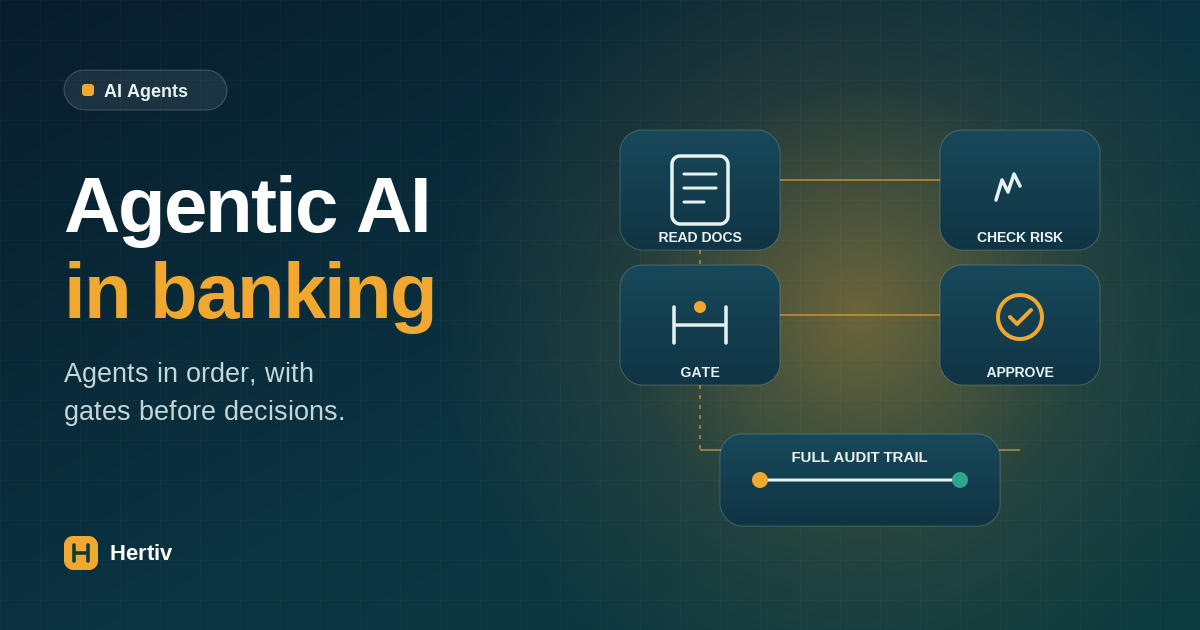
- Intake. The case arrives with documents and a request, and the planner lists the steps needed.
- Routing. Each step goes to a specialist agent: one reads documents, one checks sanctions lists, one calculates risk.
- Tool use. Agents call approved tools only, such as the core banking system or a document store, and every call is logged.
- Checkpoint. Before any decision that moves money or changes a record, the workflow pauses for a rule check or a person.
- Completion. The result is written back with a full trail of who did what and why.
The trail is the point. Regulators and auditors ask how a decision was made, and an orchestrated workflow can answer that question step by step. For teams building these systems, AI agent development work usually starts with the workflow design, not with the agents themselves.
What orchestration patterns do banks use?
Banks use four common orchestration patterns, and most real systems mix them. The choice depends on how much freedom the agents should have and how much risk each step carries.
| Pattern | How it works | Strength | Main risk |
|---|---|---|---|
| Sequential | Agents act one after another in a fixed order | Easy to audit | Slow if one step stalls |
| Parallel | Independent checks run at the same time | Fast for checks | Results must be merged carefully |
| Supervisor | One agent plans and checks the others | Flexible for varied cases | Supervisor mistakes spread fast |
| Human in the loop | A person approves key steps | Strongest control | Slower, needs staffing |
Sequential flows suit account opening and loan processing, where each step depends on the last. Parallel checks suit fraud review, where several signals can be gathered at once. Supervisor patterns suit customer service, where the request varies widely. Human-in-the-loop is used wherever money moves or a record changes.
Most banks start with sequential flows and add parallel checks later, because a fixed order is the easiest to explain to an auditor. The supervisor pattern is the hardest to govern, since the supervisor itself needs checking.
Where is orchestration used in banking?
Orchestration is used where a task crosses several systems and several rules. The most common areas are account opening, loan processing, fraud investigation, customer service and regulatory reporting, because each of these mixes documents, data checks and approvals.
- Account opening. Agents collect documents, verify identity, screen names and prepare the file for approval.
- Loan processing. Agents read financial statements, check collateral and draft the credit memo, while a person approves.
- Fraud investigation. Agents gather transaction history, device data and past cases, then present a summary for the analyst.
- Customer service. Agents answer routine questions, fetch account facts and hand off to a person with the full context.
- Regulatory reporting. Agents pull figures from several systems and check them against the reporting rules before filing.
The pattern is the same in each case: agents do the gathering and drafting, while rules and people handle the decisions. That split keeps the system useful without giving agents authority they should not have. It also matches how AI agents are used across other industries, where the agent prepares and a person decides.
What guardrails does banking orchestration need?
Banking orchestration needs guardrails because agents can act on the wrong data, call the wrong tool or skip a step. The guardrails are the rules that stop those failures before they reach a customer or a ledger.
- Scoped tools. Each agent can only call the tools its step needs, and cannot move money or change a record on its own.
- Data limits. Agents see only the case they are working on, not the whole customer base.
- Approval gates. Any step that changes money, a limit or a legal status pauses for a rule check or a person.
- Full logging. Every agent action, tool call and decision is recorded with a timestamp, so the trail can be replayed.
- Kill switches. The workflow can be paused or rolled back if an agent behaves oddly.
Guardrails also cover the model itself. Prompts and instructions should be versioned and reviewed like code, because a small change in wording can change what an agent does. A change to an agent's instructions should go through the same review as a change to a business rule.
For banks, these controls sit inside broader AI and blockchain work for finance and banking, where audit trails and access rules are already part of the job.
Example (hypothetical): orchestrating a loan document review
Example (hypothetical): a bank receives a small-business loan application with 40 pages of documents: tax returns, bank statements and a lease. The orchestration layer splits the review into four steps and assigns one agent to each.
The first agent extracts the figures from the documents. The second checks the figures against the bank statements and flags two mismatches. The third runs the sanctions and identity checks. The fourth drafts a summary for the credit officer, listing the mismatches and the checks that passed.
Suppose the manual review used to take 6 hours per file, and the orchestrated flow takes 2 hours of agent work plus 1 hour of officer review. That is 3 hours instead of 6, so the officer handles twice as many files in the same time. If the bank processes 100 files a month, the time saved is 100 files times 3 hours, or 300 hours a month.
The saving only holds if the agents are accurate. The bank samples 10 files a month and compares the agent summary against a manual check. If the sample shows a missed mismatch, the workflow is paused and the extraction step is fixed before more files run through it.
What are the common mistakes?
The most common mistakes in banking orchestration are giving agents too much freedom, skipping the audit trail, and letting agents share data across cases.
- Too much autonomy. An agent that can move money or change a record without a gate will eventually do it at the wrong time.
- No shared state. Agents working from different copies of the case produce conflicting results.
- Weak logging. Without a full trail, a wrong decision cannot be explained or fixed.
- Untested prompts. Instructions that were never tested on edge cases fail on the cases that matter most.
- Skipping the rollback plan. A workflow with no pause or rollback button is hard to stop when something goes wrong.
Key takeaways
- Orchestration is the workflow layer: planner, router, shared memory and checkpoints
- Sequential flows are easiest to audit; parallel checks are fastest for fraud review
- Agents gather and draft, while rules and people make the decisions
- Guardrails include scoped tools, data limits, approval gates and full logging
- Start with one workflow and full logging before adding more agents
Frequently asked questions
What is the difference between an AI agent and orchestration?
An AI agent is one worker that can use tools to complete a task. Orchestration is the system that coordinates several agents: it plans the steps, assigns them, keeps the shared facts in one place and pauses for approval at key points. One agent does the work; orchestration makes sure several agents do it together safely.
Why do banks need orchestration instead of one big agent?
Banking tasks cross documents, databases, risk rules and approval steps, and a single agent cannot hold all of that safely. Splitting the work across specialist agents keeps each one narrow, and orchestration keeps them in sync so they work from the same facts and hand off cleanly.
Can AI agents move money in a bank?
They should not do it on their own. In a well-built system, any step that moves money, changes a limit or alters a record pauses for a rule check or a person. Agents prepare the work and draft the action, while the decision and the authority stay with the rules and the staff.
How do banks audit an orchestrated workflow?
Every agent action, tool call and decision is logged with a timestamp, so the whole case can be replayed step by step. That trail shows which agent did what, which data it used and where a person approved. Without full logging, the workflow cannot be explained to an auditor.
What is the hardest part of banking orchestration?
The hardest part is usually the guardrails, not the agents. Scoping tools, limiting data, setting approval gates and keeping a full audit trail take more design work than connecting the agents, and they decide whether the system is safe enough to run on real cases.
How should a bank start with agentic AI orchestration?
Start with one workflow that is common, well understood and easy to measure, such as document review for account opening. Build it with a fixed order, one approval gate and full logging, then expand to more agents only after the first workflow runs cleanly for a month.


