Agentic AI Companies for Enterprises: How to Choose One
Agentic AI companies build systems that plan and act on their own. Here is what enterprises should check before choosing one.
On this page
Short answer
Agentic AI companies build systems that plan multi-step work, use tools and take actions with limited human input. For enterprises, the choice is less about the model and more about guardrails, integration and support. This guide explains what these companies offer and how to evaluate them.
What is an agentic AI company?
An agentic AI company builds software in which AI agents plan and carry out multi-step work, rather than only answering questions. An agent might check stock, draft a quote, create a ticket and notify a customer, chaining several steps together without a person doing each one by hand.
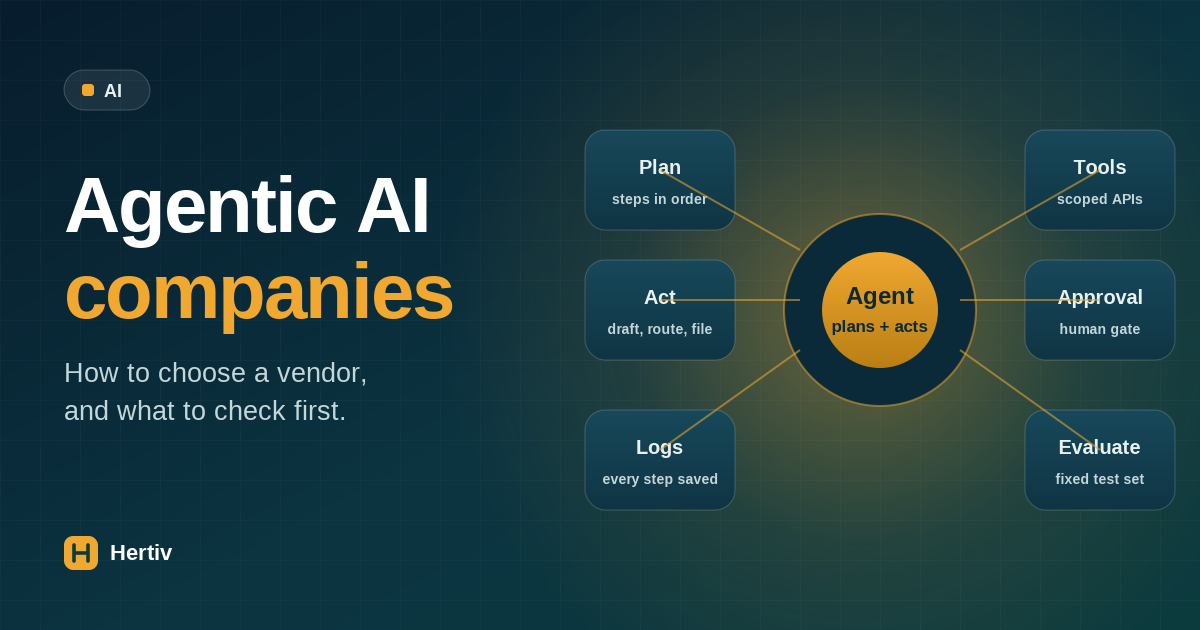
These companies differ from chatbot vendors. A chatbot answers; an agent acts. That difference changes everything about the product: agents need tool access, permissions, logs and approval gates, because a wrong action can move money, change records or message customers.
Some companies sell a finished agent product for one job, such as support triage or procurement. Others build custom agents for an enterprise, starting from a discovery phase and ending with a system running in production. A third group sells platforms and tooling that an enterprise team uses to build agents itself.
Enterprises usually need a mix: a vendor that can deliver a working agent for one workflow, and a platform the internal team can extend later. The rest of this guide explains how to tell the three types apart and what to check before signing.
What do agentic AI companies actually offer?
Most agentic AI companies offer a combination of strategy, build and support, but the balance varies. The table below shows the usual mix.
| Offer | What it includes | Who it suits |
|---|---|---|
| Discovery and design | Workflow mapping, use-case selection, guardrail design | Teams starting out |
| Custom agent build | Agents, tool integrations, approval gates, logging | One high-value workflow |
| Finished agent product | Pre-built agent for support, sales or operations | Standard workflows |
| Platform and tooling | Agent framework, evaluation, monitoring, deployment | Internal teams building agents |
| Managed operations | Monitoring, tuning, incident handling, updates | Teams without AI staff |
The offer that matters most for enterprises is rarely the model. Models change quickly, and most vendors use the same ones. What differs is how the vendor handles permissions, evaluation, integration with your systems and support when something goes wrong.
Ask each vendor to describe one agent running in production for a customer like you, including what it does, what it cannot do, and how failures are handled. A vendor that cannot describe a real deployment in those terms is selling a demo, not a product.
How to evaluate an agentic AI company
Evaluation should start with guardrails, not with a demo. A good demo shows what an agent can do when everything works. A good evaluation shows what happens when it does not.
- Check the guardrails. Ask how permissions are scoped, which actions need human approval, and how an agent is stopped.
- Ask for an evaluation set. A serious vendor tests agents on fixed real cases and can show pass rates before and after changes.
- Look at integration. Ask which of your systems the agent connects to, and whether it uses narrow APIs or broad database access.
- Review the logs. Every step, prompt, tool call and decision should be logged and reviewable.
- Test support. Ask who answers when an agent misbehaves at 2 a.m., and how fast they respond.
Run a short pilot on one workflow with a fixed success threshold, as a guide to how to build an AI proof of concept explains. If the vendor will not agree to a measured pilot, that is useful information too.
Price matters, but compare like with like. A quote that includes evaluation, integration and support is not comparable with one that covers only the build. Ask for the full first-year cost, including running and support.
What should enterprises ask about security and governance?
Security and governance decide whether an agent can run in production at all. An agent with write access to systems is a powerful identity, and it needs the same controls as a service account, plus a few more.
Ask where your data goes. Some vendors send prompts and documents to third-party model providers; others run models in your own cloud. Ask what is logged, how long logs are kept, and who can see them. If your industry has data rules, check that the vendor's setup fits them before the pilot, not after.
Ask about permissions in detail. Each agent should have its own scoped permissions, not a shared service account with broad access. Irreversible actions, such as payments, refunds or external messages, should need a human approval gate. There should be a kill switch that stops all agents quickly, and a rollback plan for actions already taken.
Governance also covers who owns the agent. Name an owner for each workflow, with responsibility for the evaluation set, the approval rules and the incident response. Without an owner, agents drift: prompts change, tools are added, and nobody notices until a failure.
For a deeper look at the control points, generative AI implementation consulting firms covers the governance patterns that apply to agents as well as to chatbots.
Example (hypothetical): choosing a vendor for support triage
Example (hypothetical): a retailer receives 400 support tickets a day and wants an agent to triage them: read each ticket, check the order, draft a reply, and route the hard cases to a person. Three vendors bid.
Vendor A offers a finished triage product with a fixed price and a two-week setup. Vendor B offers a custom build with an evaluation set and a four-week pilot. Vendor C offers a platform and training for the internal team to build it themselves.
The retailer scores them on five measures, each out of 5: guardrails, evaluation, integration, support and cost. Vendor A scores 3, 2, 4, 3, 5 for a total of 17. Vendor B scores 5, 5, 4, 4, 3 for a total of 21. Vendor C scores 4, 3, 3, 2, 4 for a total of 16. Vendor B wins, because the retailer values guardrails and evaluation over the lowest price.
In the pilot, the agent handles 150 of 400 tickets correctly on the first draft, saving about 13 hours a day after review time. The retailer expands the agent to a second workflow only after the first one runs cleanly for a month.
Common mistakes
The most common mistakes when choosing an agentic AI company are buying the demo, skipping the pilot, and giving agents broad access. Each one is avoidable with a short checklist.
- Buying the demo. A polished demo does not show failure handling, logging or support. Ask for a real deployment story.
- Skipping the measured pilot. Without a fixed success threshold, every vendor claims success.
- Broad permissions. Agents with shared service accounts and wide access are a security risk.
- No owner. An agent without a named owner drifts and nobody notices failures.
- Comparing prices without scope. A cheap build quote often leaves out evaluation, integration and support.
- Starting with payments. Begin with a workflow where a mistake is cheap, not with money or legal commitments.
If you are budgeting for an agent project, AI consulting cost gives a realistic picture of what discovery, build and support usually cost, so you can compare vendor quotes fairly.
Key takeaways
- An agentic AI company builds agents that act, not just chatbots that answer.
- Evaluate guardrails, evaluation, integration, logs and support before the demo.
- Each agent needs scoped permissions, approval gates and a named owner.
- Run a measured pilot on one workflow before expanding to more.
- Compare full first-year costs, including evaluation, integration and support.
Frequently asked questions
What is the difference between an AI agent company and a chatbot company?
An AI agent company builds systems that plan multi-step work and take actions, such as checking stock, drafting a quote and creating a ticket. A chatbot company builds systems that answer questions. Agents need tool access, permissions, logs and approval gates, which chatbots usually do not.
How much does an enterprise agentic AI project cost?
It depends on scope, integration and support. A pilot on one workflow with a measured success threshold usually costs far less than a full rollout, and it is the right first step. Ask each vendor for the full first-year cost, including evaluation, integration, running and support, so quotes are comparable.
Do we need our own AI team to work with an agentic AI company?
Not necessarily. Some vendors deliver a finished agent and operate it for you, while others build with your team or train them to extend the system. The right model depends on whether you want to own the agent long term or buy it as a service.
How do we keep agents safe in production?
Give each agent scoped permissions, require human approval for irreversible actions, log every step and decision, and name an owner for each workflow. Add a kill switch and a rollback plan. Test the agent on a fixed evaluation set before launch and keep testing after changes.
What is a good first agentic workflow for an enterprise?
A good first workflow has high volume, a clear success measure and a low cost of mistakes, such as support triage, procurement quote gathering or onboarding tasks. Avoid payments, refunds and legal commitments as a first agent, because a mistake there is expensive.
How long does it take to get an agent into production?
A pilot on one workflow usually takes a few weeks when the data and integrations are ready. Moving to production adds evaluation, guardrails, logging and change management, which take longer than the agent build itself. Plan for both, and do not skip the pilot to save time.


