Why AI Hype Runs Ahead of Real Implementation
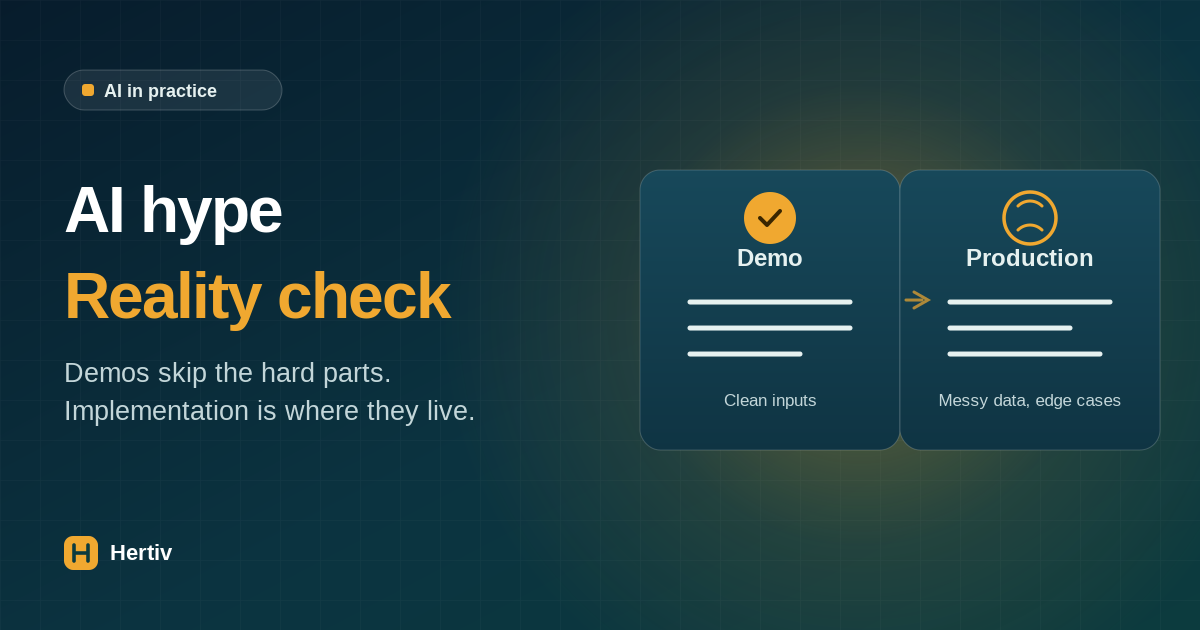
AI demos look finished because they skip the hard parts: messy data, edge cases, approvals and support. Implementation is where those parts live.
On this page
Short answer
AI hype runs ahead of implementation because a demo shows the model working on clean, chosen examples, while implementation has to handle messy data, edge cases, approvals, integration and support. The model is often the easy part; the surrounding system is what takes the time, and it is invisible in a demo.
What does it mean that AI hype exceeds implementation?
AI hype exceeds implementation when the public story about what AI can do runs ahead of what organisations have actually shipped and kept running. The gap is visible in the distance between a conference demo and a system that serves real users every day without a human fixing its output.
The hype is not dishonest, exactly. Most demos work as shown. The problem is what they leave out: the data was prepared by hand, the hard cases were avoided, nobody had to approve the decision, and no one was on call when it broke. A demo proves that a model can produce an impressive output; implementation proves that a system can produce a useful one, repeatedly, under real conditions.
That distinction explains most of the frustration. A team that buys the demo story expects a working product in weeks, then discovers the surrounding work and concludes AI does not work. The model worked. The system around it was never built.
Why do demos look further ahead than deployments?
Demos look further ahead than deployments because they control everything a deployment cannot control. The input is chosen, the data is clean, the scope is narrow, and the audience never sees the failures that were cut from the recording.
| Factor | In a demo | In production |
|---|---|---|
| Data | Clean, prepared by hand | Messy, duplicated, out of date |
| Inputs | Chosen examples | Anything users type, including abuse |
| Errors | Edited out | Reach real users and need handling |
| Approvals | None needed | Legal, security and compliance review |
| Support | Nobody on call | Monitoring, logging and a fix path |
The demo also benefits from novelty. The first time a model writes a decent draft or answers a hard question, it feels like magic, and the feeling hides the scaffolding. After the third week of real use, the feeling fades and the scaffolding is all that matters. For a grounded view of what survives contact with production, see AI proof of concept development, which starts from a fixed evaluation set rather than a demo.
What slows implementation down?
Implementation is slowed by data, integration, governance and change, in that order. Data is first because most AI systems are only as good as the documents and records they read, and those are usually duplicated, outdated or stored in five places at once.
Integration comes next. A model that works in a notebook still has to connect to the CRM, the ticketing system and the identity provider, respect their permissions, and fail safely when one of them is down. That work is ordinary software engineering, and it is where most of the calendar goes.
Governance is the step teams discover late. A system that drafts customer replies needs a policy for what it may say, who reviews it, and what happens when it is wrong. Getting that policy written and approved takes longer than building the draft feature.
Finally, change: staff have to trust the tool, learn the new workflow and stop doing the old one, and that takes training and time. An AI readiness assessment finds these gaps before a build starts, which is cheaper than finding them during one.
Which AI claims deserve the most scepticism?
The claims that deserve the most scepticism are the ones with no scope attached: a system that replaces a whole role, works on any data, or needs no human review. Real systems have a scope, a data requirement and a failure rate, and a claim that mentions none of those is a sales line, not a specification.
Watch for four patterns. First, accuracy claims without a stated test set: a number means nothing if you cannot see what was tested. Second, time savings with no baseline: saving ten minutes only matters if you know what the task took before.
Third, customer stories with no named process: a story that says a company saved money without saying which workflow changed is hard to verify. Fourth, roadmaps presented as products: a feature that will exist next quarter is not a capability today.
None of this means the technology is weak. It means the buyer has to ask the questions a demo will not answer: what data does it need, what does it get wrong, who reviews it, and what happens when it fails. Those four questions separate a real product from a good presentation.
How do you tell a real AI capability from a demo?
You tell a real AI capability from a demo by testing it on your own data, your own edge cases and your own users, with a fixed success threshold agreed in advance. If the vendor will not run that test, the capability is not proven for you, whatever the demo showed.
- Write the success threshold first. Define what good looks like in one sentence, such as fewer than one wrong answer in twenty on real tickets.
- Build a test set from real cases. Use twenty to fifty real inputs with known good outputs, including the awkward ones.
- Run the test on your data. Do not accept results from the vendor's data; your documents and customers are different.
- Count the failures, not the highlights. Read every wrong answer and ask whether it is acceptable in production.
- Test the failure path. Break the input, cut the data source, and see what the system does when it cannot answer.
That test takes days, not months, and it is the cheapest way to close the gap between hype and implementation. If the system passes, you have a real capability and a baseline to improve from. If it fails, you have learned that before spending a budget on it.
Example (hypothetical): a support chatbot pilot
Example (hypothetical): a support team handles 500 tickets a day, and each ticket takes a support agent 6 minutes to answer. That is 500 times 6, or 3,000 minutes a day, which is 50 hours of answering work every day.
A demo shows a chatbot answering the ten most common questions perfectly, and the team expects it to handle half the tickets. In the pilot, the chatbot answers 200 of the 500 tickets without help, because the other 300 involve billing disputes, account changes and edge cases the demo never showed.
The arithmetic: 200 tickets at 1 minute of review each is about 3.3 hours, plus the remaining 300 tickets at 6 minutes is 30 hours, for a total of about 33 hours a day against 50 before.
The saving is real, about 17 hours a day, but it is not the half the team expected, and it came from the easy tickets only. The demo was honest about what it showed; the team was wrong about what it implied.
What are the common mistakes?
The most common mistakes when judging AI hype are buying the demo, skipping the test set, and confusing a model with a product.
- Buying the demo. A demo proves a model can produce an output, not that a system can serve users.
- Skipping the test set. Without real cases and a fixed threshold, quality debates are anecdotal.
- Confusing a model with a product. The model is one part; data, integration, governance and support are the rest.
- Starting with the hardest workflow. The hardest case has the most edge cases and the least margin for error.
- No fallback path. When the system cannot answer, the failure reaches the user instead of a human queue.
- Measuring usage instead of outcomes. People trying a tool is not the same as the tool saving time or improving answers.
Key takeaways
- A demo proves a model can produce an output, not that a system can serve users
- Data, integration, governance and change are what take the time, not the model
- Accuracy claims mean nothing without a stated test set and a baseline
- Test on your own data and edge cases with a fixed threshold agreed in advance
- Count the failures, not the highlights, and test what happens when it cannot answer
- A real saving on the easy tickets is still a win, if you plan for it honestly
Frequently asked questions
Why does AI hype run ahead of implementation?
Because a demo shows a model working on clean, chosen examples, while implementation has to handle messy data, edge cases, approvals, integration and support. The model is often the easy part; the surrounding system is what takes the time and is invisible in a demo.
Is AI overhyped?
The capabilities are real, but the timelines are not. Systems that draft, summarise and retrieve well are in production today. Systems that replace whole roles or work on any data without review are further away than the demos suggest.
What slows AI implementation down most?
Data comes first, because most systems are only as good as the documents they read. Integration, governance and staff change follow. The model itself is rarely the bottleneck once a team has a clear workflow and a test set.
How can I tell if an AI product is real?
Test it on your own data with a fixed success threshold agreed in advance. Use twenty to fifty real cases, including the awkward ones, and read every failure. If the vendor will not run that test, the capability is not proven for you.
Should we wait for AI to get better before starting?
No. Start with one narrow workflow where output is checked and the data is ready. A small live system teaches you more about your data and governance gaps than waiting, and it gives you a baseline to improve from.
What is the most common AI implementation mistake?
Buying the demo and skipping the test set. Without real cases and a fixed threshold, teams cannot tell whether the system is improving, and quality debates stay anecdotal until something reaches a customer.


