8 Essentials of White Label Sports Betting Game Development
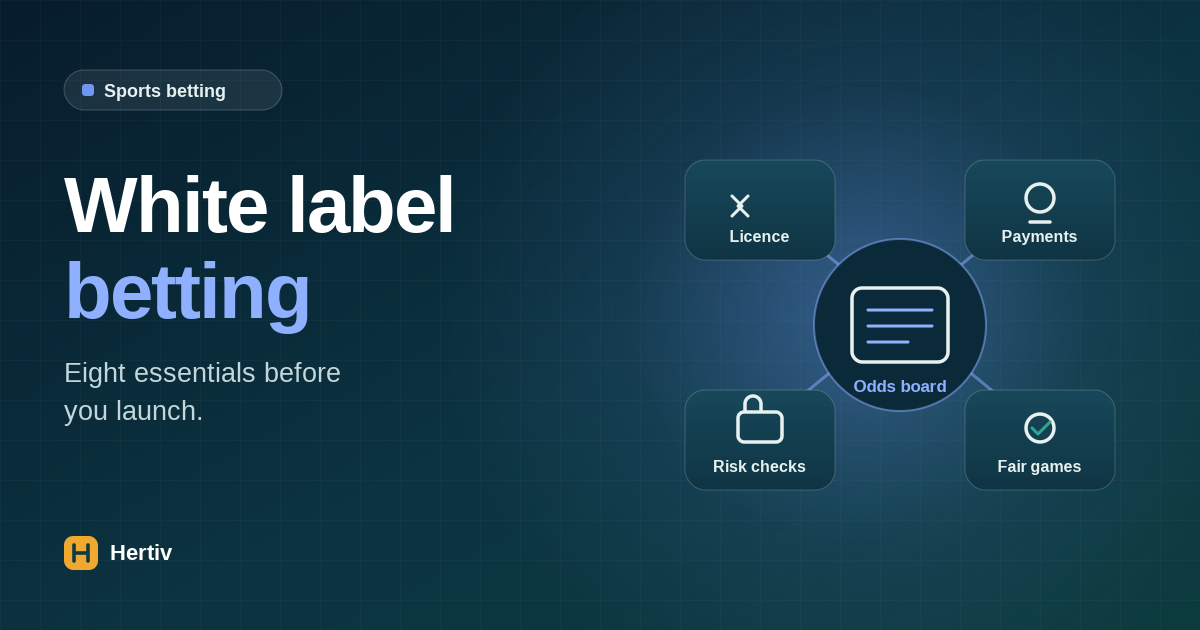
White label sports betting software lets you launch a betting product on a ready-made platform. These eight essentials decide whether it holds up after launch.
On this page
Short answer
White label sports betting game development means building a betting product on a ready-made platform instead of from scratch. The essentials are a valid licence, a reliable odds feed, secure payments, risk and fraud controls, a fair games engine, responsible gambling tools, a tested app and a support plan. Miss one and the launch stalls or the regulator stops it.
Which eight essentials matter most?
White label sports betting game development means launching a betting product on a platform that is already built, branded as your own. The eight essentials below decide whether the product launches on time, passes review and keeps players.
Use this comparison to check a provider before you sign anything.
| Essential | What it covers | Why it matters |
|---|---|---|
| Licence and compliance | Legal permission to operate | Without it you cannot take bets |
| Odds feed and markets | Live prices and events | Stale odds lose money and trust |
| Payments | Deposits and withdrawals | Slow payouts drive players away |
| Risk and fraud controls | Limits, monitoring, fraud checks | Protects the business from abuse |
| Games engine and fairness | Random outcomes, tested logic | Fairness is checked by regulators |
| Responsible gambling tools | Limits, self-exclusion, checks | Required in most markets |
| App experience | Speed, design, reliability | Players leave a slow app fast |
| Support and operations | Help desk, monitoring, updates | Problems need answers in minutes |
Check each essential against the provider's own documentation before you sign. A demo hides the gaps; a contract and a test account show them.
Licence, compliance and the odds feed
1. Licence and compliance: best for launching legally
A licence is the first essential because nothing else matters without it. The provider should hold, or help you obtain, a licence for each market you plan to enter, and the platform should support the reporting and checks each regulator requires.
Ask which licences the provider already holds and which markets are excluded. A provider that is licensed in one market may not be licensed in yours, and operating without the right licence can end the business before it starts.
What to check:
- Licences held, and the markets they cover
- Reporting tools for regulators and auditors
- Age and identity verification built into sign-up
2. Odds feed and markets: best for live betting
The odds feed is the heart of a sports betting product. It should cover the sports and leagues your players want, update fast during live events, and handle suspended markets cleanly when play stops.
Check how the feed behaves under load. A feed that lags during a big match creates bad prices, and bad prices create disputes and losses. Ask for the number of events covered and the update speed in live play.
What to check:
- Sports, leagues and markets covered
- Live update speed and suspended-market handling
- Cash-out and bet builder support, if you need them
Payments, risk and fraud controls
3. Payments: best for fast deposits and payouts
Payments decide whether players trust the product. Deposits should clear fast, withdrawals should arrive on the promised schedule, and the methods offered should match the market: cards, bank transfer, e-wallets and local options where they matter.
Payment failures are the most common support complaint in betting products. Test the full flow, including failed cards, refunds and withdrawal limits, before launch. For the wider picture, crypto payment gateway options are worth comparing where your market allows them.
What to check:
- Payment methods offered in each target market
- Deposit and withdrawal times, and the fees on each
- Chargeback handling and fraud screening on payments
4. Risk and fraud controls: best for protecting margins
Risk controls protect the business from players who exploit pricing errors, bonus abuse and multi-accounting. The platform should set betting limits, flag unusual patterns and let your team review and restrict accounts quickly.
Good risk tooling is quiet when things are normal and fast when they are not. Ask how limits are set, how alerts reach your team, and whether the provider shares liability for pricing errors.
What to check:
- Betting limits per player, market and event
- Alerts for unusual patterns and bonus abuse
- Who carries the cost of a pricing error
Games engine, fairness and responsible gambling
5. Games engine and fairness: best for trusted outcomes
The games engine produces the outcomes players bet on, so it must be random, tested and certified. Ask for the certification documents and the testing lab behind them; a provider that cannot show them is a provider to avoid.
Fairness is not only a regulatory box. Players talk, and a product with a reputation for odd outcomes loses players faster than any marketing can replace them.
What to check:
- Certification of the random number generator and games
- Which independent lab did the testing
- How game results are logged and audited
6. Responsible gambling tools: best for staying licensed
Responsible gambling tools are required in most regulated markets. The platform should offer deposit limits, loss limits, session reminders, time-outs and self-exclusion, and it should make them easy for players to find.
These tools also protect the business. A player who can set a limit stays a player; a player who cannot, leaves or causes a complaint that reaches the regulator.
What to check:
- Deposit, loss and session limits a player can set
- Self-exclusion and time-out flows
- How staff are alerted to at-risk behaviour
App experience, support and operations
7. App experience and performance: best for keeping players
Players judge a betting product in seconds. The app should load fast, place a bet in a few taps, and stay stable during live events when traffic spikes. A crash during a big match costs more than a day of marketing.
Test the app on real devices and slow networks, not only on the provider's demo. Check how odds update in play, how quickly a bet slip confirms, and what happens when the connection drops mid-bet.
What to check:
- Load time and bet placement speed on real devices
- Behaviour on slow networks and after a dropped connection
- Crash and uptime reporting you can actually read
8. Support and operations: best for launch week and beyond
Support and operations cover the help desk, monitoring and updates after launch. Your team needs a way to answer player questions, fix payment issues and push fixes fast, especially in the first weeks.
Ask what the provider handles and what falls to you. Some providers run support and monitoring for you; others hand you the platform and a dashboard. The cheaper option is not cheaper if your team has to build an operations desk from scratch.
What to check:
- Who runs player support, and in which languages
- Monitoring, alerts and incident response times
- How updates and new markets are rolled out
How to choose a white label sports betting provider
Choose a white label provider by testing the product, not by reading the sales deck. A provider that survives a structured check is worth the price; one that only survives a demo is not.
- List your markets and licence needs first. If the provider cannot operate where you need to, nothing else matters.
- Get a test account and place real bets. Test deposits, withdrawals, live odds and a dropped connection.
- Read the contract for liability. Check who pays for pricing errors, downtime and compliance failures.
- Ask for certification documents. Games, random number generation and payment security should all be certified.
- Talk to an existing operator. Ask what broke in the first three months and how fast it was fixed.
Take the time to do this before signing. A provider switch after launch costs far more than a careful check before it. If you are scoping the wider build, how to create a mobile app for business covers the sequence from first version to store release.
What are the common mistakes?
The most common mistakes are skipping the licence check, trusting a demo instead of a test account, and underestimating the operations work after launch.
- Assuming one licence covers every market. It does not; each market has its own rules.
- Choosing on price alone. The cheapest platform often shifts support and risk costs onto you.
- Ignoring payment testing. Withdrawal delays are the fastest way to lose players.
- No responsible gambling plan. Regulators check this before and after launch.
- No launch-week operations plan. Traffic spikes and payment issues arrive together.
Keep the checklist in this article and work through it with each provider you shortlist. The one that passes the most checks is usually the one that costs least over the first year. For the build itself, mobile app development covers the app side of the product.
Key takeaways
- A licence is the first essential; without it you cannot take bets
- Test the odds feed, payments and risk controls on a real account, not a demo
- Responsible gambling tools are a licence requirement, not a nice extra
- App speed and stability during live events decide whether players stay
- Choose the provider that passes the most checks, not the cheapest one
Frequently asked questions
What is white label sports betting software?
White label sports betting software is a ready-made betting platform that a company brands as its own. It includes the odds feed, bet slip, payments, risk controls and admin tools, so the operator focuses on marketing and players instead of building the platform.
How much does a white label sports betting platform cost?
Costs vary by provider, market and features, and most providers quote per project. Ask for the setup fee, monthly fee, revenue share and payment costs in writing, and check what support and updates are included before you compare prices.
Do I need a gambling licence to use white label software?
Yes, in almost every market. Either you hold the licence or the provider operates under its own licence for you. Check which model applies in each market you plan to enter, because the rules differ by country.
How long does it take to launch a white label betting product?
A launch typically takes weeks to a few months, depending on licensing, payment setup and customisation. Licence applications and payment contracts are usually the slowest parts, so start them before the app work.
What is the difference between white label and building from scratch?
White label means you launch on a ready-made platform with your branding; building from scratch means you design and code the odds, payments and risk systems yourself. White label is faster and cheaper to start, while a custom build gives more control.
Can a white label platform handle live betting?
Most modern white label platforms support live betting, but the quality varies. Test the odds update speed and bet placement during a live event on a real account, because a slow feed during a big match creates bad prices and disputes.


