White Label HR and Payroll Software Cost in Australia
White label HR and payroll software lets you sell a ready-made platform under your own brand. Learn what it costs in Australia and how to budget for it.
On this page
Short answer
White label HR and payroll software in Australia costs a one-off setup and branding fee, a monthly per-employee platform fee, and extra charges for integrations, customisation and support. Australian compliance, including Single Touch Payroll, superannuation and award rates, is the biggest cost driver, so confirm it is included before signing.
What is white label HR and payroll software?
White label HR and payroll software is a ready-made platform for managing staff records, leave, timesheets and pay runs that a company rebrands and sells as its own product. The vendor builds and maintains the software, while the buyer puts its own name, logo and pricing on it.
It differs from off-the-shelf software, which you use as it is, and from custom software, which you build from scratch. White label sits between the two: you get a working product quickly, with some control over branding and configuration, but the core features and roadmap belong to the vendor.
For Australian buyers, the software must handle local rules such as Single Touch Payroll reporting to the tax office, superannuation calculations and award-based pay rates. A platform that works in another country may not cover these, so local compliance is the first thing to check.
What does white label HR and payroll software cost to build in Australia?
White label HR and payroll software in Australia usually costs a buyer in setup fees, a per-employee monthly fee, and optional customisation work, rather than a single build price. The vendor has already built the platform, so you pay to brand it, configure it and connect it to your systems.
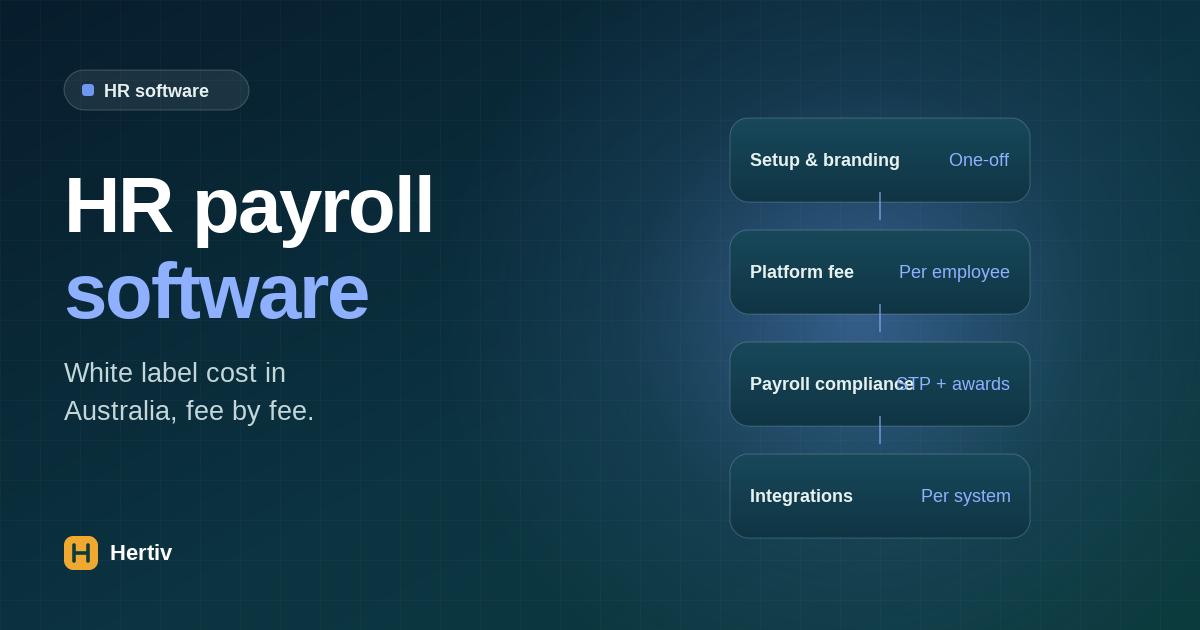
Costs vary widely by vendor and by the number of employees you serve, so treat any figure as a range to confirm with the vendor. The table below shows the cost parts you should expect in a quote.
| Cost part | What it covers | How it is charged |
|---|---|---|
| Setup and branding | Logo, colours, domain, initial configuration | One-off fee |
| Platform fee | Access to the HR and payroll system | Monthly, per employee |
| Payroll compliance | Single Touch Payroll, super, awards | Included or add-on |
| Customisation | Extra fields, reports, workflows | Quoted per job |
| Integrations | Accounting, rostering, time tracking | Per integration |
| Support and training | Helpdesk, onboarding, documentation | Monthly or per hour |
Always ask for the total first-year cost in writing, including every fee above. A low per-employee price can hide expensive setup or integration charges that appear later.
White label vs custom build: which fits?
White label fits when you need a working HR and payroll product quickly and your customers accept standard features. A custom build fits when your product needs workflows or compliance handling that no white label platform offers.
White label usually reaches market in weeks rather than months, because the core is already built and tested. The trade-off is control: you cannot change how payroll is calculated or how leave approvals work beyond the vendor's configuration options. If a customer needs a feature the platform lacks, you wait for the vendor's roadmap.
A custom build gives full control but costs far more and takes longer, since you must build payroll rules, tax reporting and award logic yourself. For most resellers, white label is the right start, with a custom build only when the product's core value is a feature the vendor cannot offer.
What Australia-specific costs should you budget for?
Australia-specific costs come from compliance: Single Touch Payroll reporting, superannuation guarantee calculations, award interpretation and state-based payroll tax rules. A platform that does not handle these natively will cost you extra in manual work or custom development.
Check four things before signing. First, does the platform lodge Single Touch Payroll reports in the format the tax office expects? Second, does it calculate superannuation on the right pay components? Third, can it apply award rates and penalties for your customers' industries? Fourth, does it keep an audit trail that an accountant can follow?
Also budget for local support. Payroll questions are time-sensitive: a pay run that fails on a Friday cannot wait until Monday. Confirm the vendor's support hours in Australian time and whether payroll help is included or charged separately.
Example (hypothetical): a Brisbane reseller launches white label payroll
Example (hypothetical): a Brisbane company wants to sell HR and payroll software to small businesses. It chooses a white label platform and budgets for the first year.
The setup and branding fee is $12,000. The platform fee is $6 per employee per month, and the company expects to serve 200 employees in year one, which is $1,200 a month or $14,400 a year. Two integrations, one for accounting and one for rostering, cost $4,000 each, so $8,000. Training and support add $3,600 for the year.
The first-year total is $12,000 plus $14,400 plus $8,000 plus $3,600, which is $38,000. The company also keeps a $5,000 reserve for custom reports customers ask for, bringing the planned spend to $43,000. The arithmetic shows why the per-employee fee is only part of the story: setup and integrations are more than half of the first-year cost.
By month six the company reviews the numbers. If employee count grows to 400, the platform fee doubles to $2,400 a month, so the second-year budget must rise even though setup does not repeat.
How do you control the budget in 5 steps?
Control the budget by fixing the scope before you sign, then tracking the per-employee cost as your customer base grows.
- List must-have features. Separate compliance needs from nice-to-have features and refuse to pay for the second group in year one.
- Get three written quotes. Compare the total first-year cost, not the headline per-employee price.
- Cap customisation. Agree a fixed budget for extra work and require written approval before it is spent.
- Test with one customer. Run a single pay cycle end to end before onboarding the rest.
- Review quarterly. Check the per-employee cost and the support hours used, and renegotiate if either is climbing.
A short pilot with one customer teaches you more about the true cost than any vendor demo. If you need help scoping the build, SaaS development covers how to plan a software product budget.
What are the common mistakes?
The most common mistakes are buying on the per-employee price alone, skipping a payroll test run, and assuming Australian compliance is included.
- Ignoring total cost. Setup, integrations and support often cost more than the platform fee in year one.
- No test pay run. A platform that cannot run your customer's award correctly will cost you in manual fixes.
- Assuming compliance. Not every white label platform handles Single Touch Payroll or awards out of the box.
- Unlimited customisation. Agreeing to every customer request turns a white label product into a custom build.
- Weak support terms. Payroll failures need same-day help, not a ticket queue.
- No exit plan. Check how you export customer data if you leave the vendor.
Key takeaways
- White label means a ready-made platform you rebrand, not software you build
- First-year cost is setup plus per-employee fees plus integrations and support
- Single Touch Payroll, super and awards are the key Australian cost drivers
- Compare total first-year cost across vendors, not the headline per-employee price
- Run one full pay cycle with a real customer before onboarding the rest
Frequently asked questions
How long does it take to launch white label HR and payroll software?
Most vendors can brand and configure a platform in a few weeks, since the core software already exists. The longer part is usually testing: a full pay cycle with a real customer's awards and pay rules takes at least one pay period to validate.
Is white label payroll software cheaper than a custom build?
Usually yes in year one, because you are not paying to build payroll rules, tax reporting and award logic from scratch. A custom build only makes sense when your product needs features no white label platform offers.
What is Single Touch Payroll and why does it matter?
Single Touch Payroll is the Australian requirement to report pay, tax and superannuation details to the tax office each time you run payroll. Any platform you sell in Australia must lodge these reports correctly, or your customers face compliance problems.
Can I switch vendors later if I use white label software?
It depends on the contract. Ask before signing how customer data is exported, what format it comes in, and whether there are exit fees. A vendor that cannot answer clearly is a risk to your customers.
Do I need an Australian vendor for Australian payroll?
Not necessarily, but the platform must handle Australian rules natively. A vendor without local payroll experience often leaves Single Touch Payroll and award handling to you, which adds cost and risk.
What support should I expect from a white label vendor?
At minimum, same-day help for payroll failures and a named contact during Australian business hours. Check whether payroll support is included in the platform fee or charged separately, and get the response times in writing.


