What Is Tokenization in NLP, and Why Does It Matter?
Tokenization in NLP splits raw text into tokens before a model can read it. Learn the main methods, why token counts drive cost, and how to manage them.
On this page
Short answer
Tokenization in NLP is the step that splits raw text into smaller pieces, called tokens, before a language model can work with it. A token can be a whole word, part of a word, a punctuation mark or a single character, and each token is mapped to a number the model understands.
What is tokenization in NLP?
Tokenization in NLP is the step that splits raw text into smaller pieces, called tokens, before a language model or a text-processing system can work with it. A token can be a whole word, part of a word, a punctuation mark or a single character, depending on the method used.
Models do not read sentences the way people do. They work with numbers, so every piece of text must first be turned into a list of tokens, and each token is then mapped to a number in the model's vocabulary. That list is the input the model actually sees.
Tokenization is not the same as the tokenization used for assets on a blockchain, where a token stands for ownership of something real. In NLP, a token is simply a unit of text. The two ideas share a name and nothing else, which is a common source of confusion when teams talk across departments.
How does tokenization work?
Tokenization works by applying a fixed set of rules or a learned vocabulary to a string of text, cutting it into pieces that the model knows. The tokenizer is trained on a large body of text, so the pieces it produces reflect the words and word parts that appear most often in that training data.
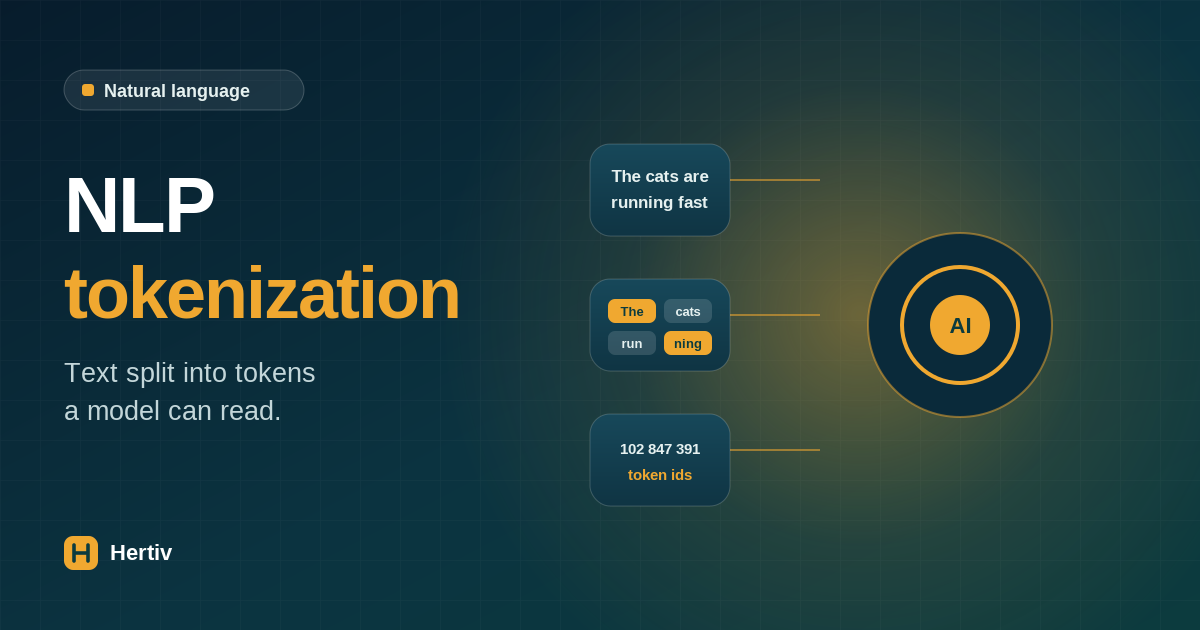
A simple example shows the idea. The sentence "The cats are running" might become the tokens ["The", " cats", " are", " run", "ning"]. The word "running" is split into "run" and "ning" because those parts appear often enough to be worth keeping as separate tokens.
The tokenizer also adds special tokens, such as a marker for the start or end of a text, and it handles spaces, line breaks and punctuation. Once the text is a list of token numbers, the model can process it in fixed-size chunks, which is what makes training and inference practical.
Teams building text features usually start with NLP development advice, because the tokenizer choice affects everything downstream, from the data pipeline to the cost of each request.
What are the main tokenization methods?
There are three main tokenization methods, and they differ in how small the pieces get. Word tokenization splits on spaces and punctuation, which is simple but breaks on new or misspelled words. Subword tokenization splits words into common parts, which handles new words better. Character tokenization splits into single letters, which never fails on a new word but makes sequences very long.
| Method | How it splits | Strength | Weakness |
|---|---|---|---|
| Word | On spaces and punctuation | Simple to read and debug | Breaks on unseen words |
| Subword (BPE) | Into common word parts | Handles new words well | Pieces are harder to read |
| Character | Into single letters | Never fails on a new word | Very long sequences |
| SentencePiece | Learned subwords, no spaces needed | Works for many languages | Needs training data |
Most modern language models use subword methods such as byte-pair encoding, usually shortened to BPE, or SentencePiece. BPE starts with single characters and merges the most common pairs until the vocabulary reaches a set size. SentencePiece treats the text as a raw stream, which helps for languages that do not use spaces between words.
The method matters because it decides the vocabulary size and the length of each sequence. A word-level tokenizer needs a huge vocabulary to cover rare words, while a character-level one needs almost no vocabulary but turns every sentence into a long list of tokens.
Why does tokenization matter for your product?
Tokenization matters because it decides how much text fits in the model's context window, how much each request costs, and how well the model handles your users' language. A model charges and counts by tokens, not by words, so the tokenizer is part of the bill.
Three effects show up in real products. First, the same sentence can cost a different number of tokens in different languages, because the tokenizer was trained mostly on one language. Second, a long document can exceed the context window once it is tokenized, even if it looks short in words. Third, splitting a word in an odd place can change what the model does with it, which matters for names, codes and technical terms.
These effects are easy to miss in testing and expensive to fix later. A team that counts tokens during the pilot, rather than after launch, avoids the surprise of a feature that costs twice as much as planned.
Where tokenization meets real users, real-world NLP examples show how the choice plays out in support, search and document work.
How do you count tokens and manage cost?
Count tokens with the tokenizer that your model actually uses, not with a word count. A rough rule of thumb is that one token is about four characters of English text, but that is only a planning guide: code, numbers and other languages tokenize very differently.
- Use the model's own tokenizer. Most providers publish a tokenizer tool or library; test your real prompts and documents through it.
- Measure your worst case. Take the longest realistic input, tokenize it, and check it against the context limit and the price per token.
- Trim before you send. Cut repeated headers, old chat history and boilerplate from the prompt before tokenizing.
- Cache what repeats. If the same instructions go out with every request, keep them short and reuse them rather than re-sending long text.
- Track tokens per user. Log token counts with each request so you can see which features and users drive the bill.
See vendor site for current token pricing, because rates differ by model and change often. The counting habit matters more than the exact price: once you can see tokens per request, you can decide where to trim.
Example (hypothetical): a support chatbot's token bill
Example (hypothetical): a company runs a support chatbot that answers 1,000 customer messages a day. Each message, with its instructions and retrieved help text, averages 800 tokens in and 200 tokens out, so 1,000 tokens per message.
The arithmetic: 1,000 messages × 1,000 tokens = 1,000,000 tokens a day, or 30,000,000 tokens in a 30-day month. If the model charges $1 per million tokens in and $3 per million out, the cost is $0.80 a day in plus $0.60 a day out, which is $1.40 a day, or about $42 a month.
Now suppose the team trims the retrieved help text and the chat history so each message uses 500 tokens in and 150 out. That is 650 tokens per message, or 650,000 a day. The cost falls to $0.50 a day in plus $0.45 a day out, which is $0.95 a day, a saving of $0.45 a day, or about $13.50 a month.
The team can see from these numbers that token trimming is worth more than haggling over the model price. The same logic applies to any feature that sends text to a model on every request.
What are the common mistakes?
The most common mistakes with tokenization are counting words instead of tokens, using the wrong tokenizer to estimate cost, and ignoring how other languages tokenize.
- Counting words, not tokens. A 500-word document can be 700 tokens or 1,500, depending on the text.
- Estimating with a different tokenizer. Each model has its own tokenizer, so a count from one model does not apply to another.
- Ignoring other languages. Text in a language the tokenizer rarely saw can take far more tokens than the same meaning in English.
- Sending the whole history every time. Long chat histories are the fastest way to blow the context window and the budget.
- Forgetting special tokens. Start, end and formatting markers add tokens that do not appear in the visible text.
Key takeaways
- Tokenization turns text into numbered tokens a model can process
- Subword methods such as BPE handle new words better than word splitting
- Models charge and count by tokens, not by words
- Count tokens with the model's own tokenizer, not a word count
- Trim prompts and chat history to cut token cost without changing the model
Frequently asked questions
Is tokenization in NLP the same as asset tokenization?
No. In NLP, tokenization splits text into pieces called tokens so a model can process it. In blockchain, tokenization turns ownership of a real asset into a digital token. The two ideas share a name and nothing else, which is why teams from different departments often talk past each other.
How many tokens is a word?
There is no fixed answer. As a rough guide, one token is about four characters of English text, so a typical English word is about one token. Code, numbers and other languages tokenize very differently, so always measure with the model's own tokenizer on your real text.
What is the difference between BPE and SentencePiece?
Both are subword methods that split words into common parts. BPE starts with single characters and merges the most common pairs until the vocabulary reaches a set size. SentencePiece treats text as a raw stream without assuming spaces, which helps for languages that do not use spaces between words.
Why do some languages cost more tokens?
Tokenizers are trained mostly on the languages that dominate their training data, so those languages split into fewer, larger tokens. A language the tokenizer rarely saw splits into many small pieces, so the same meaning costs more tokens and more money.
Do I need to choose a tokenizer for my product?
Usually you use the tokenizer that comes with the model you picked, so the choice is made for you. The work is to measure with it: count tokens on your real inputs, check the context limit, and trim prompts and history before you send them.
What happens if my text exceeds the context window?
The model will cut off the extra tokens, usually from the start or the end, depending on the setup. That can remove the instructions or the most recent message. Check the token count before sending, and trim history or split long documents into chunks.


