What Is Serverless? A Clear Guide for Engineering Leaders
Serverless is a cloud model where you deploy code and events trigger it, with no servers to manage. Learn how it works, real trade-offs, and when to use it.
On this page
Short answer
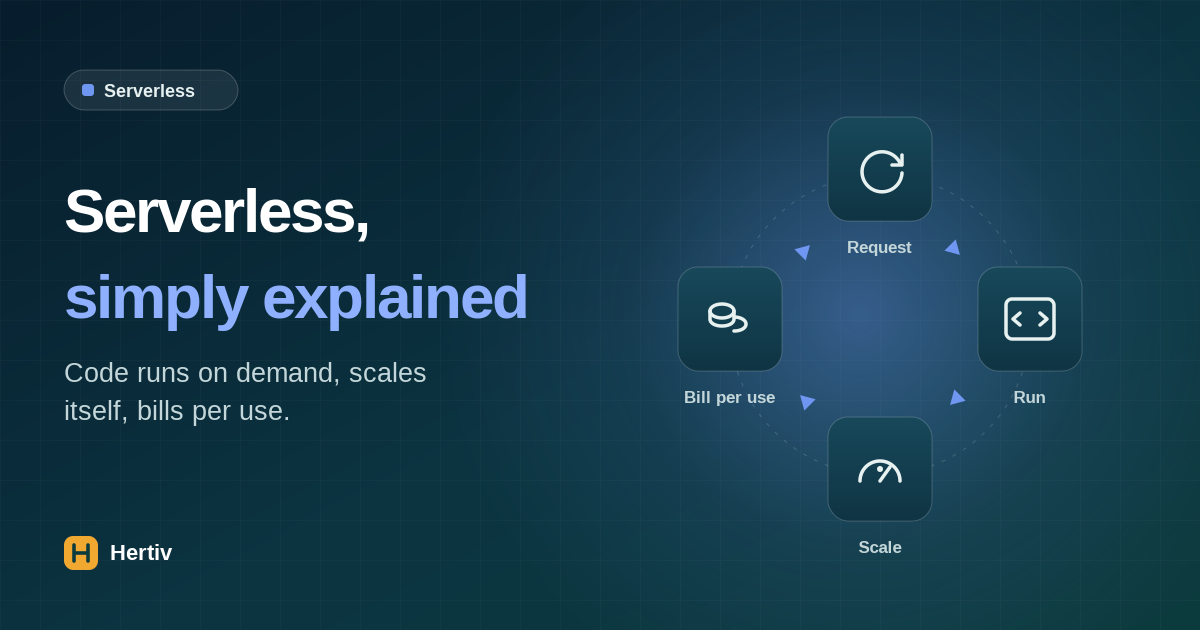
Serverless is a cloud execution model where the provider runs your code on demand in response to events, scales automatically, and bills per use. You manage functions, configuration and data, not servers, operating systems or idle capacity.
Serverless in plain terms
Serverless is a cloud model where you deploy functions or managed services, and the provider runs them on demand without you provisioning or patching servers. "Serverless" does not mean no servers exist; it means you do not manage, scale or pay for idle servers.
The core idea is event-driven execution. A request, a file upload, a queue message, a schedule or a database change triggers code that runs for as long as it needs, then stops. The provider handles capacity, patching and availability across its infrastructure.
Billing follows usage: typically requests plus compute time measured in small increments, and managed services such as queues, object storage or managed databases billed separately. That shifts spending from reserved capacity to per-execution cost, which is an advantage for spiky or low-volume workloads and can be more expensive for steady, high-throughput ones.
It helps to separate two meanings that often get mixed up. Function-as-a-service (FaaS) is the runtime model: upload a function, it runs on an event. Serverless also covers managed services that need no capacity planning, such as object storage, message queues, managed databases and API gateways. Most real systems combine both.
How serverless works under the hood
A serverless platform accepts your code package or container image, stores it, and starts an isolated runtime when an event arrives. The platform decides where to run it, handles scaling and shuts the runtime down when idle.
A simplified flow:
- An event arrives: an HTTP request, a queue message, a scheduled trigger or a file upload.
- The platform routes it to a function instance, starting a new sandbox if none is warm.
- Your handler runs with a time limit and memory ceiling, using environment configuration for secrets and settings.
- The result is returned or written to a downstream service, and the instance may stay warm for a short period before being reclaimed.
The startup time for a new sandbox is the cold start. It varies with runtime, package size and platform. Keeping dependencies small, avoiding heavy initialization and using provisioned concurrency where available reduces its effect. Long-lived connections and in-memory caches are unreliable because instances are ephemeral, so state belongs in a database, cache or object store.
Observability needs deliberate setup: structured logs, traces across functions and queues, and metrics per function. Without it, distributed event chains are hard to debug.
Where serverless fits well
Serverless fits event-driven, bursty or low-baseline workloads where managing servers adds cost without adding value.
Typical fits:
- HTTP APIs with unpredictable or low traffic. A small team can run an API without capacity planning or a container platform.
- Background processing. Image resizing, document parsing, video transcoding triggers, PDF generation and report jobs.
- Scheduled tasks. Cron-style jobs, data syncs, cleanup and reminder emails.
- Webhooks and integrations. Receiving events from payment providers, CRMs or messaging platforms and forwarding them.
- Glue between managed services. Transforming events, fan-out to queues and writing to storage.
- AI and data pipelines. Preprocessing documents, calling a model endpoint and storing results, with concurrency managed by the platform.
It is a poor default for long-running compute, steady high-throughput services where per-request pricing is higher than reserved capacity, or workloads that need custom kernels, specific networking or persistent local state. A useful rule is to start with managed containers or a platform service for the core product and use serverless for the edges and background work around it.
If your team is weighing this against broader platform choices, a review with software engineering services can help map workloads before committing.
The trade-offs that matter in production
Serverless removes server management but introduces different constraints, and those constraints should be designed for, not discovered later.
- Cold starts and tail latency. Fast responses on average can hide slow p99 latency when sandboxes start. Keep packages small and keep initialization cheap.
- Execution limits. Time limits and memory ceilings vary by platform. Long jobs need chunking, queues or a different runtime.
- Local development and testing. Emulators approximate the platform but do not match it. Integration tests against a real environment cost time and money.
- Vendor coupling. Triggers, identity, queues and storage APIs are provider-specific. Abstracting them costs effort; ignoring them raises migration cost.
- Distributed debugging. Many small functions mean many logs and traces. Invest in correlation IDs and dashboards early.
- Cost surprises. High request volume, heavy invocations, retries and data transfer can add up. Monitor cost per feature, not just total spend.
When not to use serverless
Serverless is the wrong tool when workload shape or control requirements conflict with its model.
Signals to choose containers, virtual machines or managed platform services instead:
- Long-running or stateful compute. Model training, video processing at scale, websocket servers or anything needing persistent memory.
- Predictable high throughput. If traffic is steady and high, reserved capacity or containers are usually cheaper and simpler to reason about.
- Strict latency budgets. Where p99 needs to be very tight and cold starts are unacceptable.
- Special networking or hardware. Custom protocols, static IPs, GPUs, specific kernels or on-premises connectivity.
- Heavy regulatory or data residency requirements that conflict with the provider's shared model, if you cannot meet them through region and configuration choices.
A pragmatic pattern is to place serverless at the edges, for webhooks, scheduled jobs and async processing, and run the core product on containers with autoscaling. That keeps the operational savings while avoiding the constraints where they hurt. The decision is per workload, not per company.
Example: a document intake pipeline
Example (hypothetical numbers, for illustration only): a mid-size operations team receives documents by email and needs them parsed, classified and stored.
A serverless design: an inbound email or upload event writes the file to object storage; that triggers a function that extracts text; a second function classifies the document and writes the result to a database; a queue handles retries; a scheduled function produces a daily summary. The team writes four small functions and one queue configuration.
Now estimate traffic and cost shape with labelled assumptions: if the team processes 300 documents a day and each pipeline run takes about 30 seconds of total function time, that is roughly 9,000 function-seconds per day, plus storage and queue requests. With duplicates from retries, budget more rather than less. If a single document needed 20 minutes of processing, the same design would hit time limits and would need chunking or a container-based worker.
The practical lesson is that serverless rewards small, idempotent units with clear inputs and outputs. If the natural unit of work is large and stateful, the model fights you.
How to evaluate serverless for your team
Decide per workload, with explicit criteria, and pilot before committing the architecture.
- List workloads and their shape. Note traffic pattern, duration, memory, state and latency budget for each. Serverless rarely applies to all of them.
- Check the constraints against the platform limits. Confirm execution time, payload size, connection limits and regional availability for the services you need.
- Estimate cost under realistic load and retries. Include invocation count, memory setting, data transfer and the managed services around the function. Compare with container alternatives.
- Plan observability and testing first. Set up structured logs, traces, correlation IDs and a staging environment before the first production function.
- Set a migration guardrail. Keep business logic in plain code with thin handlers so a move to containers stays feasible.
For broader architecture decisions, our custom software development team works with product and engineering leads on these trade-offs. More guides sit in the blog.
Key takeaways
- Serverless means event-triggered code on managed infrastructure, billed by execution time and requests rather than reserved capacity.
- It fits bursty, event-driven workloads such as APIs at low traffic, file processing, scheduled jobs and webhooks.
- Cold starts, execution time limits, local testing friction and vendor coupling are the main engineering trade-offs.
- Choose serverless for glue code and unpredictable traffic; use containers or managed services for steady, long-running or latency-sensitive workloads.
Frequently asked questions
Is serverless the same as cloud computing?
No. Cloud computing covers renting servers, storage and managed services. Serverless is a subset where the provider runs code on demand and you do not provision or manage servers, scaling or capacity.
Does serverless mean there are no servers?
Servers still exist; you just do not manage them. The provider handles hardware, patching, scaling and availability across its regions. Your responsibility is code, configuration, data and access control.
What is a cold start in serverless?
A cold start is the extra time a platform takes to start a fresh runtime for a function because no warm instance is available. It adds latency to that request. Smaller packages and lower initialization work reduce its effect.
Is serverless cheaper than containers?
It depends on traffic shape. Serverless is often cheaper for spiky, low-baseline workloads because you pay per use. For steady high throughput, reserved containers are often cheaper and easier to predict.
Can serverless run AI workloads?
Yes, for orchestration around model calls: preprocessing, calling model endpoints, post-processing and storing results. Long training jobs or GPU-heavy inference usually need containers or dedicated infrastructure instead.
How do I stop vendor lock-in with serverless?
Keep business logic in plain code with thin handler wrappers, isolate provider-specific calls behind interfaces, and use infrastructure as code. Full portability has a cost, so decide which services are worth abstracting.


