What Is SCM? Supply Chain Management Explained
Supply chain management (SCM) plans, buys, makes and delivers goods so the right product reaches the right place on time. Here is how the chain works.
On this page
Short answer
Supply chain management, or SCM, is the planning and control of how goods move from raw materials to the finished product in a customer's hands. It covers sourcing, production, warehousing, transport and returns, and its goal is to keep costs down while keeping products available when customers want them.
What is supply chain management?
Supply chain management is the planning and control of how goods move from raw materials to the finished product in a customer's hands. It covers sourcing, production, warehousing, transport and returns, and its goal is to keep costs down while keeping products available when customers want them.
SCM stands for supply chain management, and the word "chain" describes the sequence of steps and companies involved: a supplier sells materials to a manufacturer, the manufacturer ships to a warehouse, the warehouse ships to a shop or a customer. Each link depends on the one before it, so a delay at one step ripples through the rest.
The work is mostly planning and coordination. Teams forecast demand, decide how much to order, choose suppliers, schedule production, and arrange transport. When the plan is wrong, the result is either empty shelves or warehouses full of stock nobody wants.
SCM matters to more than manufacturers. Retailers, hospitals, food companies and software sellers all run supply chains, even when the "product" is a part, a meal or a device. The same planning ideas apply, which is why AI in supply chain management is now a common topic.
What are the five stages of SCM?
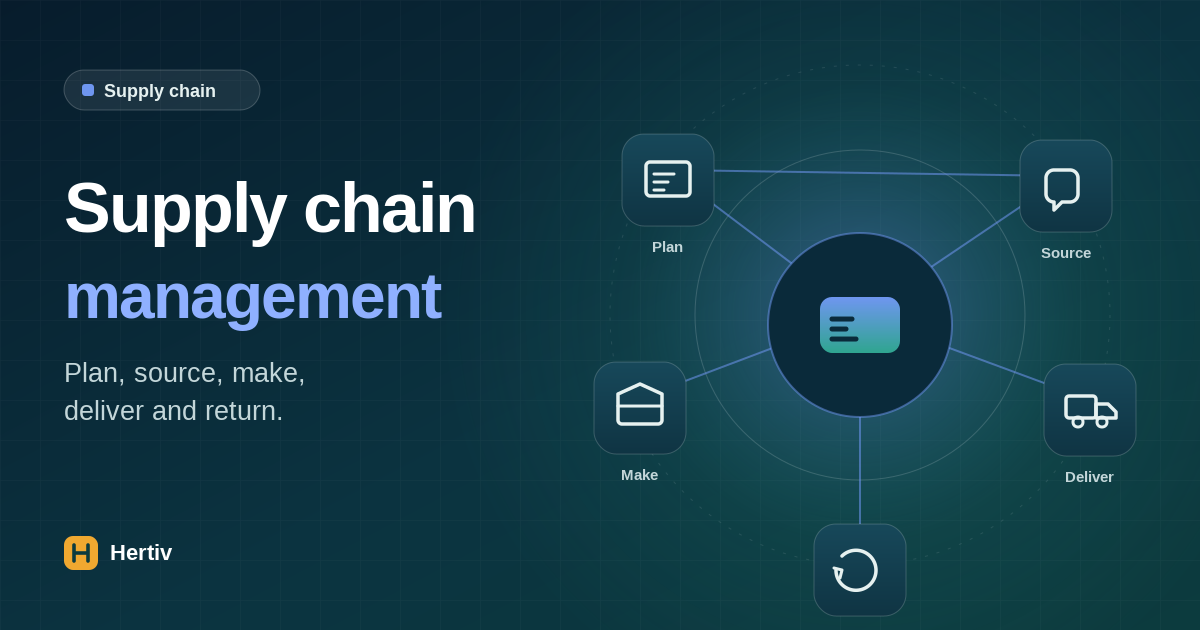
The five stages of SCM are plan, source, make, deliver and return. Each stage has its own decisions, and a problem in one stage shows up as cost or delay in the next.
| Stage | What happens | Key decision |
|---|---|---|
| Plan | Forecast demand and set stock levels | How much to hold, and where |
| Source | Choose suppliers and place orders | Which suppliers, at what price |
| Make | Produce or assemble the product | When to run each batch |
| Deliver | Move goods to shops or customers | Which routes and carriers |
| Return | Handle faulty or unwanted goods | Repair, resell or scrap |
Planning sits above the other four stages: a good forecast makes sourcing, production and delivery cheaper, while a bad one forces each stage to improvise. Most SCM improvement work starts with better planning, not faster trucks.
How does SCM differ from logistics?
SCM differs from logistics in scope: logistics covers the movement and storage of goods, while SCM covers the whole chain from planning and sourcing to delivery and returns. Logistics is one part of SCM, not a synonym for it.
A logistics team asks how to move a shipment from a warehouse to a shop at the lowest cost. An SCM team asks whether the shipment should exist at all: how much to make, where to store it, which supplier to use, and what to do when demand changes. The logistics answer is about routes and carriers; the SCM answer is about the plan behind them.
The two roles work together. A good logistics operation cannot fix a bad forecast, and a good forecast is wasted if deliveries arrive late. Companies that treat logistics as the whole supply chain usually find that their stock and service problems keep returning, because the planning work was never done.
Technology helps both sides. Tracking, warehouse and transport systems handle the logistics work, while planning software connects demand, stock and supplier data. Technology in supply chain management covers the tools that tie the stages together.
What software runs a supply chain?
The software that runs a supply chain is usually a mix of planning, warehouse, transport and enterprise systems, connected so that an order in one place updates stock and schedules everywhere else.
An enterprise resource planning (ERP) system holds the core records: products, suppliers, orders, stock and finance. A warehouse management system (WMS) runs the warehouse itself: where each item sits, which orders to pick, and how to pack them. A transport management system (TMS) plans routes, books carriers and tracks deliveries.
Planning software sits on top and answers the hard questions: how much to order, when to produce, and where to hold stock. It reads sales history, open orders and supplier lead times, then suggests a plan that a planner reviews and adjusts.
Smaller companies often start with one system, such as an ERP with basic stock features, and add the others as volume grows. The order matters less than the connection: a warehouse that cannot see the sales plan will keep picking the wrong items first.
Example: a retailer cuts stockouts without raising stock
Example (hypothetical): a retailer with 12 shops sells a popular kitchen item. Each shop holds its own stock, orders when it runs low, and suffers 18 stockouts a quarter across the chain. The team decides to plan centrally instead.
The team starts with the plan. It pools the demand data from all 12 shops and finds that total demand is steady, even though each shop varies. It cuts the supplier lead time from 40 days to 28 days by ordering more often in smaller batches, and it moves safety stock from each shop to one central warehouse.
The numbers change. Safety stock across the chain falls from 1,200 units to 840 units, a cut of 360 units, or 30%. Stockouts fall from 18 a quarter to 7, because the central warehouse can send stock to the shop that needs it instead of leaving it in a shop that does not.
The retailer spends the same on stock overall but holds it in one place. The lesson is that better planning beats more stock: the chain did not buy its way out of stockouts, it planned its way out.
What are the common mistakes?
The most common mistakes are planning from gut feel, holding stock in the wrong places, relying on one supplier, and treating returns as an afterthought.
- Planning from gut feel. Orders based on last month's sales, without a forecast, repeat the same shortages.
- Stock in the wrong place. Full shelves in one shop and empty shelves in another is a planning failure, not a stock failure.
- One supplier for a key part. When that supplier stops, production stops too, and finding a replacement takes weeks.
- Ignoring returns. Returns need a process, a place and a decision: repair, resell or scrap. Without one, they pile up.
- No shared numbers. When sales, warehouse and finance each use different figures, nobody trusts the plan.
How do you start improving SCM?
You start improving SCM by measuring the current chain, fixing the plan first, and then working through the stages one at a time. A chain that nobody measures cannot be improved, because every change is a guess.
- Measure the basics. Track stockouts, lead times, stock value and on-time delivery for one quarter.
- Fix the forecast. Use sales history and open orders to build a simple forecast, and review it every week.
- Pool stock where it helps. Hold safety stock centrally when demand varies by location.
- Qualify a second supplier for every key part, so one failure does not stop production.
- Connect the systems. Make sure sales, warehouse and transport see the same orders and stock numbers.
Each step is small, and each one pays for the next. A team that fixes its forecast first usually finds the warehouse and transport problems shrink on their own, because the plan behind them finally makes sense. For a custom system that ties planning, stock and orders together, custom software development is the usual route.
Key takeaways
- SCM plans and controls goods from raw materials to the customer's hands
- The five stages are plan, source, make, deliver and return
- Logistics moves goods; SCM plans the whole chain behind the movement
- Better planning usually beats more stock for cutting stockouts
- Start by measuring, then fix the forecast before changing anything else
Frequently asked questions
What does SCM stand for?
SCM stands for supply chain management. It is the planning and control of how goods move from raw materials to the finished product in a customer's hands, covering sourcing, production, warehousing, transport and returns.
What is the difference between SCM and logistics?
Logistics covers the movement and storage of goods, such as transport and warehousing. SCM is broader: it also covers planning, sourcing, production and returns. Logistics is one part of SCM, not the whole of it.
Why is supply chain management important?
It decides whether products are available when customers want them, and how much cash is tied up in stock. Good SCM keeps shelves full without over-ordering, while poor SCM causes stockouts, waste and late deliveries.
What software do companies use for SCM?
Most use a mix of an ERP system, a warehouse management system, a transport management system and planning software. The systems share orders, stock and schedules, so a change in one place is visible everywhere else.
How do you measure a supply chain?
Common measures are stockout rate, on-time delivery, supplier lead time, stock value and order accuracy. Track them monthly on the same definitions, so changes over time mean something. Review them with the teams that own each stage, so a bad number leads to a fix.
Can small companies use SCM?
Yes. The ideas are the same at any size: forecast demand, order in the right amounts, keep stock where it is needed and measure the result. Small companies usually start with a spreadsheet and one system, then add tools as volume grows.


