What Is Python and Where Is It Used? A Plain Guide
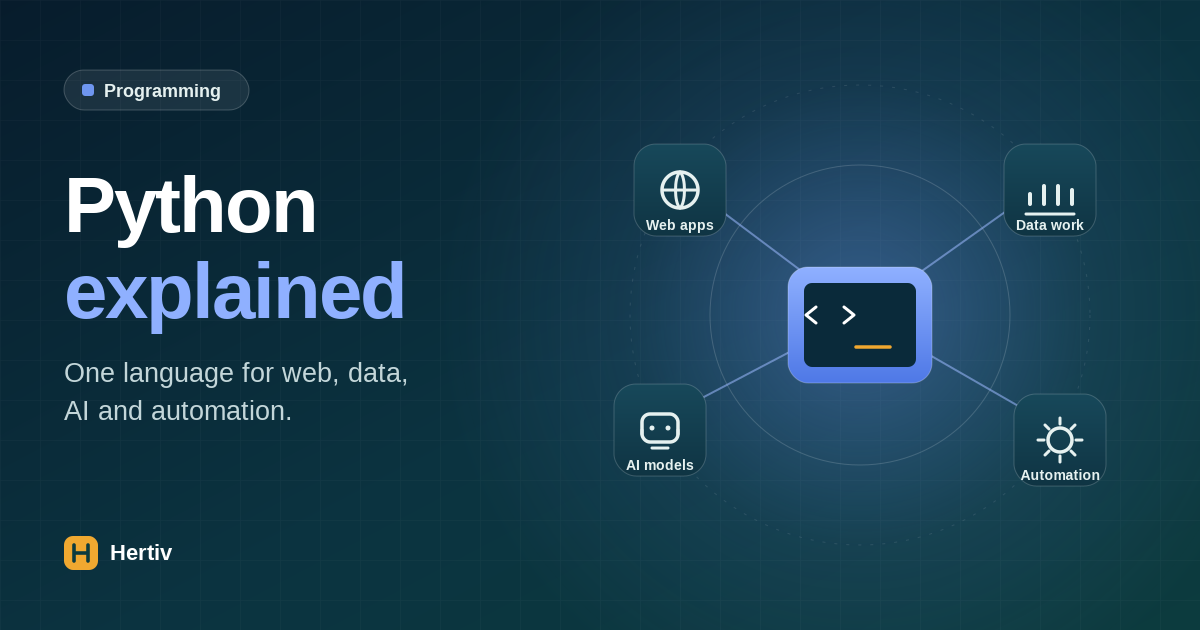
Python is a general-purpose language known for readable code and a large library of ready-made tools. It is used for web apps, data work, AI and automation.
On this page
Short answer
Python is a general-purpose programming language that reads much like plain English, which makes it a common first language and a fast way to build working software. It is used to build websites and APIs, analyse data, train machine learning models, automate routine tasks and control hardware, and its large standard library and package index mean most common jobs start from existing code rather than from scratch.
What is Python?
Python is a general-purpose programming language first released in 1991, designed to be readable and easy to write. Its code uses plain words and indentation instead of heavy punctuation, so a program that takes fifty lines in another language may take twenty in Python.
Python is an interpreted language, which means code runs line by line without a separate compile step. That makes it quick to try an idea: write a few lines, run them, see the result, and change them. It runs on Windows, macOS and Linux, and the same code usually works on all three without changes.
The language is free and open source, and it is maintained by a large community. That community has built a package index with hundreds of thousands of ready-made libraries, so most common jobs, from reading a spreadsheet to training a model, start from code someone has already written and tested.
Why do developers choose Python?
Developers choose Python mainly because it is fast to write and easy to read. A team can build a working version of an idea in days, show it to users, and change it based on what they learn, instead of spending weeks on setup.
- Readable code. Python reads like plain instructions, so a new developer can follow an existing codebase without weeks of study.
- Large standard library. Common jobs such as reading files, calling web services and handling dates are built in.
- Package index. The Python Package Index holds ready-made libraries for almost every task, from web frameworks to data analysis.
- Strong community. Answers, tutorials and examples are easy to find, and most popular libraries are well maintained.
- Cross-platform. The same code runs on a laptop, a server and a small device with few changes.
These traits make Python a common choice for prototypes and first versions. A team can prove an idea works before deciding whether to rebuild parts of it in a faster language. For a comparison with the language most often weighed against it, see JavaScript vs Python.
What is Python used for?
Python is used across software because it is general purpose. The same language can run a website, a data pipeline, a machine learning model and a factory sensor, and teams often use it for several of those jobs at once.
| Area | What Python does there | Common tools |
|---|---|---|
| Web development | Builds websites and APIs that serve pages and data | Django, Flask, FastAPI |
| Data analysis | Cleans, explores and charts data from files and databases | pandas, NumPy, Matplotlib |
| Machine learning | Trains and runs models for prediction and language tasks | scikit-learn, PyTorch, TensorFlow |
| Automation | Scripts routine jobs such as file handling and reports | Standard library, requests |
| DevOps and testing | Writes deployment scripts and automated tests | Ansible, pytest |
| Hardware and IoT | Controls small devices and reads sensors | MicroPython, CircuitPython |
Web work is the most visible use: many well-known sites run Python on the server. Data work is the fastest growing use, because Python is the default language for data analysis and machine learning in most teams. For how Python is used in product teams, see Python development for startups.
How does Python fit into AI and data work?
Python fits AI and data work because the tools data teams use are written in Python, or have Python interfaces. A data scientist can load a dataset, clean it, train a model and plot the results without leaving the language.
The usual flow starts with pandas for tables and NumPy for numbers, moves to scikit-learn for classic models such as regression and classification, and reaches PyTorch or TensorFlow for deep learning. Jupyter notebooks let the team run code in small steps and see charts next to the code, which suits exploration better than a plain script file.
That flow is also why Python is the first language most AI courses teach. The language itself is a small part of the job; the libraries do the heavy work, and the team spends its time on the data and the problem rather than on the syntax. For a deeper look at this use case, read why Python is used for AI.
How do you start a Python project?
You start a Python project by setting up an isolated environment, choosing the libraries you need, and writing a small working version before adding features. The steps below are the usual sequence for a first project.
- Install Python. Use a current stable release from python.org or your system package manager, and check the version on the command line.
- Create a virtual environment. An isolated environment keeps this project's libraries separate from other projects on the same machine.
- Pick the libraries. Add only what the first version needs, such as a web framework or a data library, and pin the versions.
- Write the smallest working version. Get one feature running end to end, from input to output, before adding the next one.
- Add tests early. A few tests for the core logic catch regressions while the code is still small and easy to fix.
- Set up version control. Track the code with git from day one, so every change is recorded and reversible.
- Document how to run it. A short readme with the setup steps saves every new developer hours of guessing.
Resist the urge to plan the whole system before writing code. Python rewards short cycles: build a thin slice, run it, and let what you learn shape the next slice.
Example (hypothetical): a startup's first Python service
Example (hypothetical): a startup of three developers wants a Python service that takes orders from a website and stores them in a database. The team plans six weeks of work, at 40 hours a week each, which is 3 developers times 6 weeks times 40 hours, or 720 hours in total.
At an indicative rate of $60 an hour, the build costs 720 times 60, which is $43,200. The team uses FastAPI for the service and PostgreSQL for the database, both free and open source, so the only software cost is hosting, at an indicative $200 a month.
The service goes live in week six, and the team spends the next two weeks fixing the issues real orders expose. Because the code is short and readable, a new developer joining in week eight can follow the order flow in a day. The example shows Python's main trade: the build is fast and cheap to staff, and the cost sits in running and improving the service, not in writing the first version.
What are the common mistakes?
The most common mistakes in Python projects are skipping the virtual environment, adding libraries without need, and writing code that only works on one machine.
- No virtual environment. Installing libraries globally mixes projects together and breaks old code when a library updates. Always isolate.
- Too many dependencies. Each library is a thing to maintain and a possible security issue. Add a library only when it saves real work.
- Works on my machine. If the setup steps live in one developer's head, the next developer cannot run the project. Write them down and test them on a clean machine.
- No tests for the core logic. Python's flexibility means errors appear at run time, not at compile time. Tests are the safety net.
- Ignoring performance until it hurts. Python is slower than compiled languages for heavy number crunching, so measure early and move only the slow parts to a faster tool.
Key takeaways
- Python is a general-purpose language that reads much like plain English
- Its large library of ready-made packages covers web, data, AI and automation
- Python is the default language for data analysis and machine learning work
- A first version can be built in weeks because the language rewards short cycles
- The costs to watch are running, testing and maintenance, not the first build
Frequently asked questions
Is Python a good first programming language?
Yes. Its syntax is close to plain English, it runs without a compile step, and there are many free tutorials and courses. Beginners can write a working program in the first lesson, which keeps motivation up while they learn the harder ideas such as data structures and testing.
Is Python only used for AI and data science?
No. Python is also widely used for websites and APIs, automation scripts, testing, DevOps tooling and small devices. AI and data science are the most talked-about uses, but web development and automation employ at least as many Python developers.
Is Python slow?
Python is slower than compiled languages for heavy computation, because it runs line by line. In practice most applications spend their time waiting on databases, networks or files, where the language speed does not matter. Teams move only the slow, number-heavy parts to faster tools.
What is the difference between Python 2 and Python 3?
Python 3 is the current version, released in 2008, and Python 2 reached end of life in 2020. Python 3 changed how text, numbers and printing work, and the two versions are not fully compatible. All new projects should use Python 3.
Do I need to learn another language after Python?
Not necessarily, but many developers add one. JavaScript is useful for browser work, SQL for databases, and a compiled language such as Go or Rust for performance-critical services. Python remains the main language for many developers throughout their careers.
Can Python build mobile apps?
It can, with frameworks such as Kivy or BeeWare, but it is not the usual choice. Most mobile apps are built with Swift, Kotlin or a cross-platform framework, while Python is used for the server and data work behind them. Mobile is the one area where Python is a niche, not a default.


