What Is OpenAI, and What Does It Build?
OpenAI is the AI company behind ChatGPT. It builds large language models, the tools around them, and APIs that let other teams put those models into their products.
On this page
Short answer
OpenAI is an AI research and product company best known for ChatGPT, the chat assistant it released in late 2022. It builds the GPT family of large language models and sells access to them through an API, so other teams can put those models into their own products.
What is OpenAI?
OpenAI is an AI research and product company best known for ChatGPT, the chat assistant it released in late 2022. The company builds large language models and the tools around them, and it sells access to those models through an API so other teams can put them into their own products.
OpenAI began in 2015 as a research lab focused on building safe, broadly useful artificial intelligence. It grew from research into products: first the GPT family of language models, then ChatGPT, then tools for images, voice and video, and a platform where developers can build on top of its models.
Today OpenAI is both a model maker and a product company. It trains the models, runs them at scale, and ships the consumer and developer products that use them. That dual role is why its name comes up in almost every conversation about enterprise AI: teams either use its models directly or compare their own tools against them.
What products does OpenAI make?
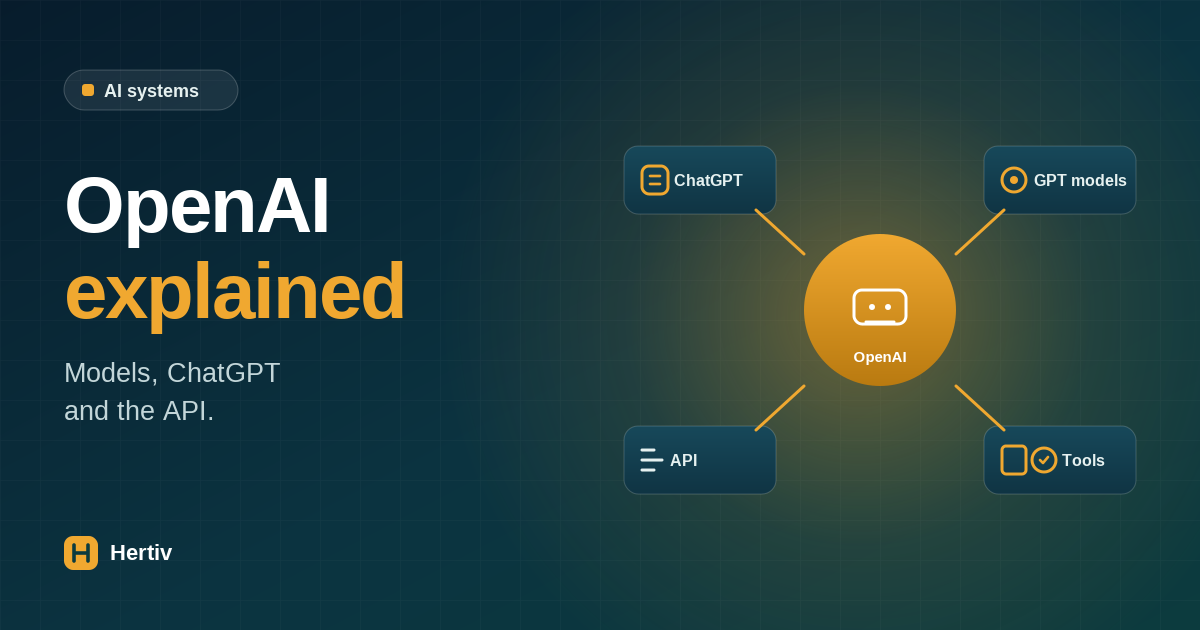
OpenAI's products fall into three groups: chat products for people, tools for developers, and the models underneath. The table below shows the main ones and who each is for.
| Product | What it does | Who uses it |
|---|---|---|
| ChatGPT | Chat assistant for writing, analysis and questions | Individuals and teams |
| API | Access to OpenAI models from your own software | Developers and companies |
| GPT models | Language models that generate and understand text | Apps built on the API |
| Image and voice tools | Generate images, transcribe speech, speak aloud | Creators and product teams |
| Agents and assistants | Tools that carry out multi-step tasks with models | Teams automating workflows |
ChatGPT is the product most people know. It is a chat interface on top of a GPT model, with features such as file upload, web search and custom assistants added around it. The free and paid tiers differ in which model you get, how fast it answers and which features are included, so check the vendor site for current plans.
The API is the product that matters most to businesses. It lets a team send prompts to a GPT model from its own software and get answers back, paying per use. That is how most companies actually use OpenAI: not by sending staff to ChatGPT, but by putting a model inside their support, sales or operations tools.
How do teams use OpenAI's models?
Teams use OpenAI's models for work that involves reading, writing and summarising. Support teams draft replies and summarise tickets. Sales teams draft outreach and summarise calls. Operations teams pull key points from long documents and turn them into structured data. The pattern is the same: the model does the first draft, and a person checks it.
A second common use is retrieval. A team connects a model to its own documents — help articles, contracts, manuals — so the model answers from company knowledge instead of general knowledge. This is retrieval-augmented generation, and it is how most serious business uses of OpenAI work. A short guide to retrieval-augmented generation explains the pattern in detail.
A third use is building products on the API. Startups and software teams put a GPT model at the centre of a feature: a writing assistant, a tutor, a code helper, a document reviewer. The model is the engine; the company's product is the workflow, the data and the user experience around it.
All three uses share the same rule: the model assists, and a person or a check decides. Teams that let model output go straight to customers without review learn the cost of that shortcut quickly.
OpenAI vs other model providers
OpenAI is one of several companies that build large language models. Anthropic builds Claude, Google builds Gemini, Meta builds the Llama family, and Mistral and others build their own. The models differ in style, strengths and price, and the best choice depends on the task. A comparison of OpenAI, Claude and Gemini covers the differences teams usually care about.
OpenAI's strength is breadth. It has the widest-known consumer product, a large developer platform, and models that perform well across many tasks. Teams that want a single provider for chat, API access and tools often start here, because the ecosystem is the most mature.
The trade-off is dependence. Building on one provider's API means your product depends on its prices, its limits and its roadmap. Some teams accept that and build in safeguards; others spread their use across providers or run open models themselves for parts of the work. The right answer depends on how much of your product would break if the provider changed its terms.
Cost is the other factor to weigh. API use is charged per token, so a feature that sends long documents to the model can cost far more than a short chat. Teams should measure token use on real traffic before committing, and design prompts that send only the context the model needs.
Example (hypothetical): a support team pilots ChatGPT drafts
Example (hypothetical): a software company with a five-person support team pilots model-drafted replies. Each agent handles 40 tickets a day, and drafting a reply takes about 5 minutes. That is 5 x 40 x 5 = 1,000 minutes a day, or about 16 hours and 40 minutes of drafting across the team.
With the model drafting first, an agent spends about 2 minutes checking and editing each draft instead of 5 minutes writing it. Daily drafting time becomes 5 x 40 x 2 = 400 minutes, or 6 hours and 40 minutes. The saving is 1,000 - 400 = 600 minutes, or 10 hours a day across the team.
The pilot does not remove the agents. It removes the blank-page time and leaves the judgement: checking facts, fixing tone, and deciding when a draft is wrong. The team also tracks how often drafts need a correction, because a draft that is fast but wrong costs more than a slow one that is right.
What are the common mistakes?
The first mistake is treating the model as a source of truth. A GPT model generates text that sounds confident, and it can state wrong facts in that confident tone. Teams that publish model output without checking it will ship errors. Every answer that reaches a customer, a contract or a decision should pass a check — a person, a retrieved source, or a rule.
The second mistake is sending the model everything. Long prompts with whole documents cost more in tokens and often give worse answers, because the model has to find the relevant part itself. Send the smallest useful context, and use retrieval to pick it. A team that wants the full picture can read the OpenAI use cases for business to see how other teams scope their prompts.
The third mistake is building a product that is only a wrapper around the API. If your product is a chat box over a GPT model, anyone can copy it in a weekend. The durable part is the workflow, the data and the integrations around the model — the things that make it useful in a specific job, not the model itself.
The fourth mistake is ignoring data and privacy rules. Prompts sent to an API may leave your systems, and some plans use data for training while others do not. Check the vendor's data policy for the plan you use, keep sensitive data out of prompts unless the terms allow it, and get legal sign-off before putting customer data through any external model.
What to check before building on OpenAI
Start with the plan and its terms. Check the current pricing, rate limits and data policy on the vendor site, and confirm whether your plan allows your data to be used for training. These terms change, so check them when you start and review them when you renew.
Then test the model on your own work. A demo that writes a good poem tells you nothing about how it handles your support tickets. Build a small test set of real cases, run them through the API, and measure how often the answers are good enough to use with light editing.
Next, plan for failure. Models go down, rate limits bite, and answers are sometimes wrong. Build retries, fallbacks and a human review step for the answers that matter. A pilot that works only when everything goes right is not a pilot; it is a demo.
Finally, keep an exit in mind. Design your code so the model call is one replaceable part, not woven through the whole product. That way a price change, a limit change or a better model from another provider is a small job, not a rebuild.
Key takeaways
- OpenAI builds GPT language models and sells access to them through an API
- ChatGPT is its consumer chat product; the API is what most businesses actually use
- Models assist with drafting, summarising and retrieval; a person or a check should decide
- Check the vendor site for current plans, prices and data policies before building
- A product that is only a chat box over the API is easy to copy; the workflow around it is the value
Frequently asked questions
Is OpenAI the same as ChatGPT?
No. OpenAI is the company, and ChatGPT is one of its products. OpenAI also builds the GPT language models, the API that lets developers use those models, and tools for images, voice and video.
Does OpenAI offer a free plan?
ChatGPT has a free tier, and paid tiers add faster models and more features. The API is charged per use. Plans and prices change, so check the vendor site for the current options before choosing.
Can I use OpenAI models in my own product?
Yes, through the API. You send prompts from your software and receive answers back, paying per token used. Most business uses work this way, with the model inside a support, sales or operations tool.
Is my data used to train OpenAI models?
It depends on the plan and the product. Some plans allow data to be used for training, and business plans typically do not. Read the vendor's data policy for the plan you use, and keep sensitive data out of prompts unless the terms allow it.
What is the difference between OpenAI and Anthropic?
They are different companies building different model families: OpenAI builds GPT models and ChatGPT, while Anthropic builds Claude. The models differ in style, strengths and price, so teams usually test both on their own tasks before choosing.
Should a startup build on OpenAI or use open models?
It depends on speed and control. The OpenAI API is the fastest way to ship a model-powered feature, but your product then depends on its prices and terms. Open models give more control and can run on your own hardware, at the cost of more engineering work.


