What Are Backend Frameworks? A Plain Guide for Builders
A backend framework is the structure behind a web app: it routes requests and handles repetitive work, so your team builds only the product-specific parts.
On this page
Short answer
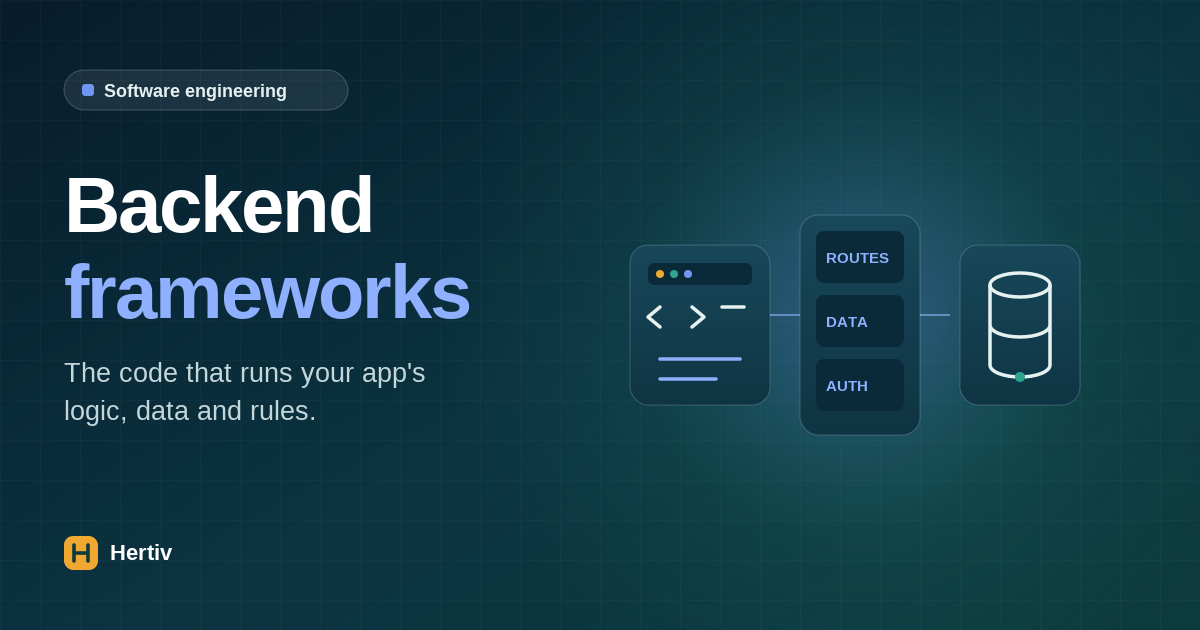
A backend framework is a ready-made set of tools and conventions for building the server side of an application: the code that receives requests, applies business rules, talks to the database and returns answers. It supplies routing, database access, authentication and error handling so developers write only the logic that is specific to the product.
What is a backend framework?
A backend framework is a ready-made set of tools and rules for building the server side of an application: the code that handles requests, talks to the database and returns answers. Instead of writing every common task from scratch, a developer starts from the framework's structure and adds only the parts that are specific to the product.
Think of it as the skeleton of a web application. The framework decides how requests are routed to code, how data is stored and retrieved, and how errors are handled. The developer fills in the business logic: what happens when a user signs up, places an order or asks for a report.
Most frameworks cover the same basics: routing, database access, user sessions, security headers and testing helpers. They differ in language, style and how much they decide for you. Some are strict and opinionated; others are small and flexible, leaving more choices to the team. The ideas carry over to any web application you build.
What does a backend framework actually do?
A backend framework handles the repetitive work that every server application needs, so the team can focus on the product itself. The exact feature list varies, but the core jobs are the same in nearly every framework.
- Routing. Matching each incoming URL and HTTP method to the code that should answer it.
- Request handling. Reading input, checking it is valid, and shaping the response as HTML, JSON or a file.
- Database access. Mapping code objects to database tables, running queries and keeping data consistent.
- Authentication. Signing users in, keeping sessions safe and checking who may do what.
- Background jobs. Sending emails, processing uploads and running scheduled tasks outside the request.
- Error handling and logging. Catching failures in one place and recording what went wrong.
Because these pieces are built in, a new project starts from a working skeleton instead of an empty folder. The team still has to design the data model and the business rules, but it does not have to invent the plumbing.
What kinds of backend frameworks are there?
Backend frameworks fall into two broad styles. Full-featured frameworks ship with most of what an app needs, while minimal frameworks ship with a small core and let the team add libraries as needed.
| Framework | Language | Best for | Style |
|---|---|---|---|
| Django | Python | Admin-heavy apps and fast starts | Full-featured |
| Express.js | JavaScript | Small APIs and Node.js teams | Minimal |
| Laravel | PHP | Full-featured web apps | Full-featured |
| Spring Boot | Java | Large enterprise systems | Opinionated |
| FastAPI | Python | Fast APIs and AI services | Minimal |
| Ruby on Rails | Ruby | Startups that value convention | Full-featured |
The language matters as much as the framework. A team that already knows Python will move faster with Django or FastAPI than by learning a Java stack for one project. Hiring, hosting and the libraries your product needs all weigh in the same decision.
How do you choose a backend framework?
You choose a backend framework by matching it to your team, your product and how long the system must last. A short checklist keeps the decision grounded.
- Start with your team's language. Pick a framework in a language your developers already write well, unless the product clearly needs another stack.
- Match the style to the product. A content-heavy app with an admin panel suits a full-featured framework; a single-purpose API suits a minimal one.
- Check the ecosystem. Look for maintained libraries for payments, email, file storage and the services you plan to use.
- Weigh hiring and hosting. A popular framework is easier to hire for and to host, and it has more answers available when the team gets stuck.
- Build a small proof. Before committing, build one real feature end to end and see how the framework feels in practice.
There is rarely one right answer. Two sensible teams can pick different frameworks for the same product and both ship. The cost of switching later is high, so the proof step is worth the week it takes.
Example: a four-person team picks a framework
Example (hypothetical): a four-person team is building a booking app for local sports centres. They need user accounts, an admin panel, payments and email reminders, and they know Python well.
They price the work two ways. Building login, password reset and an admin panel by hand would take about 80 hours. Django ships those pieces built in, so setting them up and adjusting them to the product takes about 12 hours, saving about 68 hours. The saving is real, but it is not the whole story.
They also check the trade-offs. Django's admin panel fits their needs, its payment libraries are maintained, and hiring a fifth Python developer later will be straightforward. A minimal framework would give them more freedom, but they would spend that freedom rebuilding the same admin screens.
They choose Django, build one booking flow end to end in the first week, and only then commit the whole product to it. The proof confirms the admin panel and the email jobs work the way they expected.
What are the common mistakes?
The most common backend framework mistakes are picking for fashion instead of fit, fighting the framework's conventions, and letting the codebase grow without structure.
- Choosing by popularity alone. The most talked-about framework may not fit your language, your team or your product's shape.
- Fighting the defaults. Every framework has a preferred way of doing things. Working against it costs more than learning it.
- Skipping tests. A framework's test helpers only help if the team actually writes tests for the business logic.
- Putting logic in the wrong place. Business rules scattered across controllers and templates become hard to change and harder to test.
- Ignoring upgrades. Falling several versions behind turns a routine upgrade into a risky project.
When is a framework the wrong call?
A framework is the wrong call when the job is too small or too unusual for its structure to pay off. A single static page, a tiny script that moves files between two systems, or a one-off data migration does not need routing, sessions and an admin panel.
Very high-performance services can also outgrow a general framework. A team handling extreme request rates may need a leaner stack tuned to one job, and the framework's conveniences become overhead. That is a rare case, and it is usually reached by growing out of a framework, not by starting without one.
For most products, the question is which framework, not whether to use one. The structure, the security defaults and the tested plumbing save more time than they cost, and the team can still replace any single piece later. If you are scoping a new product, a partner for custom software development can help weigh the options against your timeline.
Key takeaways
- A backend framework supplies routing, database access, auth and error handling out of the box
- Full-featured frameworks trade freedom for speed; minimal ones trade speed for control
- Choose by team language, product shape, ecosystem and hiring, not by popularity
- A one-feature proof is the cheapest way to test a framework before committing
- Most products need a framework; the wrong call is fighting its defaults or skipping tests
Frequently asked questions
Do I need a backend framework for a small app?
Not always. A single static page or a tiny script does not need one. But once an app has user accounts, a database and more than a few pages, a framework saves more time than it costs, and it brings security defaults that are easy to get wrong by hand.
Is Django better than Express.js?
Neither is better in general. Django suits admin-heavy Python apps that need many built-in features, while Express.js suits small JavaScript APIs where the team wants control. The right choice depends on your team's language, the product's shape and the libraries you need.
Can I switch frameworks later?
Yes, but it is expensive. The business logic can move, but routing, database code, auth and tests usually have to be rewritten. That is why teams build a small proof before committing, and why they keep business rules separate from framework code.
Do backend frameworks handle security?
They handle the common parts: password hashing, session handling, protection against common web attacks and secure defaults. They do not make an app secure on their own. The team still has to configure access rules, keep dependencies updated and review its own code.
What is the difference between a framework and a library?
A library is code you call when you need it, while a framework calls your code and sets the structure of the app. With a framework you fill in the gaps it leaves; with a library you stay in charge of the overall shape and add pieces as needed.
Should a startup use a full-featured or minimal framework?
Most startups move faster with a full-featured framework, because admin panels, auth and database tools come built in. A minimal framework suits teams that already know exactly what they need and want to assemble the stack themselves.


