Voice Technology in Healthcare: Where It Works and Where It Fails
Voice technology in healthcare covers clinical documentation, patient intake and phone triage. Here is where it works, the compliance risks, and how to start safely.
On this page
Short answer
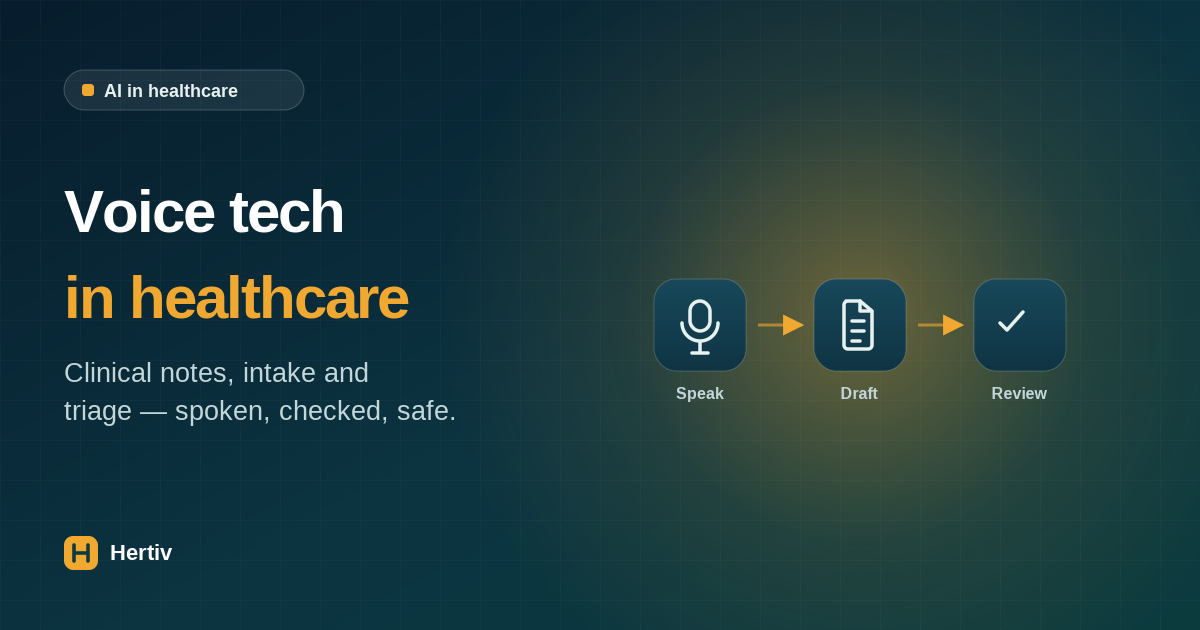
Voice technology in healthcare is the use of speech recognition, natural-language understanding and voice interfaces to support clinical and administrative workflows such as documentation, patient intake, triage and results delivery. It works well for structured, high-volume tasks with a human reviewer, and poorly for open-ended clinical decisions without oversight.
What is voice technology in healthcare?
Voice technology in healthcare is the use of speech recognition, natural-language understanding, text-to-speech and conversational agents to support clinical or administrative work through spoken language. It includes tools that listen to a consultation and draft notes, phone agents that book appointments, and voice interfaces that read results or instructions to patients.
The category is broader than "voice assistants." Three layers matter:
- Capture: turning speech into text accurately, including accents, background noise and clinical terms.
- Understanding: extracting intent, entities and structure, such as a medication name, a symptom or an appointment slot.
- Action: writing to the EHR, booking a slot, escalating to a nurse, or reading a result aloud.
Most failures happen in the middle layer, not the speech-to-text engine. A transcript can be accurate and still produce a wrong action if the intent model misreads what the patient asked. That is why healthcare voice projects need workflow design, not just a better model.
Hertiv builds these systems under AI for healthcare providers and health tech and treats clinical safety and audit trails as part of the build, not an afterthought.
Where does voice technology actually work in healthcare?
Voice technology works best in healthcare where the task is repetitive, structured, and has a natural review point. The table below compares common uses.
| Use case | What it does | Typical data needed | Effort |
|---|---|---|---|
| Ambient clinical documentation | Listens to a visit and drafts a note | Consultation audio, specialty templates | Medium to high |
| Patient intake | Collects history and reason for visit by voice | Intake forms, clinic rules | Medium |
| Appointment scheduling and reminders | Books, reschedules, confirms by phone | Scheduling system, provider calendars | Medium |
| Phone triage and routing | Sorts calls and routes to the right team | Call scripts, escalation rules | Medium |
| Results and instructions readout | Reads lab or discharge instructions | Verified results, plain-language scripts | High |
| Medication reminders | Prompts patients at set times | Prescription data, consent | Low to medium |
| Post-visit follow-up | Checks symptoms and flags concerns | Follow-up protocols | Medium to high |
| Staff voice commands | Hands-free lookup in the EHR | Role permissions, audit logs | Medium |
Two patterns repeat. First, documentation and intake reduce typing and free staff time; the value is measured in minutes saved per encounter, not in model accuracy. Second, any use that touches clinical judgement, medication or consent needs a human check before action. Treat the voice layer as an assistant, not an authority.
How do AI voice agents handle patient calls?
AI voice agents handle patient calls by combining speech recognition, a dialogue policy and a connection to scheduling or records systems, with a clear handoff to staff when the request falls outside their scope. They work well for high-volume, low-ambiguity calls and poorly for anxious patients or complex complaints if the escalation path is weak.
A workable design has four parts:
- Greeting and intent detection. State clearly that the caller is speaking to an automated system and offer a route to a person.
- Structured dialogue. Ask only for what the downstream system needs: name, date of birth, reason, preferred slot.
- Action with confirmation. Read back the appointment or request before writing it.
- Escalation. Transfer to staff on clinical questions, distress, or repeated misunderstanding.
Example (hypothetical): a clinic receives 400 calls a day and estimates that 60 percent are scheduling or rescheduling. If a voice agent handles half of those with a 90 percent success rate, that is roughly 108 calls resolved without staff time, and the rest routed or handed off. The arithmetic is simple; the hard part is measuring whether those calls stay resolved a week later.
Watch out for the "false completion" failure: the agent believes it booked a slot when the scheduling system rejected the request. Always reconcile against the system of record. For phone-channel builds, see AI voice agent development for phone and voice channels.
What are the compliance and privacy risks?
The main compliance risks are recording and retaining identifiable voice data without a lawful basis, sending audio to vendors without a data processing agreement, and letting an agent take clinical action without documented human oversight. Voice adds a biometric and emotional layer that text does not, so it deserves stricter handling than a form.
Practical controls:
- Minimise retention. Keep raw audio only as long as needed; store transcripts or structured outputs where possible.
- Consent and notice. Tell patients when a call is recorded or handled by an automated system, and offer a human route.
- Vendor review. Confirm where audio is processed and stored, and whether the vendor trains on your data.
- Access control. Voice commands and transcripts inherit the same role permissions as the EHR.
- Audit trail. Log what the agent heard, decided and wrote, so a reviewer can reconstruct the encounter.
Regulation varies by market: HIPAA in the US, GDPR and national health rules in the EU and UK, and local health data rules in the Middle East. The EU AI Act adds obligations for certain clinical uses, so treat classification as part of design. Hertiv's AI governance and responsible AI consulting covers this mapping.
What are the common mistakes?
The common mistakes in healthcare voice projects are organisational and design failures more than model failures. Most pilots that stall do so because nobody owned the workflow change or measured the right outcome.
- Buying a transcription engine and calling it a solution. Accuracy on a benchmark does not mean the note is usable in your specialty.
- Skipping the review step. Draft notes or readouts that reach patients without clinician sign-off create risk fast.
- Ignoring accents and noise. Test on recordings from your own clinic, not clean studio audio.
- No escalation path. Callers who cannot reach a person hang up and call again, or go elsewhere.
- Unclear ownership. If no clinical lead owns the output quality, errors accumulate silently.
- Treating consent as a checkbox. Patients need a real route to opt out of automated handling.
How do you start a voice project safely?
Start with one workflow, one site and a short evaluation window, then expand only if the measured outcome holds. A four-step sequence keeps risk contained.
- Pick the workflow by volume and structure. Scheduling, intake and documentation are good first candidates because success is easy to measure.
- Define the human review point. Decide exactly where a clinician or staff member checks the output, and log it.
- Build a narrow pilot. Use real audio from your setting, with consent, and compare against the current process.
- Measure and decide. Track handling time, correction rate, escalation rate and patient feedback over several weeks.
- Expand with governance. Add specialties or channels only after the first workflow is stable, and keep the audit trail intact.
A short proof of concept is often the cheapest way to learn whether the speech layer holds up in your environment; Hertiv runs these under AI proof of concept development in four weeks. Resist the urge to connect the agent to clinical systems before the review step and logs exist.
How to choose a voice technology approach
Choose the approach that matches the task's ambiguity and the cost of a wrong action, not the most capable model available. A scheduling bot and a diagnostic assistant need very different safeguards.
- Classify the task. Is it administrative, clinical-support or clinical-decision? Only the first is safe for a fully automated agent today.
- Check the integration surface. Confirm the scheduling, EHR or CRM system has an API you can write to with proper permissions.
- Test speech on your audio. Run a sample of real, consented calls through the candidate engine and review errors by accent and specialty term.
- Design escalation first. Write the handoff rules before the happy path; they determine whether staff trust the system.
- Confirm data handling. Match vendor processing and retention to your jurisdiction and your own policy.
Treat vendor selection as the last step, not the first. Teams that start with a demo and work backwards usually end up rebuilding the workflow. For broader agent patterns that connect voice to back-office tasks, see Agentic AI development: workflows that run themselves, safely.
Key takeaways
- Ambient clinical documentation is the most mature use case; always keep a clinician review step.
- Phone and voice agents handle appointment scheduling, reminders and intake well if they hand off to staff on complex requests.
- HIPAA, GDPR and the EU AI Act shape what you can record, retain and transcribe; treat voice data as sensitive by default.
- Speech recognition degrades with accents, noise and medical terminology; test on your own audio before committing.
- Start with one workflow, measure handling time and error rates, then expand.
- Keep a human in the loop for anything that could affect diagnosis, medication or consent.
Frequently asked questions
Is voice technology in healthcare accurate enough to replace medical transcriptionists?
No. It reduces typing and drafting time, but clinician review remains necessary for accuracy and liability. The realistic gain is fewer minutes spent writing notes, with a human confirming the final record.
Can AI voice agents handle patient calls without staff?
For scheduling, reminders and simple intake, an agent can handle a large share of calls. Complex clinical questions, distressed callers and ambiguous requests need a fast handoff to staff, so plan for a blended model.
What regulations apply to healthcare voice data?
It depends on the market. HIPAA applies in the US, GDPR and national health rules in the EU and UK, and local health data laws in the Middle East. Some clinical uses may also fall under the EU AI Act, so classify early.
Do patients accept automated voice systems?
Acceptance varies. Clear notice that the caller is speaking to an automated system, an easy route to a person, and reliable resolution matter more than voice quality. Test with your own patient population before scaling.
What is the best first voice use case for a clinic?
Appointment scheduling and reminders are usually the safest first step: high volume, structured, easy to measure and low clinical risk. Ambient documentation is next if the specialty templates are stable.
How long does a healthcare voice pilot take?
A narrow pilot on one workflow can run in a few weeks to a couple of months, depending on integration and compliance review. Plan for evaluation time after launch, not just build time.


