Voice and Sentiment Analysis in Insurance Claims
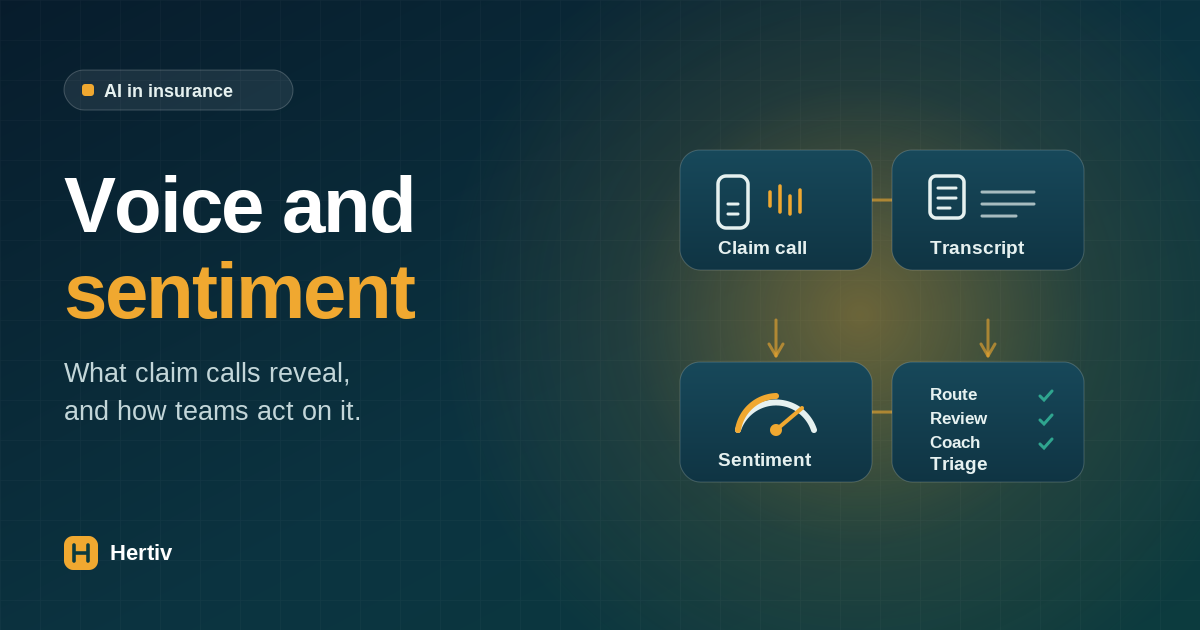
Voice and sentiment analysis listens to claim calls, scores tone and language, and helps insurers route claims and coach handlers. Here is how it works.
On this page
Short answer
Voice and sentiment analysis in insurance claims uses AI to transcribe recorded claim calls and score the caller's tone and words for emotion, urgency and risk. It helps insurers route claims to the right handler, flag calls that need human review, and improve how handlers respond.
What is voice and sentiment analysis in insurance claims?
Voice and sentiment analysis in insurance claims is the use of AI to listen to recorded claim calls, transcribe what was said, and score the caller's tone and language for emotion, urgency and risk signals. It turns a phone conversation into structured data that a claims team can act on.
The voice side covers the sound of the call: pace, pauses, pitch changes and interruptions. The sentiment side covers the words: what the caller asks for, how they describe the loss, and whether they sound frustrated, confused or distressed. Together they give a fuller picture than a transcript alone.
Insurers use the output in three ways. First, to route the claim to the right handler. Second, to flag calls that need a human review, such as a caller in distress or a story that does not add up. Third, to coach handlers, because patterns across many calls show where scripts and processes fail. The analysis supports the handler; it does not replace the decision.
How voice analysis works on a claims call
Voice analysis works by processing the call recording in stages, from raw audio to a set of scores that the claims system can store next to the claim file. Each stage adds a layer of meaning that the next stage can use.
| Stage | What it does | What it tells the team |
|---|---|---|
| Recording and consent | Captures the call with the caller's permission | Which calls may be analysed at all |
| Transcription | Turns speech into text with timestamps | What was said, and in what order |
| Speaker separation | Splits caller and handler speech | Who said what, and who talked over whom |
| Acoustic signals | Measures pace, pauses and pitch | Stress, hesitation and urgency |
| Language scoring | Scores words for sentiment and intent | Frustration, confusion or a request to escalate |
Most teams run the first three stages on every recorded call and the last two only where the claim type justifies it. A motor claim with a clear police report may need little more than a transcript, while a complex liability claim benefits from the full pipeline. Keeping the pipeline narrow at first also keeps the cost and the privacy review manageable.
What sentiment analysis adds beyond transcription
Sentiment analysis adds the caller's state of mind to the facts of the claim. A transcript tells you that a caller reported a burst pipe; sentiment tells you they are distressed, have already waited a week for a callback, and are close to making a formal complaint.
Three signals matter most in claims. Emotion shows whether the caller is calm, angry or upset, which changes how the handler should respond. Intent shows what the caller wants: a repair, a payment date, a callback or an escalation. Confusion shows where the process failed, for example when a caller repeats the same question because the answer was unclear.
The value is in the combination. A caller who is calm and asks for a payment date needs a different response from a caller who is upset and repeats a question three times. The first is a status check; the second is a sign that something in the claim has gone wrong. Handlers who see these signals before they pick up the phone can prepare a better first sentence.
Where insurers use it across the claims journey
Insurers use voice and sentiment analysis at several points in the claims journey, from the first call to the final payment. Each stage uses the output differently, and each has its own measure of success.
| Stage | What the analysis does | Who uses it |
|---|---|---|
| First notice of loss | Captures the loss details and the caller's urgency | Intake team and triage |
| Triage | Scores complexity and routes the claim | Claims handlers |
| Investigation | Flags inconsistent statements for review | Investigators |
| Settlement | Tracks frustration during negotiation | Handlers and managers |
| Follow-up | Checks the caller is satisfied after payment | Quality team |
Triage is usually the first place to apply it, because routing is a clear, measurable task: did the claim reach the right handler first time? Investigation is the most sensitive, because a flag can look like an accusation. Teams that do this well treat flags as a prompt for a second look, never as proof of anything. That distinction should be written into the process, not left to individual judgement.
How to start in five steps
You start by picking one claim type and one use, then proving the value on a small set of calls before expanding. A narrow pilot avoids the two common traps: analysing everything at once, and buying a platform before you know what you need from it.
- Pick one claim type. Motor or property claims with high call volume give you enough data to learn from quickly.
- Confirm consent and storage rules. Check what your call recording notice covers, how long recordings are kept, and who may listen to them.
- Define the labels. Decide what counts as urgent, confused or distressed in your own words, and label a sample of calls by hand.
- Run a pilot with human review. Let the model score calls, but have handlers check every flag before it affects a claim.
- Measure one outcome. Track routing accuracy, time to first response, or repeat calls, and expand only if the pilot moves the number.
The labelling step is the one teams most often skip, and it is the one that decides whether the pilot works. A model trained on generic sentiment data will miss the language of claims, where words like "total loss" or "write-off" carry a specific meaning. Your own labelled sample is what makes the scores useful for your claims.
Example (hypothetical): a motor claims team
Example (hypothetical): a motor claims team takes 120 calls a day. Handlers spend about 8 minutes per call reading notes and listening back to parts of the recording, which is 120 times 8, or 960 minutes, about 16 hours of review work a day across the team.
The team adds transcription and sentiment scoring to first notice of loss calls. Handlers now read a short summary and check the sentiment flags instead of listening to the full call, which takes about 3 minutes per call, or 120 times 3, or 360 minutes, about 6 hours a day. That saves roughly 10 hours a day, which the team spends on complex claims and callbacks.
The saving only holds because a handler still reviews every flagged call. In the first month, about one call in five is flagged for a human listen, usually because the caller is distressed or the story is unclear. The team treats those flags as work, not as errors, and the review time is part of the plan.
What are the common mistakes?
The most common mistakes are treating scores as proof, ignoring consent and privacy, and rolling the system out to every claim type before the pilot is measured.
- Treating a score as evidence. A high stress score is not proof of fraud, and a calm caller is not proof of honesty. Scores guide review; they do not decide claims.
- Skipping the consent check. If the recording notice does not cover analysis, the project stops. Get the privacy review done before the pilot, not after.
- No human in the loop. Fully automated routing based on sentiment will misroute calls. Keep a handler reviewing flags until the error rate is known.
- Training on one accent or region. A model tuned on one group of callers will misread others. Test on the full range of callers you serve.
- Measuring volume instead of outcomes. Counting analysed calls proves nothing. Measure routing accuracy, repeat calls and complaint rates.
Key takeaways
- Voice analysis turns claim calls into structured data: transcripts, tone scores and intent signals
- Sentiment adds the caller's state of mind to the facts of the loss
- Triage is the best first use, because routing accuracy is easy to measure
- A sentiment flag is a prompt for human review, never proof of fraud or dishonesty
- Consent, labelled samples and a human in the loop decide whether a pilot works
Frequently asked questions
What is voice and sentiment analysis in insurance claims?
It is the use of AI to transcribe recorded claim calls and score tone and language for emotion, urgency and risk. The output helps insurers route claims, spot distressed callers and coach handlers, while a human still makes the claim decision.
Is it legal to analyse claim calls?
It depends on consent and local rules. Most insurers already record calls, but analysis needs to be covered by the recording notice and by privacy rules on storage, access and retention. Check this with your privacy team before any pilot.
Can sentiment analysis detect insurance fraud?
No, not on its own. It can flag inconsistent statements or unusual stress for a human investigator to review, but a score is not evidence. Fraud decisions need documents, records and human judgement, not a sentiment number.
How accurate is sentiment analysis on calls?
Accuracy varies with accents, background noise and the language of claims. Models trained on generic data often misread claim-specific words. Labelling a sample of your own calls and testing on them is the only reliable way to know.
What does it cost to start?
Costs depend on call volume, whether you use a vendor platform or build in-house, and how much labelling and review you do. Start with one claim type and a small pilot, and see vendor site for platform pricing.
Does it replace claims handlers?
No. It handles transcription, summaries and flagging so handlers spend less time on routine review. Complex claims, distressed callers and settlement talks still need a person, and flagged calls always need human review.


