Virtual AI Companions in Healthcare: What They Do Today
A virtual AI companion chats with patients between visits, reminds them about medicines and flags worries to a nurse. Learn what they do and their limits.
On this page
Short answer
A virtual AI healthcare companion is a conversational helper that talks with patients between appointments, reminding them about medicines, checking how they feel and passing worries to a nurse or doctor. It is not a doctor. It handles routine contact so the care team can spend its time on the patients who need help.
What is a virtual AI healthcare companion?
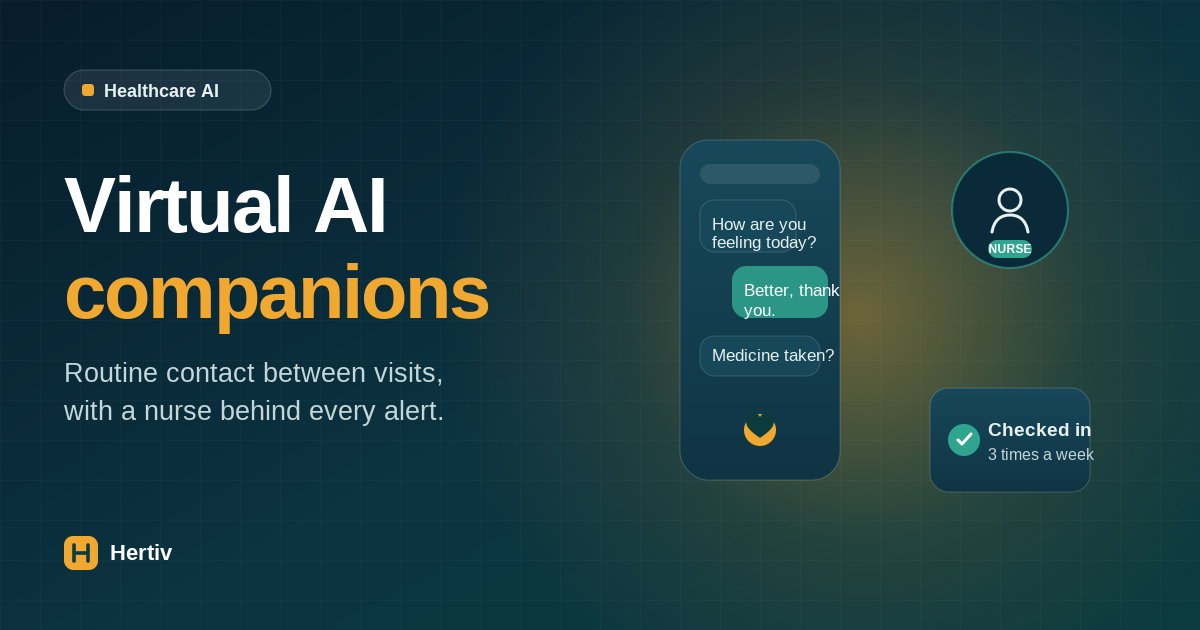
A virtual AI healthcare companion is a software companion that talks with patients between appointments, reminding them about medicines, checking how they feel, and answering everyday health questions. It is not a doctor. It is a conversational helper that sits between the patient and the care team.
The companion usually lives on a phone, a tablet or a voice device. It can send reminders, ask a short set of check-in questions, record answers, and pass anything worrying to a nurse or doctor. Some companions are built for older adults living alone, some for people recovering after surgery, and some for people managing a long-term condition.
What makes it a companion rather than a reminder app is the conversation. It asks how the person is doing, listens to the answer, and responds in plain language. That back-and-forth is what keeps people using it, and what gives the care team a steady view of the patient between visits.
What can a virtual AI companion do?
A virtual AI companion can do a small set of jobs well, and the limits matter as much as the jobs. The table below lists what companions are used for, and where a person must step in.
| Job | What the companion does | Where a person steps in |
|---|---|---|
| Medicine reminders | Reminds and records whether a dose was taken | A nurse follows up on missed doses |
| Daily check-ins | Asks about pain, sleep and mood | A clinician reviews worrying answers |
| Appointment help | Books, confirms and explains visits | Staff handle changes and transport |
| Symptom logging | Records what the patient reports | A doctor interprets the record |
| Companionship | Chats and reduces loneliness | Family and carers provide real contact |
| Health information | Explains a condition in plain words | A clinician answers personal questions |
The companion is most useful for routine, repeated contact. A daily check-in, a reminder and a short chat are jobs a person would find repetitive, and a companion can do them every day without tiring. The care team then spends its time on the patients the companion flags, not on routine calls.
The companion is not a substitute for care. It cannot examine a patient, order a test or make a diagnosis, and it should say so clearly when a question is beyond it. A companion that pretends to be a doctor is a risk, not a help.
How does a virtual AI companion work?
A virtual AI companion works by combining a language model with care rules written by clinicians, and a route to a human when the conversation goes beyond those rules. The model handles the conversation. The rules decide what is safe to say, and when to hand over.
The rules are the important part. They say which symptoms trigger an alert, which answers are safe to give, and which questions must always go to a person. A companion without such rules is a chatbot with no guardrails, and it will eventually give an answer it should not have given.
The companion also keeps a record. Each check-in, reminder and answer is logged, so the care team can see the pattern over days and weeks instead of relying on what a patient remembers at the next visit. That record is health data, so it needs the same protection as any other medical record.
Voice matters too. Many companions speak as well as write, because older patients and people with poor eyesight find talking easier than typing. A companion that only works by text leaves out the people who need it most.
Where are AI companions used in healthcare today?
AI companions are used today in home care for older adults, in post-discharge check-ins, in mental health support, and in routines for long-term conditions. Each setting uses the same idea in a different way.
For older adults living alone, a companion provides a daily check-in and a conversation. It notices when someone does not answer, or when their answers change, and it alerts a family member or a care team. The point is not the chat. It is the noticing.
After surgery or a hospital stay, a companion checks recovery: pain, sleep, appetite, wound care and whether medicines are being taken. A patient who is recovering well gets a short daily chat. A patient who is not gets a call from a nurse. That split lets a small team follow many patients at once.
In mental health support, companions offer a place to talk at any hour, with exercises for low mood and worry. They are not a replacement for therapy, and a good companion says so and points to a person when the conversation turns serious. NLP in healthcare covers the language technology that makes these conversations possible, including how it handles medical wording.
For long-term conditions such as diabetes or heart disease, a companion keeps the routine going: reminders, logged readings, and gentle prompts when the routine slips. The routine is the treatment, and the companion is what keeps it from being forgotten.
Example (hypothetical): a clinic checks in on 60 patients
Example (hypothetical): a small clinic follows 60 patients who have recently left hospital. A companion calls each patient 3 times a week for a short check-in. Sixty patients times 3 calls is 180 check-ins a week.
Most check-ins are routine. In one week, 12 of the 180 check-ins flag something: pain that is worse, a missed dose, or a wound that looks red. Twelve out of 180 is about 1 in 15, so roughly 1 in 15 check-ins needs a person.
The nurse team now makes 12 follow-up calls a week instead of 180 routine calls. That is 168 fewer calls, and the 12 calls they do make are the ones that matter. The patients who are recovering well still get their daily contact, and the patients who need help get it sooner.
The numbers are invented to show the arithmetic, not a real clinic. The point is that the companion does not replace the nurse. It sorts the routine from the urgent, so the nurse's time goes where it is needed.
What are the common mistakes?
The most common mistakes with AI healthcare companions are treating them as doctors, leaving them without a human backup, and ignoring privacy.
- Letting the companion diagnose. A companion that guesses at a diagnosis can delay real care. It should log what the patient says and hand over, not interpret it.
- No human backup. A companion without a nurse or doctor behind it is a dead end. Every alert needs a named person who will act on it, including outside office hours.
- Ignoring privacy. Conversations with a companion are health data. They need the same protection as medical records, and patients should know what is stored and who can read it.
- Designing for the team, not the patient. A companion that asks long, formal questions will be ignored. Short, plain questions in the patient's own words are what keep people answering.
- Assuming everyone can use it. Some patients have no smartphone, poor hearing or low literacy. A companion that only works one way leaves them out, and the team needs another way to reach them.
Another mistake is measuring success by how much patients talk to the companion. The measure that matters is whether the care team acts sooner on the patients who need help. AI in biopharma shows the same pattern in a different setting: the value is in the decision the system supports, not in the conversation itself.
How do you choose a virtual AI healthcare companion?
You choose a virtual AI healthcare companion by checking the clinical rules, the human backup and the privacy protections before you look at the conversation quality.
- Ask who wrote the rules. The care rules should be written or approved by clinicians, not only by the vendor's engineers.
- Check the handover. Ask what happens when a patient reports a serious symptom, and who is contacted, at what hour.
- Check the privacy. Ask where conversations are stored, who can read them, and how long they are kept.
- Test with real patients. Run a small pilot with the patients who will actually use it, and watch whether they keep answering after the first week.
- Plan the review. Decide who reads the flagged check-ins, how often, and what changes when the pattern of flags changes.
This article is general information, not medical advice. A companion is a support tool, and any decision about care should be made with a qualified clinician. For teams planning the product side, AI for healthcare work usually starts with the same questions: who acts, and what happens when the system flags something.
Key takeaways
- A companion handles routine contact, not diagnosis
- Medicine reminders, check-ins and logging are the main jobs
- Clinical rules and a human handover are what make it safe
- Conversations are health data and need the same protection
- Choose by the rules, the backup and the privacy, not the chat quality
Frequently asked questions
Can an AI companion replace a doctor?
No. A companion cannot examine a patient, order a test or make a diagnosis. It can remind, ask questions, log answers and alert a clinician when something looks wrong. Any decision about care should be made with a qualified clinician, not with a companion.
Are AI companions safe for older patients?
They can be, when they are designed for them: voice as well as text, short plain questions, and a clear route to a person. Safety depends on the clinical rules behind the companion and on who acts when an alert arrives, not on the conversation alone.
What happens if a patient reports a serious symptom?
A well-built companion hands over to a person at once, following rules written by clinicians. It should not try to interpret the symptom itself. The team behind the companion needs a named person who will act on alerts, including outside office hours.
Do companions store what patients say?
Yes, the conversations are logged so the care team can see patterns over time. That makes them health data, with the same protection as medical records. Patients should be told what is stored, who can read it and how long it is kept.
Can a companion help with loneliness?
It can help, by giving a daily conversation and noticing when someone stops answering. It is not a replacement for family, friends or carers. A companion that reduces loneliness is useful, but it should never be the only contact a person has.
How much does a virtual AI companion cost?
It depends on the number of patients, the channels used and the clinical support behind it. Vendors usually price by patient numbers and by the level of human support included. Ask for a quote based on your patient group, and check what the price includes.


