Vertical AI Agents: What They Are and When to Use One
A vertical AI agent is built for one industry's work, with its data, rules and tools baked in. Here is how it differs from a general agent and when to use one.
On this page
Short answer
A vertical AI agent is an AI agent built for one industry or job, such as a legal intake agent or a real estate viewing agent. It knows the industry's documents, rules and tools, so it can do the work with less setup than a general agent. It is the choice when the work follows a repeatable pattern in one field and the cost of a wrong answer is high.
What is a vertical AI agent?
A vertical AI agent is an AI agent built for one industry or one job. It works with that industry's documents, vocabulary, rules and software, so it can carry out a real task from start to finish instead of answering general questions.
A legal intake agent, for example, knows what a client intake form asks, which fields matter, and what must never be treated as legal advice. A real estate viewing agent knows listings, viewing slots and the questions buyers ask. The knowledge is built in, not added by the user in every prompt.
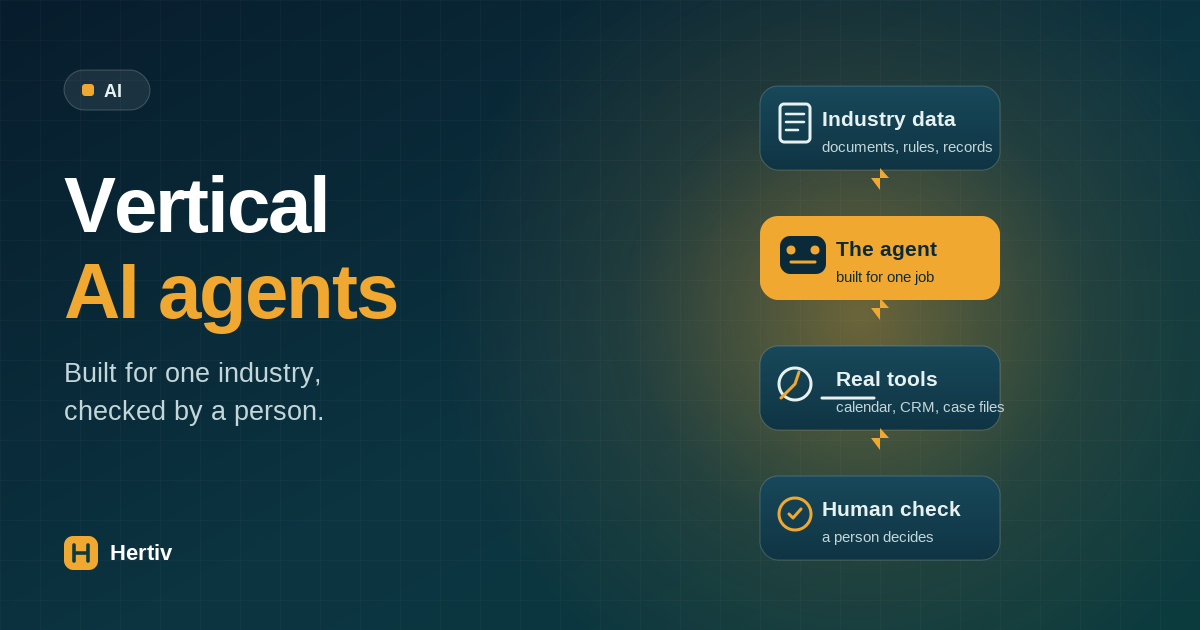
The agent still runs on a general language model underneath. What makes it vertical is the layer on top: the prompts, the data connection, the tools and the guardrails that fit one field. The same model with a different layer becomes a different agent.
Vertical agents are the narrow end of the agent market. General agents help with anything a little; vertical agents help with one thing a lot. Logistics teams use the same idea for their own work; see AI agents in logistics for how one industry's agents are built.
How is it different from a general agent?
A general agent and a vertical agent differ in what they know, what they can touch, and how much setup they need. The table below shows the split.
| Part | Vertical AI agent | General AI agent |
|---|---|---|
| Knowledge | One industry's documents, terms and rules | General knowledge, no industry depth |
| Tools | Connected to the industry's own software | Generic tools: search, files, email |
| Setup | Ready to use, tuned for the job | Needs prompts and instructions per task |
| Guardrails | Rules for that field, such as no legal advice | Generic safety rules only |
| Failure cost | High, so the agent checks itself more | Low, so a wrong answer costs little |
The trade-off is breadth against depth. A general agent can draft a letter, summarise a paper and write code in one afternoon. A vertical agent cannot do any of those well, but it can run one industry workflow every day with far less supervision.
The choice is practical, not philosophical. If the work is the same every day and follows one industry's pattern, the vertical agent wins. If the work changes every hour, the general agent wins.
Where do vertical agents work best?
Vertical agents work best where the work is repeatable, documented and checked by a person. The pattern shows up in the same industries again and again.
- Real estate. Viewing agents that answer buyer questions, book viewings and draft follow-ups from listing facts. Multi-agent teams already cover this field; see multi-agent systems in real estate for the use cases.
- Banking. Agents that reconcile accounts, chase overdue invoices and prepare loan files, with a human approving every money movement. See agentic AI in banking for how banks keep control.
- Legal. Intake agents that collect client facts and draft first versions of standard documents, with a lawyer reviewing every output.
- Logistics. Agents that track shipments, answer delivery questions and flag delays, working from the company's own tracking data.
- Healthcare. Agents that book appointments, collect intake forms and remind patients, with clinical questions routed to staff.
The common thread is a workflow with clear inputs, a clear output and a named person who checks it. A job with no clear output and no checker is a bad fit for any agent, vertical or not.
How do you build or buy one?
You build or buy a vertical agent in five steps, starting with the workflow, not the model. The model is the last choice, not the first.
- Pick one workflow. Choose a single repeatable job, such as qualifying viewing enquiries, with a clear input and a clear output. One workflow keeps the project small.
- Write the rules first. List what the agent may do, what it must never do, and when it must hand over to a person. The rules are the product; the model is the engine.
- Connect the real tools. Give the agent the calendar, the CRM or the case system it needs, with scoped access. An agent that cannot reach the tools can only talk about the work.
- Test on real cases with a human watching. Run 50 real cases through the agent and log every error. Fix the rules and the prompts before widening the pilot.
- Decide build or buy. If a vendor already sells an agent for your workflow, buy it and spend the saving on the pilot. Build only when no vendor covers your field or your rules.
The build-or-buy decision is usually won by buying. A vendor agent for your industry already carries the documents, the tools and the guardrails. Building the same thing from scratch costs months and still needs the same pilot. Logistics teams faced the same choice; see how to build AI agents for logistics for the build path.
Example: a real estate viewing agent
Example (hypothetical): a brokerage with six agents handles about 60 viewing enquiries a week. Each enquiry takes an agent about 15 minutes to qualify by phone, which adds up to 900 minutes a week, or 15 hours of agent time.
The brokerage buys a vertical viewing agent. The agent answers enquiries, asks the qualifying questions, checks the viewing calendar and books the slot, then hands the booking to an agent. It handles 45 of the 60 enquiries a week, leaving 15 for a person, which takes 225 minutes, or 3 hours and 45 minutes.
The saving is 675 minutes a week, or 11 hours and 15 minutes of agent time. The brokerage keeps the rule that the agent never quotes a price and never promises a viewing without checking the calendar, and one agent reviews the bookings each morning. The pilot runs for a month before the agent is offered to every listing.
What are the common mistakes?
The most common mistakes with vertical agents are picking the wrong workflow, skipping the rules, and letting the agent act without a human check.
- Automating a messy workflow. If the job has no clear steps today, an agent will not find them. Fix the workflow first, then automate it.
- No written rules. An agent without a list of what it must never do will eventually do it. Write the rules before the first test case.
- Too much access. An agent that can move money, send contracts or change records without approval is a risk, not a tool. Give it read access first and add write access slowly.
- Skipping the pilot. A vendor demo is not a pilot. Run 50 real cases with a human watching and log every error before going wider.
- Buying the general tool for a vertical job. A general agent can be prompted to do the job, but it needs the same instructions every time and forgets the rules. The vertical tool carries the rules itself.
- Forgetting the handover. Every vertical agent needs a clear point where it stops and a person takes over. A job with no handover is a job with no owner.
How do you measure whether it helps?
You measure a vertical agent by time saved, error rate and handover quality, not by how many tasks it completes. A task done wrong is worse than a task not done.
Track three numbers each week. First, minutes saved per case, counted as the old handling time minus the new agent plus review time. Second, the error rate: the share of cases the reviewer has to fix or redo. Third, the handover rate: how often the agent correctly sends a case to a person instead of guessing.
Set a bar before the pilot starts. A common one is an error rate under 5 percent and a handover that catches the hard cases, not just the easy ones. If the numbers miss the bar, the fix is usually the rules, the tools or the workflow choice, not the model.
Ask the people who review the agent's work. If the reviewer says fixing the agent's output takes longer than doing the job by hand, believe them: the time saved on paper may be lost in rework, and a different workflow may suit the agent better.
Key takeaways
- A vertical agent is built for one industry's documents, rules and tools
- It does one repeatable workflow well, with a person checking the output
- Write the rules and the handover before picking a model or vendor
- Buy when a vendor already covers your workflow; build only when none does
- Measure time saved, error rate and handover quality before widening the pilot
Frequently asked questions
What is a vertical AI agent?
An AI agent built for one industry or job, such as legal intake or real estate viewings. It carries that industry's documents, rules and tool connections, so it can do real work with less setup than a general agent.
How is it different from a general agent?
A general agent helps with many tasks a little and needs instructions each time. A vertical agent does one industry workflow a lot, with the knowledge, tools and guardrails built in. The trade-off is breadth against depth.
Should I build or buy a vertical agent?
Buy first if a vendor already sells an agent for your workflow. It already carries the industry knowledge and guardrails. Build only when no vendor covers your field or your rules, and budget the same pilot either way.
What should a vertical agent never do?
It should never take an action a person must approve: moving money, sending a contract, or giving advice the field reserves for a qualified person. It prepares the work and a person decides.
How long does a pilot take to judge?
Four weeks on one workflow with one reviewer is enough for a first read. Run about 50 real cases, log every error, and judge on the error rate and the time saved, not on the demo.
Can one agent cover two industries?
No, not well. An agent tuned for real estate viewings will not know legal intake rules or banking controls. Each industry needs its own layer of documents, tools and guardrails on top of the same model.


