How Uber's App Model Works, and What It Teaches On-Demand Teams
Uber's app model matches riders and drivers in real time, sets prices by supply and demand, and uses ratings to keep both sides honest. Here is how the pieces fit.
On this page
Short answer
Uber's mobile app model is a two-sided marketplace in which a rider app, a driver app and a central dispatch system match trips in real time, set prices from supply and demand, and use ratings and payments to keep the service reliable. It is the template most on-demand services copy, from food delivery to home services.
What is Uber's mobile app model?
Uber's mobile app model is a marketplace that connects people who need a ride with drivers who have a car, without owning the cars or employing the drivers. The rider opens the app, enters a destination and sees a price; a nearby driver accepts the trip, follows the route, and is paid through the app. Uber takes a share of the fare for running the marketplace.
The model works because three things happen at once: riders and drivers are matched in seconds, prices move with supply and demand, and both sides are rated after every trip. Those three parts reinforce each other. Fast matching keeps waiting times low, which brings more riders; more riders bring more drivers; and ratings give both sides a reason to behave well.
It is a model, not just an app. The same shape appears in food delivery, grocery delivery, courier work and home services: a customer app, a worker app, a dispatch system in the middle, and a payment and rating layer that holds it together. Teams that copy only the screens and skip the dispatch and trust parts usually end up with a booking form, not a marketplace.
How do the rider app, driver app and dispatch fit together?
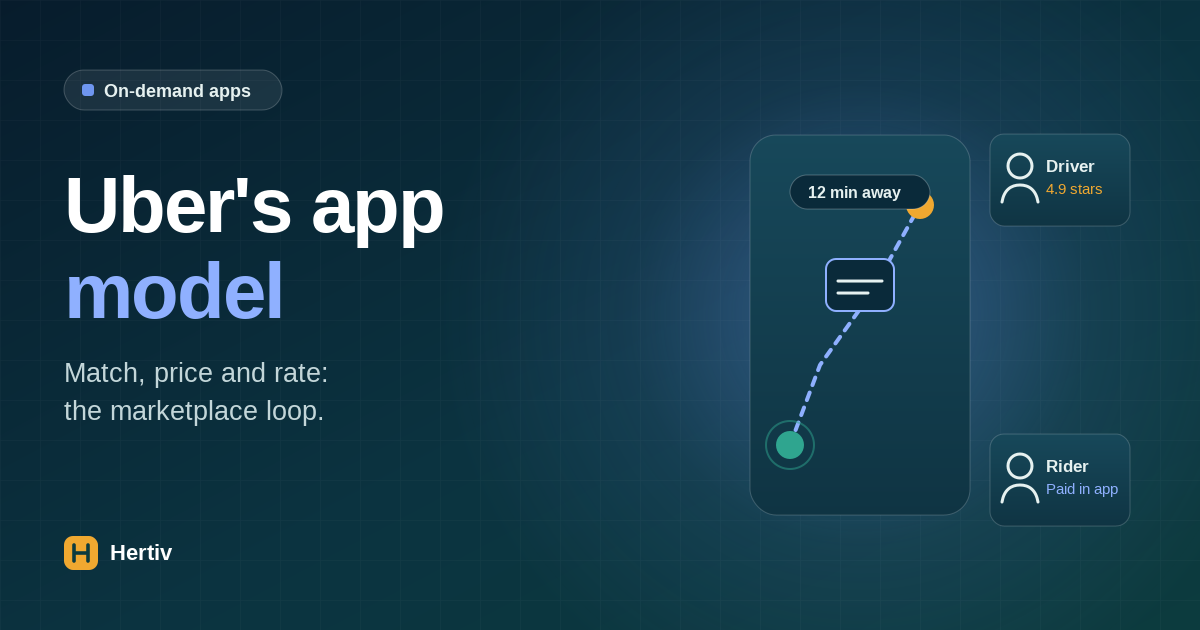
The rider app, driver app and dispatch system fit together as three views of one trip. The rider sees the price, the wait and the car; the driver sees the pickup, the route and the earnings; the dispatch system sees every rider and driver in an area and decides who goes where.
| Part | What it does | What it shows |
|---|---|---|
| Rider app | Requests a ride, pays, rates the trip | Price, wait time, driver and car |
| Driver app | Accepts trips, navigates, tracks earnings | Pickup, route, fare and rating |
| Dispatch system | Matches riders to nearby drivers | Supply, demand and wait times per area |
| Payments | Charges the rider, pays the driver | Fare split, tips and weekly totals |
| Ratings and support | Records feedback, handles problems | Scores, complaints and refunds |
The dispatch system is the part that decides whether the model works at scale. It has to match a rider to a driver who is close enough to arrive quickly, without leaving another area short of drivers. That is a routing problem that runs constantly, and it is why a simple list of available drivers is not enough once a city has more than a handful of trips.
How does matching and dispatch work?
Matching and dispatch work by dividing a city into small areas and tracking how many riders and drivers are in each one. When a rider requests a trip, the system looks for drivers nearby who are free, weighs the distance each one would travel to the pickup, and offers the trip to the closest suitable driver.
The driver can accept or decline. If nobody accepts, the system widens the search or raises the price to draw drivers in. Once a driver accepts, the rider sees the car, the driver and the arrival time, and the driver sees the route. Both sides can follow the trip on a map, which reduces the need for phone calls and messages.
Positioning matters as much as matching. After a trip ends, the driver is somewhere new, and the system may suggest where to wait next based on where demand is expected. A driver who waits in a quiet area earns less, so good dispatch also means giving drivers useful information about where the next trip is likely to come from.
How does surge pricing work?
Surge pricing works by raising the fare when demand in an area is higher than the number of available drivers. The higher price does two things at once: it asks some riders to wait or choose another option, and it encourages drivers in nearby areas to move towards the busy one.
The price is set per area and changes as conditions change, so a fare quoted at one moment may differ a few minutes later. The rider sees the price before confirming, which is the part that matters most for trust: nobody should be surprised by the fare after the trip. The driver sees the same change as an incentive, not as a hidden adjustment.
Surge pricing is also the most criticised part of the model, because a high fare during rain or a late night can feel unfair. Teams copying the model should treat the price as a lever with limits: cap the multiplier, show the reason for the price, and offer a cheaper option such as waiting or sharing a ride. A price that riders see as a penalty will push them to a competitor.
How do ratings and trust keep the system working?
Ratings and trust keep the system working because neither side meets the other before the trip, so both need a reason to believe the other will behave well. After each trip, the rider rates the driver and the driver rates the rider, and those scores decide who keeps getting matched.
A driver with a low score gets fewer trips and may be removed from the platform, while a rider with a low score may find it harder to get a driver to accept. That gives both sides a stake in the trip going well. Identity checks, trip records and in-app support back up the ratings: if something goes wrong, there is a record of who was where, and a way to report it.
Trust also depends on payment. The rider pays through the app, so there is no haggling over cash, and the driver is paid on a schedule they can see. Disputes over fares or routes are handled from the trip record rather than from memory, which keeps most disagreements short. For teams building their own on-demand product, the mobile app development page covers how these pieces are built into a working app.
Example (hypothetical): a city at rush hour
Example (hypothetical): a city has 200 drivers online at 6 pm and 300 ride requests in one hour. On a normal evening, 150 requests arrive in the same hour, so the rush hour has twice the demand with the same number of drivers.
The dispatch system raises the price in the busiest areas by a factor of 1.5. Of the 300 requests, 60 riders decide to wait or take another option, leaving 240 trips to be served. At the same time, 40 drivers from quieter areas move towards the busy ones, so 240 drivers are available. Each driver completes one trip in the hour, and the average wait falls from 25 minutes to 12 minutes.
The numbers are invented to show the arithmetic, not a real city. The point is that the price does two jobs at once: it trims demand and it pulls in supply, and the wait time is the measure that shows whether the balance worked.
Common mistakes when copying Uber's model
The most common mistakes when copying Uber's model come from copying the screens and skipping the systems underneath. A rider app with a map and a price is easy to build; a dispatch system that keeps waits low across a whole city is the hard part, and it is where most copies fail.
- Starting in too many areas. A marketplace needs enough riders and drivers in one place to match quickly. Spreading thin across a whole country gives long waits everywhere.
- Ignoring the worker side. If drivers earn too little or wait too long between trips, they leave, and riders then wait longer too.
- No price lever. Without a way to balance supply and demand, a busy hour means long waits and lost riders.
- Weak trust and support. Without ratings, identity checks and a way to handle disputes, bad trips drive good users away.
- Copying the fare structure blindly. A city with different distances, costs and rules needs its own pricing, not Uber's.
Each of these mistakes breaks the loop that makes the model work. Supply and demand feed each other, so a failure on one side shows up quickly on the other.
What should an on-demand team copy first?
An on-demand team should copy the marketplace loop first, not the feature list. Start with one city area, a small group of riders and workers, and the three parts that make a trip work: matching, payment and ratings.
- Pick one area and one service. A single neighbourhood and a single job type give enough density to match quickly.
- Build the dispatch first. Matching, wait times and worker positioning matter more than extra features in the apps.
- Add a price lever. Even a simple busy-hour rate, shown before booking, keeps waits down when demand spikes.
- Ship ratings and support early. Trust is hard to add later, and early bad trips will cost more than the support work.
- Measure wait time and worker earnings. If waits grow or earnings fall, the marketplace is thinning, and that is the signal to fix supply before adding features.
Once the loop works in one area, the team can widen the map, add services and tune pricing. The custom software development page covers how dispatch, payments and ratings are put together for a first on-demand product.
Key takeaways
- Uber's model is a two-sided marketplace: rider app, driver app and dispatch in the middle
- Dispatch decides whether the model works at scale, not the screens in the apps
- Surge pricing trims demand and pulls in supply at the same time
- Ratings, identity checks and in-app payment are what make strangers trust the trip
- Copy the marketplace loop first: one area, matching, payment and ratings
- Measure wait time and worker earnings, because both show whether the loop is healthy
Frequently asked questions
Is Uber's app model the same as a taxi booking app?
No. A taxi booking app sends a request to a fixed fleet and charges a set fare, while Uber's model matches any available driver in real time and changes the price with supply and demand. The difference is the marketplace: the system balances riders and drivers continuously instead of dispatching from a fixed list.
Do on-demand teams need surge pricing?
They need some way to balance supply and demand, but it does not have to be surge pricing. A busy-hour rate, a queue with a clear wait time, or a booking slot can all work. What matters is that the rider sees the price or the wait before confirming, and that workers are drawn towards busy areas.
Why do drivers accept some trips and not others?
Drivers weigh the fare, the distance to the pickup, and where the trip ends. A short trip to a quiet area can leave a driver far from the next fare, so the system needs to make that trip worth accepting. Showing the destination and the fare before acceptance helps drivers decide fairly.
How does Uber handle safety for riders and drivers?
Through identity checks, trip records, in-app ratings and support that can review a trip from its record. Both sides are identified, the route is tracked, and either side can report a problem. These parts matter more as the service grows, because strangers meeting through an app need a record they can point to.
Can a small team build an Uber-style app?
A small team can build the apps, but the dispatch system and the marketplace density are the hard parts. Starting in one area with a small group of workers is the usual path: it gives enough trips to match quickly without needing a city-wide fleet on day one.
What is the most copied part of Uber's model, and what is most often missed?
The most copied part is the rider app: map, price and a button. The most often missed part is the dispatch and trust layer: matching, positioning, price levers, ratings and support. Without those, the app is a booking form, and wait times grow as soon as demand rises.


