Toptal Competitors Worth Comparing Before You Hire
Toptal is one way to hire vetted developers, but Upwork, Fiverr, Turing and others suit different budgets and timelines. Compare six competitors and pick by fit.
On this page
Short answer
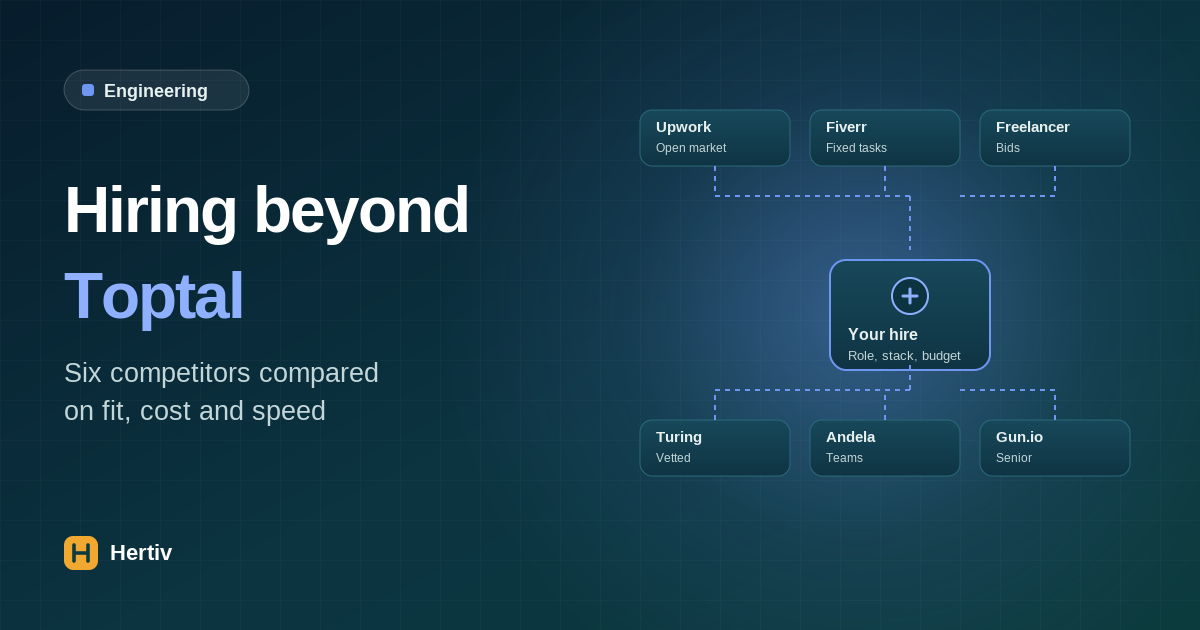
The Toptal competitors worth comparing are the freelance marketplaces and vetted talent networks that cover the same hiring need: Upwork, Fiverr, Freelancer, Turing, Andela and Gun.io. They differ on vetting, price, speed and how much of the hiring work they take off your hands, so the right pick depends on the role and the budget.
Which Toptal competitors are worth comparing?
The Toptal competitors worth comparing are the platforms that help you hire developers without a full recruitment process. Some are open marketplaces where you post a job and review proposals. Others are vetted networks that screen developers first and match you with a shortlist.
Use this comparison to shortlist two or three and try a small engagement before committing to a long contract. Prices and fees change, so see vendor site for current rates.
| Platform | Model | Best for | Vetting |
|---|---|---|---|
| Upwork | Open marketplace | Wide choice, flexible budgets | Profiles and reviews |
| Fiverr | Open marketplace | Small, fixed-scope tasks | Seller levels, reviews |
| Freelancer | Open marketplace | Competitive bidding | Profiles and reviews |
| Turing | Vetted network | Remote developers, long term | Tests and interviews |
| Andela | Vetted network | Managed remote teams | Screening and matching |
| Gun.io | Vetted network | Senior developers, fast start | Screening and references |
No platform is best in general. An open marketplace gives you choice and price control but takes more of your time to screen. A vetted network costs more and starts faster, but gives you less choice over who you get.
Upwork: best for wide choice and flexible budgets
1. Upwork: best for wide choice and flexible budgets
Upwork is the largest freelance marketplace, with developers across almost every stack and rate level. You post a job, receive proposals, and hire by the hour or by fixed price. The range is the attraction: you can find a specialist for a two-week task or a developer for a six-month engagement.
The trade-off is screening time. A popular job can attract dozens of proposals, and sorting them takes real effort. Profiles, work history and client reviews help, but they do not replace a short technical interview and a paid trial task.
Pros:
- Widest choice: developers for almost any stack and budget
- Flexible terms: hourly or fixed-price contracts
- Built-in tools: time tracking, milestones and payment protection
Cons:
- Screening takes time: many proposals need sorting
- Quality varies: reviews do not guarantee fit for your stack
- Fees add up: service fees apply on top of the rate
Fiverr: best for small, fixed-scope tasks
2. Fiverr: best for small, fixed-scope tasks
Fiverr works differently from the other marketplaces: sellers list fixed-scope services with a set price, and you buy the one that fits. That shape suits small, well-defined jobs, such as a landing page, a bug fix or a plugin setup, where the scope is clear before you start.
It is a weaker fit for long engagements or work that needs close collaboration, because the model is built around one-off deliveries rather than ongoing relationships. For a short task with a fixed budget, though, it is often the fastest route.
Pros:
- Fixed prices: you know the cost before you buy
- Fast start: no job posting or proposal round
- Clear scope: each service lists exactly what is included
Cons:
- Weak for long work: built for one-off tasks, not ongoing teams
- Quality varies by seller: levels and reviews help, but vary
- Less collaboration: limited room for changing scope mid-task
Freelancer: best for competitive bidding on defined work
3. Freelancer: best for competitive bidding on defined work
Freelancer is an open marketplace where you post a project and freelancers bid on it, often at competing prices. That bidding can keep costs down for well-defined work, such as a website build or a data entry project, where the scope is easy to describe and compare.
The same bidding dynamic is the risk: the lowest bid is not always the best value, and a project that looks cheap can cost more in rework. A paid trial and a clear milestone plan matter more here than on vetted networks.
Pros:
- Competitive prices: bidding keeps rates visible and comparable
- Wide range: developers, designers and writers in one place
- Milestone payments: pay as agreed stages are delivered
Cons:
- Screening takes time: bids need careful review
- Low bids can mislead: cheapest is not always best value
- Less vetting: no screening before you see proposals
Turing: best for vetted remote developers on long engagements
4. Turing: best for vetted remote developers on long engagements
Turing screens developers with tests and interviews, then matches you with a shortlist for remote, usually full-time work. The model suits teams that need a developer for months rather than a task for days, and that want the screening done before they meet anyone.
The trade-off is control. You meet fewer candidates than on an open marketplace, and the matching depends on how well the platform understands your requirements. A clear brief and a technical interview on your side still matter. Open-source hiring tools are covered in the open source Turing alternatives guide.
Pros:
- Pre-screened talent: tests and interviews before matching
- Long-term fit: built for months-long engagements
- Fast shortlist: matching replaces the proposal round
Cons:
- Less choice: you see a shortlist, not the whole market
- Higher rates: vetting and matching are priced in
- Matching quality varies: depends on the brief you write
Andela: best for managed remote engineering teams
5. Andela: best for managed remote engineering teams
Andela builds remote engineering teams, matching developers to your stack and managing the engagement around them. It suits companies that need more than one developer and want help with onboarding, retention and day-to-day support, not just a single hire.
That management layer is also the cost. Andela fits teams hiring at scale or for the long term, and is a heavier option than a marketplace when you only need one developer for a few weeks.
Pros:
- Team building: hires several developers as one team
- Managed support: onboarding and retention handled
- Screened talent: vetting before matching
Cons:
- Heavier commitment: built for longer engagements
- Higher cost: management is part of the price
- Slower for one-off hires: team model suits scale
Gun.io: best for senior developers who can start fast
6. Gun.io: best for senior developers who can start fast
Gun.io focuses on senior, vetted developers and aims to match them quickly, often within days. It suits teams with an urgent need for an experienced developer, such as a shortfall on a live project or a specialist skill the in-house team lacks.
The pool is smaller and the rates are higher than on open marketplaces, which is the price of seniority and speed. For a senior hire on a tight timeline, that trade is often worth it.
Pros:
- Senior focus: vetted, experienced developers
- Fast matching: shortlist within days
- References checked: screening includes past work
Cons:
- Smaller pool: fewer developers than large marketplaces
- Higher rates: seniority is priced in
- Less suited to juniors: built for experienced hires
How to choose a Toptal competitor
You choose a Toptal competitor by matching the platform to the hire, not by comparing headline rates. Start with the length of the engagement and how much screening you can do yourself.
- Name the engagement. A two-week task points to Fiverr or Upwork; a six-month role points to Turing, Andela or Gun.io.
- Decide who screens. If your team can interview, an open marketplace works. If not, pay for a vetted network.
- Set a trial. Hire for a small, paid task first, and judge the work before extending.
- Check the total cost. Add service fees and management time to the rate, because the cheapest rate is rarely the cheapest hire.
- Plan the handover. Agree how code, access and documentation are handed over if the engagement ends.
If you are hiring for a product rather than a single task, a dedicated development team can be the steadier option, because the team stays together across releases.
What are the common mistakes?
The most common mistakes when hiring through a Toptal competitor are skipping the trial, hiring on price alone, and leaving the scope vague.
- No paid trial. A profile is not proof of fit. A small paid task tells you more than ten interviews.
- Choosing on rate alone. A cheap developer who needs rework costs more than a senior one who ships once.
- Vague scope. A task with no definition of done will drift, whatever the platform.
- No handover plan. Code and access should be yours from day one, not something you negotiate at the end.
- Skipping the interview. Even vetted networks benefit from a short technical conversation on your stack.
These mistakes are easy to avoid with a short written brief, a trial task and a clear definition of done before the work starts.
Key takeaways
- Open marketplaces give choice and price control but take screening time
- Vetted networks cost more and start faster, but show you fewer candidates
- Match the platform to the length of the engagement first
- Always run a small paid trial before a long contract
- Compare total cost, including fees and management time, not just the rate
Frequently asked questions
Is Toptal better than Upwork?
Neither is better in general. Toptal screens developers before matching, so you start faster with less screening of your own. Upwork gives you a wider choice and more control over rates, but you do the screening. The right pick depends on whether you value speed or choice more for this hire.
How much do Toptal competitors cost?
Rates vary by skill, region and engagement length, and platform fees add to the rate. See vendor site for current pricing. The useful comparison is total cost: rate plus fees plus the hours your team spends screening and managing.
Can I hire a developer for a single task on these platforms?
Yes, especially on Fiverr and Upwork, which are built for fixed-scope tasks. Vetted networks such as Turing and Gun.io are built for longer engagements and are a heavier option for a one-off job.
Do vetted networks guarantee quality?
No. Vetting reduces the risk, but it does not replace your own judgement. A short technical interview and a paid trial task are still the best checks, because only your work shows whether a developer fits your stack and your team.
What is the difference between Toptal and Turing?
Both are vetted networks that match developers to teams. They differ in pool size, matching process and pricing, so the practical choice comes down to which one has the right developers for your stack at the time you hire. Shortlist both and compare the candidates.
Should I hire a freelancer or a dedicated team?
A freelancer suits a defined task or a short engagement. A dedicated team suits a product that needs ongoing work across releases, because the team keeps context and ships faster over time. If the work never ends, a team is usually the better deal.


