How to Choose a Software Company in San Francisco
A practical guide to finding top software companies in San Francisco: what each firm type does, what data and effort they need, and how to choose the right one for your project.
On this page
Short answer
Top software companies in San Francisco fall into a few types: custom product builders, AI and data specialists, and staff-augmentation firms. The right choice depends on whether you need a finished product, a specialised capability, or extra engineers to extend your team.
What kinds of software companies are in San Francisco?
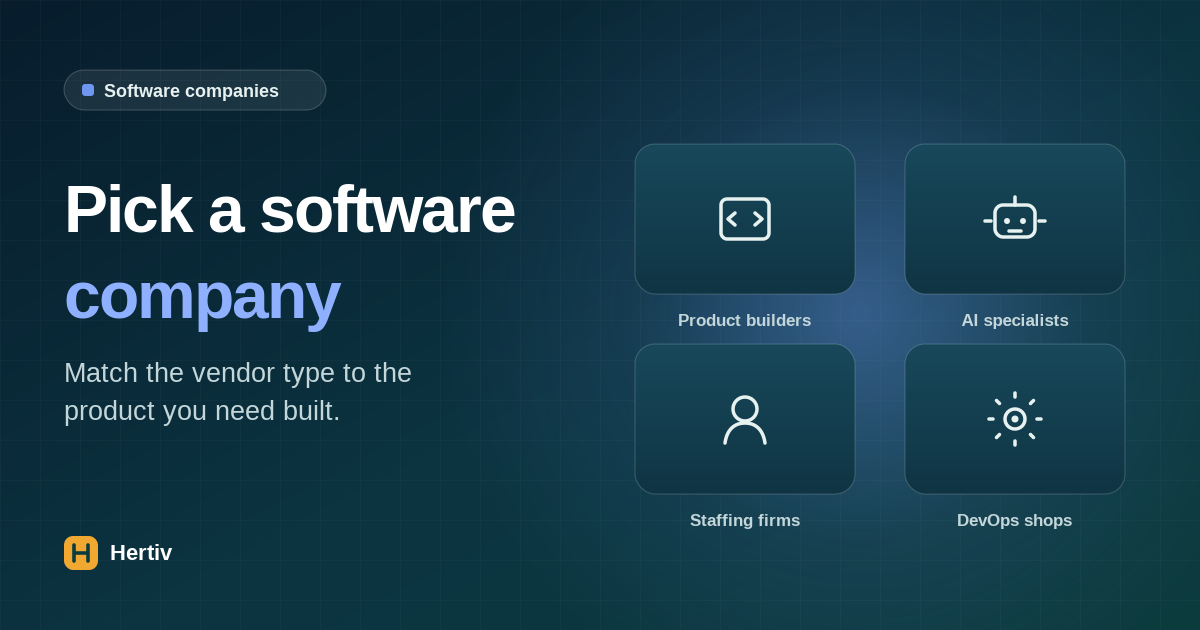
San Francisco software companies generally fall into three groups: custom product builders, AI and data specialists, and staff-augmentation firms. Most serious firms lean toward one group and partner for the rest.
| Type | What it does | Typical data needed | Effort |
|---|---|---|---|
| Custom product builder | Designs and builds a full application end to end | Product brief, user research, access to stakeholders | Medium to high |
| AI and data specialist | Builds models, pipelines, or AI features inside existing products | Data samples, schemas, security review | Medium |
| Staff augmentation | Adds engineers to your existing team | Role spec, tech stack, interview process | Low to medium |
| MVP studio | Ships a first working version quickly | Concept, target users, budget cap | Medium |
| Platform and DevOps firm | Sets up cloud, CI/CD, observability | Current architecture, access | Medium |
| Blockchain specialist | Builds smart contracts, wallets, tokenisation | Use-case brief, compliance review | Medium to high |
| Agency with design focus | Product design plus front-end build | Brand assets, UX goals | Medium |
| Consulting firm | Strategy, audits, architecture reviews | Existing code, metrics, interview access | Low |
A firm that claims all of these equally is usually brokering work. Ask who actually writes code and where that team sits. For broader engineering context, see software engineering services.
Custom product builders: best for teams shipping a new system
Custom product builders are best when you need a working system, not just extra hands. They usually handle discovery, design, build and handover.
Custom software development firms
These teams take a product brief and return a running application, often with design and QA included. They suit founders and product leaders who need to move from concept to release without hiring a full in-house team.
Pros - One team owns design, build and launch - Clear milestones and handover - Fits mid-market and enterprise scopes
Cons - Discovery phases add calendar time - Cost is higher than adding one contractor
For scopes that include regulated data, ask early about security review and compliance; see custom software development.
MVP studios
MVP studios focus on a first release with a small surface area. They work well when the goal is learning from real users rather than building for scale on day one.
Pros - Fast path to a usable product - Tighter budget than a full build
Cons - Limited backend and operational work - Rebuild is often needed as usage grows
AI and data specialists: best for adding intelligence to a product
AI and data specialists are best when the product already works and you need models, pipelines or AI features inside it. The good ones ship evaluations and guardrails along with the feature.
AI development firms
These teams build agents, copilots and retrieval systems for support, finance, operations and similar functions. They should arrive with a clear plan for data access, evaluation and human review. A useful test is whether they can describe how they will measure a wrong answer.
Pros - Deep experience with model selection and evaluation - Can integrate with existing data systems - Often cover governance and monitoring
Cons - Good teams are in demand and book out - Requires your team to provide clean, labelled data
See AI agent development for the kind of work these teams take on.
Data engineering firms
Data engineering firms build the pipelines, warehouses and quality checks that AI and analytics depend on. Without this layer, AI features tend to work in demos and fail in production.
Pros - Fixes the data foundation first - Supports both analytics and AI use cases
Cons - Outcomes are less visible to executives early - Needs access to source systems and owners
Staff augmentation and consulting: best for extending your own team
Staff augmentation and consulting are best when you have a roadmap and a team, but not enough people or a specific gap. These firms plug in rather than take over.
Staff augmentation firms
Augmentation firms add engineers, designers or data specialists to your existing process. You keep the roadmap and the codebase; the firm supplies capacity.
Pros - Faster than a full hiring cycle - Works inside your tools and rituals - Easy to scale up or down
Cons - You own onboarding and management overhead - Quality varies by individual, not just firm
See software staff augmentation for how this usually works.
Consulting and architecture firms
Consulting firms review architecture, run audits and produce plans you can fund and execute. They suit CTOs who need an outside read before committing to a large build.
Pros - Independent view of technical risk - Output is a plan your team can act on
Cons - Does not usually include implementation - Value depends on access to your real systems
How to choose a software company in San Francisco
Choose by matching the firm's main strength to your actual gap, then test that match with a small paid step. The order below keeps you from overcommitting.
- Write down the gap. Is it a missing product, a missing capability (AI, data, blockchain), or missing capacity? Each points to a different firm type.
- Check who does the work. Ask whether engineering is in-house, and where the team sits. Brokered work is harder to hold accountable.
- Ask for a discovery phase. A short paid discovery produces a scope, estimate and risk list before a build contract.
- Review two relevant references. Ask what went wrong on those projects and how it was handled.
- Agree on handover. Code ownership, documentation and environment access should be settled in the contract.
What should you ask before signing?
Ask about ownership, team composition, security and exit before signing, not after. These questions separate firms that ship from firms that sell.
- Who owns the code and infrastructure accounts at the end?
- Which named engineers will work on the project, and for how long?
- How do you handle security review and data access?
- What does the handover package include?
- How do you price change requests?
- Can we start with a small paid phase?
For projects touching customer data or regulated systems, bring in a security review early; a partner such as cybersecurity services can check the plan before build starts.
How to prioritise when several firms look good
Prioritise on fit and evidence, not on brand or bay-area address. Most of the work is remote now, so proximity matters less than a clear process.
- Rank by gap fit. A strong AI firm is a poor fit for a pure mobile app build, and the reverse.
- Compare discovery offers. The firm with the clearest discovery plan usually produces the clearest build plan.
- Check communication. Time zone overlap and written updates matter more on long projects than on short ones.
- Look at handover. Firms that plan for handover tend to write cleaner code.
- Start small. A two-to-four week paid phase limits risk while showing how the team actually works.
Example (hypothetical): a product team budgets for a four-week discovery, then a twelve-week build. If discovery shows two of five planned features are high risk, they cut them and keep the budget for launch support. The arithmetic is simple: smaller scope, same total spend, lower risk.
Key takeaways
- San Francisco software firms usually specialise: custom apps, AI and data, or staff augmentation.
- Custom product builders suit teams that need a finished system; augmentation suits teams that already have a roadmap.
- Check whether the firm does in-house engineering or outsources; it changes speed and accountability.
- Ask for a fixed discovery phase before signing a build contract.
- For AI features, look for teams that ship evaluations and guardrails, not just demos.
Frequently asked questions
Are San Francisco software companies more expensive than remote firms?
Often yes, because local salaries and overhead are higher. But cost is only one factor: a firm with the right specialism and a clear discovery phase can be cheaper overall than a lower-rate firm that needs rework.
Should I choose a firm near my office?
Proximity helps for workshops and regulated environments, but most delivery now works remotely. Time zone overlap and written communication usually matter more than the address.
How long does a typical custom software project take?
It depends on scope. A focused discovery usually takes a few weeks; a first production release often takes a few months. Ask each firm for its own estimate and the assumptions behind it.
What is the difference between a software agency and a staff augmentation firm?
An agency owns delivery of an outcome, such as a working product. A staff augmentation firm supplies people who work inside your team and process. You manage augmented staff directly.
Can I start with a small project before committing?
Yes, and you should. A short paid discovery or a single feature build limits risk and shows how the firm communicates, estimates and hands over work.
How do I check if a firm can actually build AI features?
Ask how they evaluate model output, handle bad answers and monitor a deployed system. Firms that ship AI in production talk about evaluations and guardrails; firms that do not talk only about demos.


