How to Choose Among the Top Cybersecurity Companies in the USA
The top cybersecurity companies in the USA span managed detection, cloud and app security, and compliance. Here is how to match a vendor to your real risk and team.
On this page
Short answer
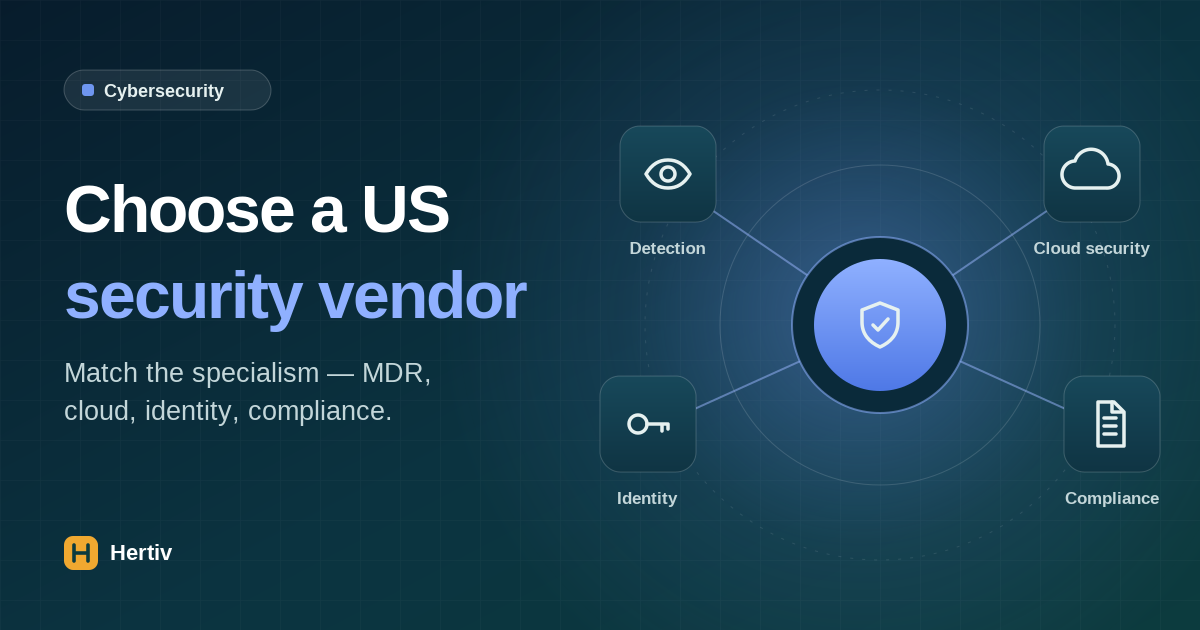
There is no single ranking of top US cybersecurity companies, because vendors specialise: some run managed detection and response, some secure cloud and applications, some focus on identity or compliance. Choose by matching the vendor's specialism to your biggest risk and your team's ability to operate the tools.
What kinds of cybersecurity companies are there in the USA?
US cybersecurity vendors cluster around a few jobs rather than one ranking. Understanding which job you are buying stops you comparing products that do not do the same thing.
| Category | What it does | Typical data needed | Effort to adopt |
|---|---|---|---|
| Managed detection and response (MDR) | Monitors endpoints, identity and cloud, triages alerts, responds | Endpoint agents, identity logs, cloud audit logs | Medium; depends on log coverage |
| Cloud security posture | Finds misconfigurations and policy gaps across cloud accounts | Cloud account read access, inventory | Low to medium |
| Application security testing | Scans code and running apps for vulnerabilities | Source code, CI pipeline access | Medium |
| Identity and access management | Controls who and what can reach systems | Directory, HR data, app inventory | High; touches every app |
| Compliance and GRC platforms | Tracks controls, evidence and audits | Policy documents, control mappings | Medium |
| Penetration testing firms | Manual testing of specific systems | Scoping call, test accounts | Low per engagement |
| Network and perimeter vendors | Firewalls, secure access, zero trust | Network diagrams, device fleet | Medium to high |
| Backup and recovery specialists | Isolated backups and ransomware recovery | Backup inventory, recovery targets | Medium |
A vendor that appears on a list of top US cybersecurity companies may sit in one row only. Many enterprise buyers combine two or three rows rather than buying everything from one supplier.
If you do not yet know which row you need, a short cybersecurity review for product and engineering teams usually settles it faster than a vendor comparison.
Managed detection and response: who is it for?
MDR is for teams that cannot staff a security operations centre around the clock. The provider watches your endpoints, identity logs and cloud activity, triages alerts and either advises or acts on incidents.
Established US providers in this space include CrowdStrike, SentinelOne, Arctic Wolf, Rapid7 and Expel, alongside the managed arms of larger consultancies. Each combines some mix of endpoint agent, log ingestion and a human analyst team.
What to check before you buy MDR
- Coverage: which log sources are included by default, and which cost extra.
- Response model: does the provider only alert, or can it isolate a host or disable an account?
- Handoff: how an incident reaches your on-call engineer, and in what format.
- Integration: whether their agent conflicts with tools you already run.
- Reporting: whether you get evidence you can hand to an auditor or insurer.
For a mid-market company, the practical question is not which provider has the largest threat feed, but whether its analysts understand your environment. A provider that has never seen your cloud setup will spend the first month learning it.
Cloud and application security vendors
Cloud and application security is where product companies spend most of their security budget after MDR. These vendors find configuration gaps, exposed services and vulnerabilities in code before attackers do.
Well-known US names include Wiz and Palo Alto Networks for cloud posture, Snyk and Veracode for code and dependency scanning, and Contrast Security for runtime application testing. The tools differ in how they connect to your environment: agentless snapshot scanning, sidecar agents, or CI pipeline integration.
What matters in practice
- Noise level: a scanner that reports hundreds of low-value findings will be ignored within weeks.
- Developer workflow: findings should appear where engineers already work, such as pull requests, not in a separate portal.
- Ownership mapping: the tool should say which team owns each cloud account or service.
- Remediation guidance: a finding without a concrete fix wastes engineering time.
A useful pattern for product teams is to run cloud posture scanning continuously and application scanning on every merge. That is a software engineering workflow question as much as a security one, and it often needs changes in the build pipeline described in software engineering services.
Identity, compliance and testing specialists
Identity, compliance and testing vendors solve narrower problems but often sit at the centre of enterprise security programmes. US examples include Okta and CyberArk for identity and privileged access, Vanta and Drata for compliance evidence, and specialist firms for penetration testing and red teaming.
Identity vendors decide who and what can reach your systems. They are the hardest to change later, because every application integrates with them. Choose on protocol support and migration path, not on a feature checklist.
Compliance platforms automate evidence collection for frameworks such as SOC 2 and ISO 27001. They are useful when you sell to enterprises and need to show controls, but they do not make you secure on their own; they record what you already do.
Penetration testing firms provide a point-in-time view from an attacker's perspective. For most teams, an annual test plus targeted tests after major architecture changes is a reasonable rhythm.
Questions that separate strong vendors from weak ones
- Which frameworks and regions do you support out of the box?
- Who writes the remediation plan, and is it included?
- How do you handle privileged accounts and break-glass access?
- What does the handover look like when we leave?
For companies preparing for enterprise procurement, a data security and compliance review often runs in parallel with vendor selection.
How to choose among top cybersecurity companies
Choose by risk and operating capacity, not by brand recognition. A short, structured process beats a long vendor list.
- Name your top three risks. For example: ransomware on employee laptops, exposed cloud storage, or a supplier breach. Write them down with the systems involved.
- Map each risk to a category. Ransomware usually points to MDR plus backup. Exposed cloud storage points to posture scanning. Supplier risk points to third-party assessment.
- Check what your team can operate. A tool that needs a dedicated analyst is a poor fit for a five-person platform team. Prefer managed services where you lack staff.
- Run a proof of value on real data. Give each shortlisted vendor the same scope and compare the quality of findings, not the length of the report.
- Price the whole picture. Include integration work, log storage, staff time and renewal terms, not just the first-year licence.
Example (hypothetical): a 120-person SaaS company with two platform engineers shortlists three MDR providers and two cloud posture tools. It picks one of each, and budgets roughly two engineer-weeks for integration. That is a planning figure, not a quote; real effort varies with log coverage and cloud complexity.
Common mistakes when buying US cybersecurity vendors
Most failed security purchases fail for organisational reasons, not because the product was weak. These mistakes recur across mid-market and enterprise buyers.
- Buying by logo. A vendor that suits a bank may be overbuilt and overpriced for a 150-person product company.
- Skipping the integration plan. Log ingestion, agent rollout and identity changes take longer than the sales cycle suggests.
- Ignoring alert ownership. Without a named owner, alerts pile up and the tool becomes shelfware.
- Treating compliance as security. A certificate does not stop an attacker; controls do.
- Signing multi-year deals before a trial. A short proof of value reduces the risk of a poor fit.
- Forgetting staff training. Tools only help if engineers and support staff know what to do when something looks wrong.
A practical countermeasure is to write a one-page operating model before you talk to vendors: who monitors, who responds, who approves changes and how incidents are reported to leadership. Vendors can then be scored against that model.
If your team lacks the bandwidth to run this process, a cybersecurity services engagement can provide the operating model and vendor shortlist.
Key takeaways
- Split the market by job: managed detection, cloud and app security, identity, compliance and testing are different purchases.
- For most mid-market teams, a managed detection and response provider plus a cloud security posture tool covers the most ground.
- Ask every vendor who does the work, how alerts reach your team, and what happens at 2am.
- Run a short proof of value on your own telemetry before signing an annual contract.
- Budget for integration and staff time, not just licence cost; that is where most deployments stall.
Frequently asked questions
Who are the biggest cybersecurity companies in the USA?
By revenue and reach, the largest US-headquartered security vendors include Microsoft's security division, Palo Alto Networks, CrowdStrike, Fortinet and Cisco's security business. Size is not the same as fit, though; many mid-market teams get better value from specialists focused on one category.
Should I choose one vendor or several?
Several specialists usually beat one generalist for mid-market teams. A common combination is a managed detection provider, a cloud posture tool and a compliance platform. Consolidation makes sense mainly at large enterprises with a staffed security team.
How long does it take to deploy a US cybersecurity vendor?
A cloud posture tool can be running in days. MDR typically takes a few weeks to reach full log coverage. Identity and access projects often take months because every application must integrate. Plan integration effort before signing.
Do US cybersecurity vendors work with companies in the UK, EU and Middle East?
Most do, but data residency and support hours vary. Check where logs are stored, which region handles support, and whether the contract meets local requirements such as GDPR. Ask for the specific data processing terms, not a general statement.
How do I evaluate a proof of value?
Give every shortlisted vendor the same scope, the same data sources and the same two-week window. Compare the number of actionable findings, the quality of the explanation and how quickly the vendor's team responds. Score against your operating model, not the demo.
What if we have no dedicated security team?
Choose managed services rather than tools you must operate yourself. A managed detection provider and a compliance platform with guided onboarding cover a lot of ground. Fill remaining gaps with a partner for periodic testing and architecture review.


