Who Are the Top Cybersecurity Companies in Texas?
Texas has a deep bench of security firms, but the right pick depends on your threat model, compliance needs and team maturity. Here is how the major players differ.
On this page
Short answer
Texas hosts a mix of global security vendors headquartered there, national consultancies with large local practices, and boutique firms focused on audit, incident response or managed detection. The right choice depends on whether you need a product, a consultancy or an outsourced security team.
What kinds of cybersecurity companies operate in Texas
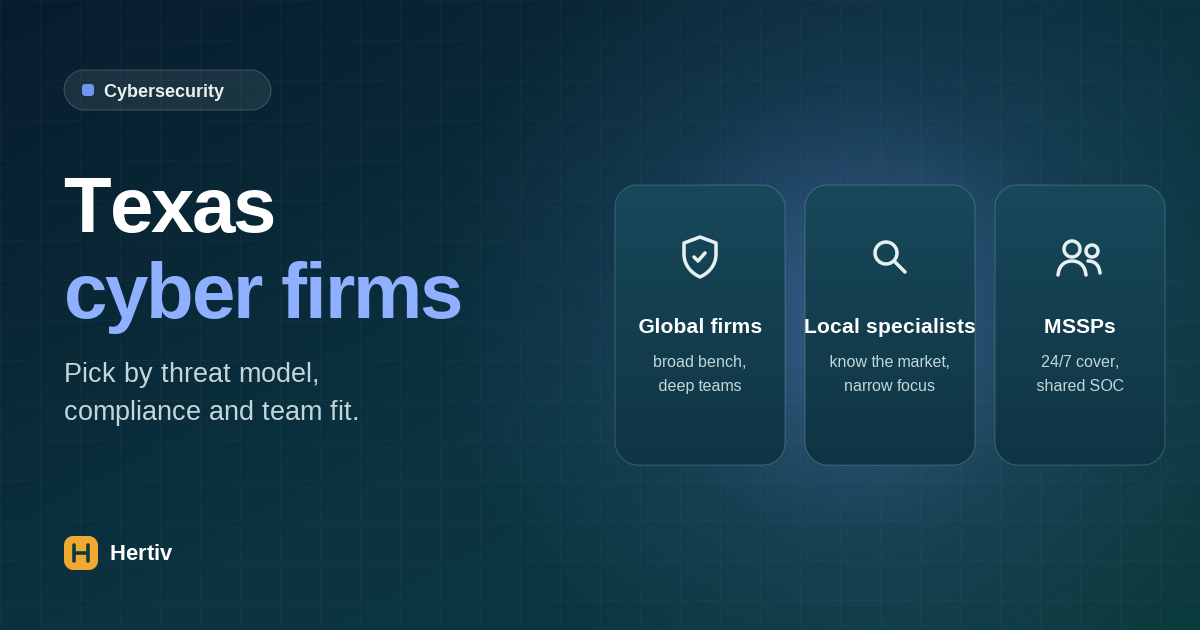
Texas security firms fall into four buckets: product vendors, consultancies, managed service providers and specialist boutiques. Knowing which bucket you need narrows the list fast.
The state has a long history as a technology and energy hub, and that shows in the local security market. Dallas, Austin, Houston and San Antonio each have distinct specialisms, from enterprise networking and cloud security to industrial control systems and defence-adjacent work.
Use this comparison to map your need to a category before you look at individual firms.
| Type | What it does | Typical buyers | Effort to engage |
|---|---|---|---|
| Product vendor | Sells tooling: endpoint, cloud, network, identity | Security and IT teams with in-house operations | Weeks |
| Consultancy | Assessments, pen tests, architecture, compliance | CTOs, CISOs, compliance leads | Weeks |
| Managed security | Runs detection and response for you (MSSP/MDR) | Teams without 24/7 SOC coverage | Weeks to months |
| Incident response | Handles active breaches and forensics | Anyone, usually urgently | Days |
| Advisory boutique | Virtual CISO, policy, programme design | Mid-market firms without a full-time CISO | Days to weeks |
| OT/ICS specialist | Secures plants, grids and industrial systems | Energy, manufacturing, utilities | Weeks to months |
Most organisations end up combining at least two categories. A product alone rarely fixes a weak process, and a report alone rarely fixes a tooling gap.
Global vendors headquartered in Texas
Several well-known security vendors are based in Texas, which makes them easy to reference but not automatically the right fit. These firms are strong when you need a mature platform and can staff the operations yourself.
1. CrowdStrike: best for endpoint and cloud-native detection
CrowdStrike is headquartered in Austin and is known for its cloud-delivered endpoint protection and threat intelligence. It suits organisations that want a single platform covering endpoint, identity and cloud workloads.
Pros - Broad platform with strong threat intelligence - Well documented integrations with common enterprise tools
Cons - Requires security staff to operate and tune it - Enterprise pricing and contracts can be heavy for smaller teams
2. Forcepoint: best for data security and network controls
Forcepoint, based in Austin, focuses on data loss prevention, cloud access security and network security. It fits regulated organisations that need to control where sensitive data moves.
Pros - Strong data-centric security story - Useful for policy-heavy environments
Cons - Multiple product lines can complicate procurement - Deployment needs careful planning
3. Rapid7: best for vulnerability management and exposure
Rapid7 has a significant Austin presence and covers vulnerability management, detection and response. It is a reasonable choice for teams building a continuous exposure programme.
Pros - Solid vulnerability and exposure tooling - Good reporting for engineering stakeholders
Cons - Findings still require internal triage capacity - Overlap with existing tools is common
Products like these are a foundation, not a strategy. If your gap is process or staffing, see cybersecurity services for product and engineering teams.
Consultancies and assessment firms with Texas practices
Consultancies are the right call when you need an independent assessment, a compliance gap analysis or architectural review. Many national firms maintain large Dallas, Houston and Austin offices.
4. Deloitte, EY, KPMG and PwC: best for regulated, large-scale programmes
All four major accounting and advisory networks have substantial Texas operations and security risk practices. They suit enterprises that need compliance attestation support, programme governance or board-level reporting.
Pros - Deep compliance and audit experience - Credible with regulators and boards
Cons - High cost relative to boutique alternatives - Deliverables can be document-heavy rather than engineering-led
5. Accenture Security: best for large transformation programmes
Accenture has a strong Texas presence and combines advisory with implementation. It fits organisations modernising security across many systems at once.
Pros - Can deliver strategy and build in one engagement - Broad industry experience
Cons - Best value at larger programme sizes - Less suited to small, focused audits
6. Optiv: best for vendor-neutral advisory at scale
Optiv is a large security solutions integrator with Texas coverage, offering advisory, integration and managed services across many vendor products.
Pros - Vendor-neutral guidance across a wide portfolio - Can bundle assessment and implementation
Cons - Engagement quality varies by local team - Commercial incentives still exist around product resale
Whatever the firm, insist that findings come with remediation guidance your own engineers can act on.
Managed detection and response providers
Managed security is the pragmatic answer for teams that cannot staff a 24/7 security operations centre. These providers monitor, triage and respond on your behalf.
7. Huntress: best for mid-market managed detection
Huntress is widely used by mid-market teams and managed service providers for endpoint detection, response and managed security coverage. It fits organisations without a dedicated SOC.
Pros - Designed for lean IT teams - Clear alerting rather than raw telemetry
Cons - Less customised than a bespoke SOC build - Coverage depends on which layers you buy
8. Arctic Wolf: best for outsourced SOC coverage
Arctic Wolf offers managed detection and response plus security operations services, including a Texas presence. It suits firms that want monitoring treated as an outsourced function.
Pros - Concierge-style security operations - Broad coverage across endpoint, network and cloud
Cons - Multi-year commitments are common - Less attractive if you already have a capable internal SOC
9. Local and regional MSSPs
Texas has many regional managed service providers offering security monitoring alongside IT support. They can be a good fit for smaller firms that want one accountable partner.
Pros - Local response and relationship - Often bundles IT and security
Cons - Security depth varies widely - Ask for evidence of detection engineering, not just tooling
Boutique and specialist security firms
Boutiques win on focus. They are often the best value for penetration testing, cloud security review, application security or virtual CISO work.
10. Application security and pen-test specialists
Smaller Texas firms focused on web, mobile and API testing are often staffed by former engineers. They suit product companies shipping frequently.
Pros - Testers who understand code and CI pipelines - Faster, more engineer-friendly reports
Cons - Limited coverage outside their niche - Capacity can be tight
11. Virtual CISO and compliance boutiques
These firms provide part-time security leadership and help prepare for SOC 2, ISO 27001, HIPAA or PCI DSS.
Pros - Affordable alternative to a full-time CISO - Practical policy and control design
Cons - Not a substitute for hands-on engineering - Quality depends heavily on the individual assigned
12. OT and industrial security specialists
Houston and the Gulf Coast host firms specialising in operational technology, reflecting the region's energy and manufacturing base.
Pros - Rare expertise in plant and grid environments - Understand safety-critical constraints
Cons - Narrow applicability outside industrial settings - Longer assessment timelines
If your product team needs security built into delivery rather than bolted on, software engineering services can pair with a specialist assessment.
How to prioritise your shortlist
Start from the gap you can actually close in the next two quarters, then match firms to it. A shortlist built around a clear need beats a list of famous names.
- Define the outcome. Write down whether you need a report, a running service, a tool or a person. These lead to different vendors.
- Check sector experience. Ask for examples in your industry and regulatory regime, such as healthcare, finance or energy.
- Test the handover. Ask how findings are delivered to engineers, whether tickets or exports are supported, and who answers follow-up questions.
- Verify coverage and response. For managed services, ask about detection coverage, escalation paths and what happens on a live incident.
- Scope a small first engagement. A time-boxed assessment or pilot reduces risk before a multi-year contract.
Budget varies by scope, but focused boutique assessments typically cost less than global consultancy programmes. Treat any range you receive as indicative until scoped.
Common mistakes when choosing a Texas security firm
Most bad outcomes trace back to a mismatched brief rather than a bad firm. Avoid these patterns.
- Buying a platform before defining the process it should support.
- Choosing a firm because it is headquartered nearby rather than because it fits your sector.
- Skipping the question of who remediates findings and how long that takes.
- Assuming a compliance certificate means the underlying systems are secure.
- Signing multi-year managed contracts without a trial or exit clause.
- Ignoring application security until after a launch.
If you are building software and want security review embedded in delivery, custom software development with security in the loop is usually cheaper than post-launch fixes.
A useful final check: ask each shortlisted firm what they would do in your first thirty days. The answer tells you more than any capability deck.
Key takeaways
- Texas combines large vendor headquarters, big-four style consultancies and boutique security shops, so shortlists should start from your need type
- Managed detection and response, penetration testing and compliance readiness are the three most common purchase categories
- A product vendor and a services firm solve different problems; many teams need both
- Check whether the firm can support sector rules such as HIPAA, PCI DSS, SOC 2 or FedRAMP
- Ask how findings are handed to your engineers, not just how they are reported
- Boutique firms often fit mid-market budgets better than global consultancies for focused audits
Frequently asked questions
Which cybersecurity company in Texas is best for a mid-market company?
It depends on the gap. For continuous monitoring without a SOC, a managed detection provider fits best. For assessments and compliance readiness, a boutique advisory firm is often better value. Large consultancies suit enterprises with governance-heavy programmes.
Do I need a Texas-based firm at all?
Not necessarily. Many security services are delivered remotely. Local presence helps for incident response, on-site assessments and industrial environments, but a strong remote firm can outperform a weaker local one.
What is the difference between an MSSP and an MDR provider?
An MSSP typically bundles monitoring with broader IT services, while an MDR provider focuses on detection and response across endpoint, network and cloud. MDR usually implies deeper investigation and response, not just alert forwarding.
How should I evaluate a penetration testing firm?
Ask about tester experience, methodology, whether they test APIs and business logic, how findings are rated and whether retesting is included. Request a sample report and check that remediation guidance is specific enough for engineers to act on.
Can a cybersecurity firm help with SOC 2 or ISO 27001?
Yes. Advisory firms commonly prepare control documentation, gap analyses and evidence for these frameworks. Note that preparation is separate from the audit itself, which must be performed by an independent auditor.
How long does a typical security assessment take?
Focused assessments often run a few weeks from kickoff to report, while broader programmes take a quarter or more. Incident response is compressed into days. Scope, system count and evidence availability drive the timeline.


