Top 6 Blockchain Consulting Agencies to Shortlist
Six blockchain consulting agencies worth a shortlist, from large firms to specialist builders. Compare what each does best and how to pick one.
On this page
Short answer
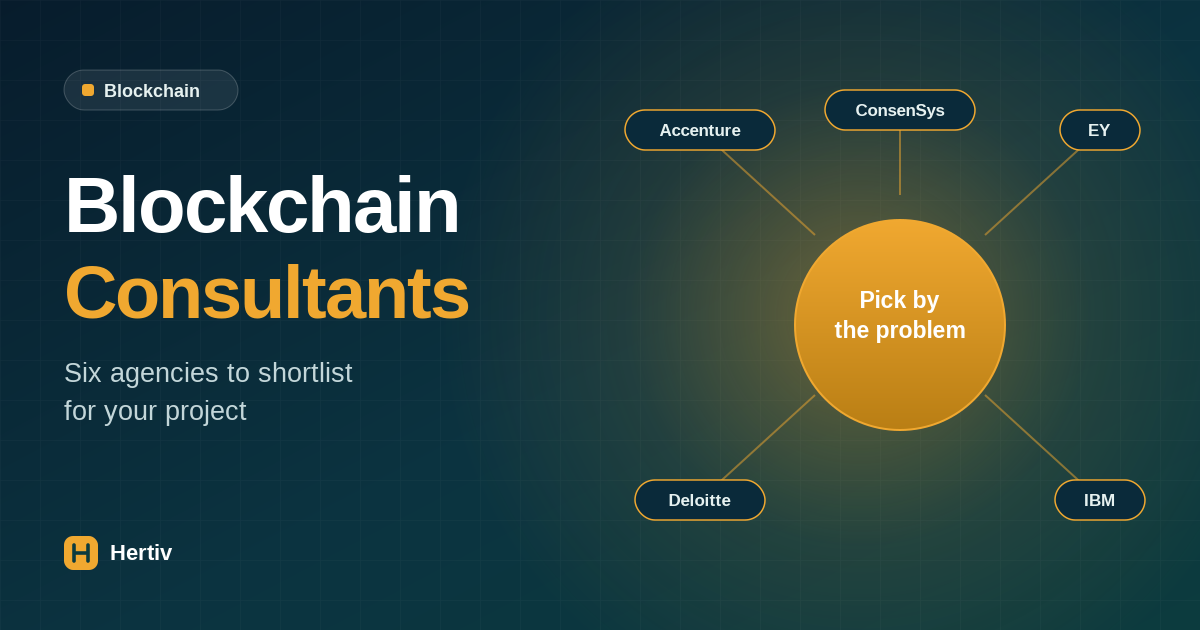
The blockchain consulting agencies worth a shortlist are Accenture for large enterprise programmes, Deloitte for regulated industries, EY for tax and audit-aware builds, IBM Consulting for enterprise blockchain platforms, ConsenSys for Ethereum work, and PwC for strategy and compliance. Each one leans on a different strength, so pick by the problem you need solved, not by size alone.
Which blockchain consulting agencies should you shortlist?
Shortlist a blockchain consulting agency by what it has actually delivered, not by how many blockchain slides it has. The six firms below all run real blockchain programmes, and each one is strongest in a different place: enterprise scale, regulated industries, tax and audit, platform engineering, Ethereum depth, or strategy and compliance.
Every firm here can advise on strategy, build a pilot and connect a blockchain to your existing systems. The differences show up in how they staff a project, how they handle regulation, and whether they stay to run the system after launch. The table below compares them at a glance.
| Agency | Best for | Main strength | Watch out for |
|---|---|---|---|
| Accenture | Large programmes | Global delivery, many industries | Premium fees, long sales cycle |
| Deloitte | Regulated industries | Risk, controls and compliance | Heavy process on small pilots |
| EY | Tax and audit-aware builds | Accounting and reporting depth | Less known for pure engineering |
| IBM Consulting | Enterprise platforms | Hyperledger and platform work | Best value on IBM platforms |
| ConsenSys | Ethereum work | Deep Ethereum and wallet expertise | Narrower than the big firms |
| PwC | Strategy and compliance | Board-level advice, assurance | Less hands-on with code |
The list is alphabetical, not ranked. A firm at the top of an alphabetical list is not better than one further down, and a firm that fits a bank may not fit a small startup. Pricing varies widely, so check the vendor site for current fees before you compare costs.
1. Accenture: best for large blockchain programmes
1. Accenture: best for large blockchain programmes
Accenture runs blockchain programmes for large companies across banking, supply chain, energy and government. Its teams cover strategy, design, engineering and running the system afterwards, and they work in many countries at once, which suits companies that need the same solution in several markets.
It fits companies that need scale and staying power: a multi-year programme, several systems to connect, and a partner that will still be there in three years. The trade-off is cost and pace, since large firms move more slowly on small pilots. For a related view, the guide to blockchain explains the technology these programmes build on.
Pros:
- Global delivery across many industries
- Covers strategy, build and support
- Stays for long-running programmes
Cons:
- Premium fees
- Slow start on small pilots
- See vendor site for pricing
2. Deloitte: best for regulated industries
2. Deloitte: best for regulated industries
Deloitte advises banks, insurers and governments on blockchain, with a strong focus on risk, controls and compliance. Its teams pair technologists with auditors and lawyers, so the design accounts for regulation from the start rather than as an afterthought.
It fits companies in regulated industries where a blockchain must pass audit and satisfy a regulator. The trade-off is process: Deloitte's method is thorough, which suits a bank and frustrates a startup that wants a pilot next week.
Pros:
- Deep risk and compliance knowledge
- Auditors and lawyers on the team
- Trusted by regulators and boards
Cons:
- Heavy process on small builds
- See vendor site for pricing
- Less suited to fast experiments
3. EY: best for tax and audit-aware builds
3. EY: best for tax and audit-aware builds
EY advises on blockchain with a focus on tax, accounting and reporting, and it has built tools for privacy-preserving transactions and for reconciling blockchain records with company accounts. Its teams work with finance departments as much as with engineers.
It fits companies whose blockchain must produce numbers the finance team can trust: tokenised assets, supply chain finance, or any system where the ledger feeds the accounts. The trade-off is engineering depth, since EY is an advisory firm first and a builder second.
Pros:
- Strong tax and accounting knowledge
- Tools for privacy and reconciliation
- Trusted by finance teams
Cons:
- Less known for pure engineering
- See vendor site for pricing
- Needs a build partner for large systems
4. IBM Consulting: best for enterprise blockchain platforms
4. IBM Consulting: best for enterprise blockchain platforms
IBM Consulting builds enterprise blockchain systems, often on Hyperledger Fabric, for supply chain, trade finance and identity. Its teams combine platform engineering with IBM's cloud and integration services, so the blockchain connects to the systems a large company already runs.
It fits companies that want a permissioned platform with known participants and clear governance, rather than a public chain. The trade-off is that the deepest value comes when the company already uses IBM platforms, so teams on other stacks get less of the benefit.
Pros:
- Strong Hyperledger and platform work
- Connects to enterprise systems
- Long experience with large clients
Cons:
- Best value on IBM platforms
- See vendor site for pricing
- Less focused on public chains
5. ConsenSys: best for Ethereum work
5. ConsenSys: best for Ethereum work
ConsenSys is a specialist firm built around Ethereum, covering wallets, smart contracts, developer tools and enterprise Ethereum networks. Its teams have worked on Ethereum since the early days, and its tools, such as MetaMask and Infura, are used by developers across the ecosystem.
It fits companies building on Ethereum or on Ethereum-compatible networks, especially where wallets, tokens or smart contracts are central. The trade-off is breadth: ConsenSys is narrower than the big firms, so a programme that needs strategy, tax and engineering across many areas may need a second partner. The guide to smart contract development explains the work these teams do.
Pros:
- Deep Ethereum and wallet expertise
- Own widely used developer tools
- Strong smart contract practice
Cons:
- Narrower than the big firms
- See vendor site for pricing
- Less suited to non-Ethereum chains
6. PwC: best for strategy and compliance
6. PwC: best for strategy and compliance
PwC advises companies on blockchain strategy, governance and assurance, helping boards decide where blockchain helps and where it does not. Its teams pair strategy consultants with assurance specialists, so the advice covers both the business case and the controls.
It fits companies that need a clear decision before they build: a strategy, a governance model and a compliance plan, with a pilot to prove the case. The trade-off is hands-on engineering, since PwC usually works with a build partner for the code.
Pros:
- Board-level strategy and advice
- Strong governance and assurance
- Helps decide what not to build
Cons:
- Less hands-on with code
- See vendor site for pricing
- Needs a build partner for delivery
How to choose a blockchain consulting agency
Start from the problem, not the firm. If you need scale across countries, Accenture fits. If you need to satisfy a regulator, Deloitte fits. If the numbers must reach the accounts, EY fits. If you want a permissioned platform, IBM Consulting fits. If you are building on Ethereum, ConsenSys fits. If you need a decision first, PwC fits.
- Write down the one outcome the programme must deliver in six months.
- Shortlist two firms whose strength matches that outcome.
- Ask each for a pilot plan, a team list and a fixed scope.
- Check two past projects in your industry, and ask what went wrong.
- Pick the firm whose team you would trust with your own data.
Keep the pilot small and the success measure written down. A pilot that proves one flow end to end says more than a strategy deck, and it gives you the evidence to fund the next stage.
Common mistakes
The most common mistake is hiring a large firm for a small experiment. A big programme team on a two-week pilot costs more than the learning is worth, and the process slows the test. Match the size of the firm to the size of the question.
Another mistake is choosing by brand instead of by team. The people who will actually do the work matter more than the firm's name, so meet the team, read their past work, and ask who will be on your project day to day.
Key takeaways
- Pick by the problem, not by firm size
- Accenture and Deloitte fit large and regulated programmes
- EY fits tax and audit-aware builds
- IBM Consulting fits permissioned platforms
- ConsenSys fits Ethereum work; PwC fits strategy first
Frequently asked questions
How much does a blockchain consulting agency cost?
Costs vary widely by scope, team size and country, from a short strategy review to a multi-year programme. Ask two firms for a written quote on the same brief, and check the vendor site for current fees before you compare.
Should a startup hire a big blockchain consulting firm?
Usually not for the first pilot. A specialist team or a small engagement fits a startup better, since the big firms are built for large programmes. Use the big firms when the programme spans countries or regulators.
What is the difference between a blockchain agency and a developer?
An agency advises on strategy, design and governance as well as building, while a developer focuses on the code. Hire an agency when you need the decision as well as the build, and a developer when the plan is already clear.
Do I need a blockchain consultant if I have engineers?
It depends. If your engineers have shipped blockchain systems before, you may not. If they have not, a consultant can save months by naming the risks early, especially around security and compliance.
How do I check a blockchain agency's past work?
Ask for two projects in your industry, with a named contact you can call. Ask what went wrong and how it was fixed. A firm that cannot name a past problem is either new or not being honest.
Can one agency cover strategy and building?
Some can, and Accenture and IBM Consulting are built for it. Others, such as PwC, usually work with a build partner. Ask who does the coding before you sign, not after.


