Top AI Programming Languages and When to Use Each
Python leads for AI work, but JavaScript, R, Java, C++ and Julia each fit different jobs. Compare the six languages and pick by the work you do.
On this page
Short answer
Python leads AI work because of its libraries, but JavaScript, R, Java, C++ and Julia each fit different jobs: browser features, analysis, enterprise systems, devices and research. Pick the language by the job, the team and where the model runs.
Which programming languages are used for AI?
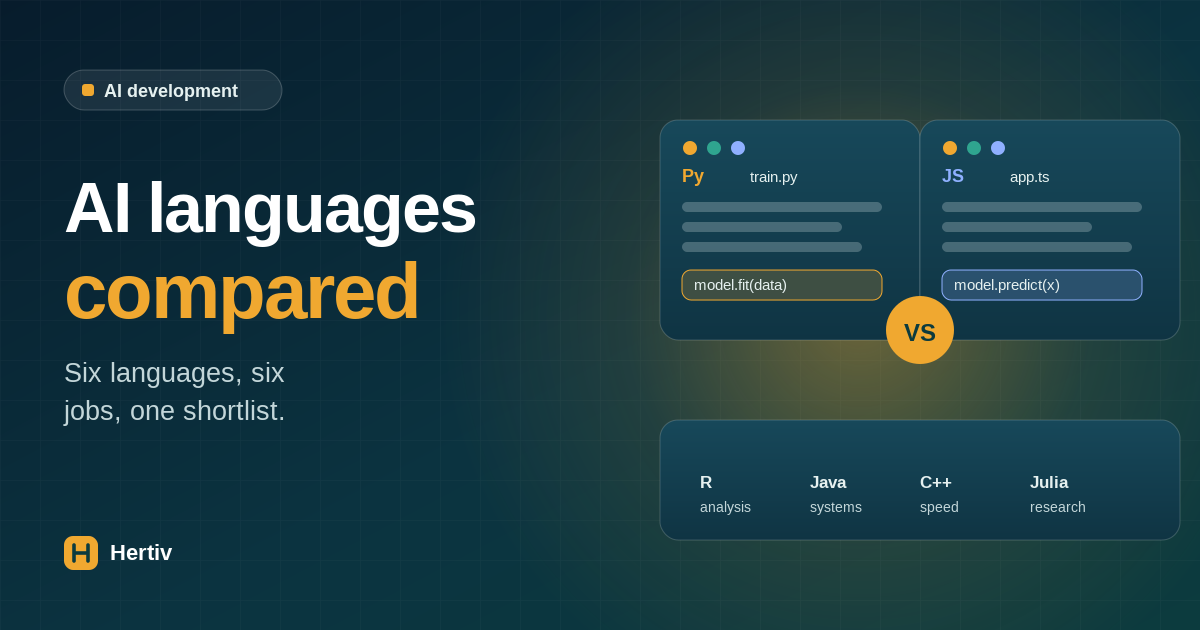
The programming languages used for AI are the ones with strong libraries, good tooling and a community that shares working code. Six names cover most of the work: Python, JavaScript and TypeScript, R, Java, C++ and Julia. Each one fits a different job.
The table below gives a quick map. Read it to shortlist two, then look at the detail for each language before you commit a team to one.
| Language | Known for | Best for |
|---|---|---|
| Python | TensorFlow, PyTorch, scikit-learn | Most AI work |
| JavaScript / TypeScript | TensorFlow.js, in-browser models | AI in the browser |
| R | Statistics and visualisation | Data analysis and research |
| Java | Enterprise systems, Deeplearning4j | AI inside large systems |
| C++ | Speed, on-device inference | Performance-critical code |
| Julia | Speed with simple syntax | Research and simulation |
No single language covers everything. A team that trains models in Python, serves them in Java and runs them in a browser will use three languages, and that is normal. The choice is about which job each one does well.
1. Python: best for most AI work
Python is the default language for AI work, and it earned that place through its libraries. TensorFlow, PyTorch and scikit-learn cover training, evaluation and deployment, and the ecosystem around them includes data tools, notebooks and model registries that teams share.
Its strength is how fast a team can move. A prototype that takes a week in another language often takes a day in Python, because the libraries already solve the hard parts. The trade-off is speed: Python is slower than compiled languages, so heavy work is usually handed to libraries written in C or run on a GPU.
Pros:
- Largest ecosystem: the most libraries, examples and trained people
- Fast to prototype: short code, quick iteration
- Strong tooling: notebooks, data tools and model registries
Cons:
- Slow on its own: heavy work needs libraries or a GPU
- Packaging pain: environments and versions need care
- Not for devices: rarely the choice for tiny hardware
2. JavaScript and TypeScript: best for AI in the browser
JavaScript and TypeScript are the languages for AI that runs in the browser or on a server built with Node. TensorFlow.js lets a team run a model in a web page, so a user gets an answer without sending data to a server.
Its strength is reach. Every browser runs JavaScript, so a model that runs in the browser works for every user without an install. That suits features like image checks, text suggestions and real-time analysis inside a web app. The trade-off is that browser models are smaller and slower than server models.
Pros:
- Runs everywhere: every browser and Node server
- Private by design: data can stay on the user's device
- Same language as the app: one team, one stack
Cons:
- Smaller models: browser limits keep models small
- Thinner AI ecosystem: fewer libraries than Python
- Harder training: training in the browser is rare
3. R: best for data analysis and research
R is a language built for statistics, and it is still the first choice for many researchers and analysts who work with data. Its packages cover modelling, testing and visualisation, and its plots are a standard way to present results.
Its strength is analysis depth. An analyst can explore a dataset, fit a model and draw a clear chart in a few lines, and the result is easy to check. The trade-off is that R is rarely used to ship a product: most teams analyse in R and deploy in Python or Java.
Pros:
- Built for statistics: modelling and testing are first-class
- Clear charts: visualisation is a core strength
- Strong in research: common in academia and data teams
Cons:
- Not for products: rarely used to ship software
- Slower for large data: needs care at scale
- Smaller hiring pool: fewer engineers know it well
4. Java: best for AI inside large systems
Java is the language of large enterprise systems, and AI inside those systems often has to live in Java. Libraries such as Deeplearning4j bring neural networks to the JVM, and Java's tooling for deployment, monitoring and security is well proven.
Its strength is fit. A bank or a hospital that already runs Java systems can add a model without rebuilding the platform, and the team that maintains the system already knows the language. The trade-off is that the AI ecosystem in Java is thinner than in Python, so training usually happens elsewhere and the model is served in Java.
Pros:
- Fits existing systems: no platform rebuild needed
- Strong tooling: deployment and monitoring are proven
- Large hiring pool: many engineers know Java
Cons:
- Thinner AI libraries: training usually happens in Python
- More code: longer to write the same feature
- Slower to prototype: iteration takes longer
5. C++: best for performance-critical AI code
C++ is the language behind most of the fast parts of AI. The libraries that Python calls for heavy work are often written in C++, and on-device inference, games and robotics still run on it directly.
Its strength is speed and control. A team that needs a model to run on a small device, or to answer in a few milliseconds, writes the hot path in C++. The trade-off is development time: C++ takes longer to write and debug, so it is used where speed matters most, not for the whole product.
Pros:
- Fastest option: full control over speed and memory
- Runs on devices: phones, robots and embedded hardware
- Powers the libraries: Python's speed comes from C++ underneath
Cons:
- Slow to write: more code and harder debugging
- Smaller AI community: fewer shared examples
- Harder to hire: fewer engineers specialise in it
6. Julia: best for research and simulation
Julia is a language built for scientific computing, and it is gaining ground in AI research where speed and simple syntax both matter. It runs fast without the compile step that C++ needs, and its syntax reads like Python.
Its strength is the combination: a researcher can write code that looks simple and still runs fast on large simulations. That suits work such as scientific modelling, optimisation and simulation-heavy research. The trade-off is the ecosystem: Julia has fewer libraries and fewer trained people than Python, so a team that picks it should be ready to build more itself.
Pros:
- Fast and readable: speed without C++ complexity
- Built for science: strong for simulation and modelling
- Growing community: active in research labs
Cons:
- Smaller ecosystem: fewer libraries than Python
- Harder to hire: fewer engineers know it
- Less production use: rare in shipped products
How to choose an AI programming language
You choose an AI programming language by matching it to the job, the team and where the model will run. Start with the job, then check the fit.
- Name the job. Training a model, serving one, analysing data or running on a device are different jobs, and each points to a different language.
- Check the team's skills. A language the team already knows beats a better language they must learn, especially for the first project.
- Check where it runs. A browser feature needs JavaScript, a device feature needs C++, and a server feature can use Python or Java.
- Check the libraries. Find out whether the libraries you need exist and are maintained in that language before you commit.
- Plan for more than one. Most AI products mix languages: Python to train, another to serve. Accept that from the start.
A short pilot answers most of these questions. Build one real feature in the shortlisted language and measure how long it takes and how well it runs. For teams choosing a stack for a first product, AI product development work usually starts with that pilot.
For a closer look at the two most common choices, see Java vs Python.
What are the common mistakes?
The most common mistakes when choosing an AI programming language are picking on popularity alone, ignoring where the model runs, and refusing to mix languages.
- Picking on popularity. The most used language is not always the best fit for your job. Match the language to the work.
- Ignoring where it runs. A model trained in Python still needs a home in production, and that home may need another language.
- Refusing to mix. One language for everything sounds tidy, but it usually means using the wrong tool for part of the job.
- Underestimating hiring. A language with few engineers costs more to staff, and that cost lasts for years.
- Choosing on speed alone. The fastest language is not the best choice if the team cannot write it well or the libraries are missing.
Another mistake is treating the language as the product. The data, the model and the checks around it matter far more than the language they are written in. A team that gets those right can change languages later without starting over.
Key takeaways
- Python is the default for training and prototyping
- JavaScript fits AI that runs in the browser
- R is for analysis, Java for large systems
- C++ is for speed, Julia for research
- Most AI products mix more than one language
Frequently asked questions
Is Python the best language for AI?
For most AI work, yes. Python has the largest set of libraries, the most examples and the most trained people. It is the default for training and prototyping, even when another language serves the model in production.
Can I use JavaScript for AI?
Yes, for AI that runs in the browser or on a Node server. TensorFlow.js lets a model run in a web page so data stays on the user's device, though browser models are smaller and slower than server models.
Is R still used for AI?
Yes, mainly for data analysis and research. R is strong for statistics, modelling and visualisation, and it is common in academia and data teams, though most products are deployed in Python or Java.
Which language is fastest for AI?
C++ is the fastest option, with full control over speed and memory. It powers the libraries Python calls for heavy work, and it is the choice for on-device inference and performance-critical code.
Should I learn Julia for AI?
Julia suits research and simulation work where speed and readable code both matter. It has a smaller ecosystem than Python, so learn it if your work is scientific computing rather than shipping products.
Do I need to know more than one language for AI?
Usually, yes. Most AI products mix languages: Python to train a model, another language to serve it, and JavaScript for the browser. Knowing two languages is normal for AI work.


