Synthetic Data in Healthcare: What It Is and When to Use It
Synthetic data in healthcare is artificially generated patient data that keeps the statistical patterns of real records without exposing real people. Here is when it works.
On this page
Short answer
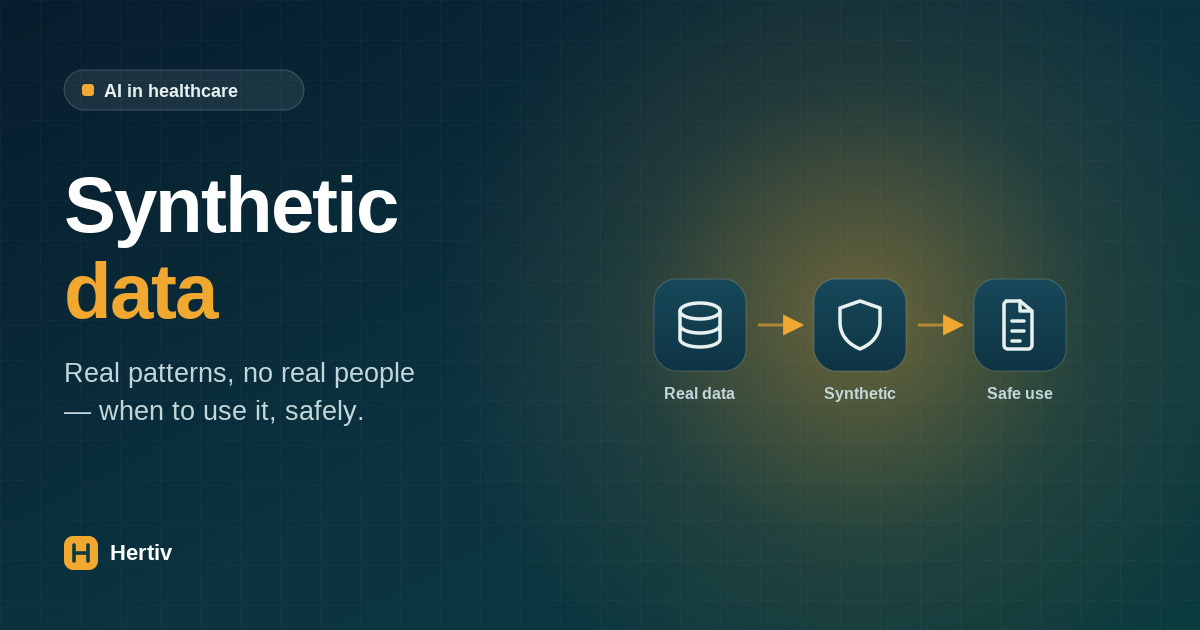
Synthetic data in healthcare is artificially generated patient data that preserves the statistical patterns of real records without exposing real individuals. Teams use it to train models, test software and share datasets when real patient data is scarce, regulated or too sensitive to move.
What is synthetic data in healthcare?
Synthetic data in healthcare is data generated by a model rather than collected from a patient, built to mimic the structure and statistics of real clinical records. It can be a table of lab values, a set of medical images, a stream of claims or a full patient timeline.
The point is not to invent medicine. The point is to produce records that behave like real ones for a defined task: training a classifier, testing a hospital integration, sharing a dataset with a partner or filling gaps where a condition is rare. A good synthetic dataset preserves the relationships that matter for the task, such as the correlation between kidney function markers and length of stay, while breaking the link to any real person.
Two terms come up constantly. Fidelity is how closely the synthetic data matches the real distribution. Privacy is how hard it is to trace a synthetic record back to a real patient. They pull against each other. A generator that memorises real records has high fidelity and poor privacy.
A generator that adds too much noise protects privacy and destroys the signal a model needs. Most of the engineering work sits in that trade-off.
Synthetic data is not a replacement for real clinical evidence. It is a tool for the parts of the pipeline where real data is scarce, restricted or unsafe to use directly.
Where does synthetic data actually help in healthcare?
The clearest wins are in software testing, model training where labels are scarce, and data sharing across organisational or national boundaries.
Testing and development environments
Hospital systems and health tech vendors need realistic test data for integrations, migrations and QA. Real patient data in a test environment is a compliance problem. Synthetic records let engineers reproduce edge cases such as conflicting medication lists or unusual insurance combinations without exposing anyone.
Rare conditions and small cohorts
When a disease affects few patients, a model may see only a handful of examples. Synthetic augmentation can add variation to the training set. The caution is strong: augmentation helps most when the synthetic data is clearly labelled and validated on real held-out cases.
Privacy-preserving collaboration
Two organisations may want to train a shared model without exchanging patient records. Synthetic data, or models trained in a federated setup with synthetic sharing, can support that. Read more about how this fits into broader AI for healthcare providers and health tech programmes.
Model pre-training and stress testing
A team can pre-train on synthetic data, then fine-tune on a smaller real set. Synthetic data is also useful for stress testing: generating rare adverse-event patterns to see whether a monitoring system fires correctly.
Example (hypothetical): a lab has 400 real records for a rare metabolic condition. It generates 4,000 synthetic records, trains on the combined set, and evaluates on 100 real records held out from the start. The synthetic records are used only for training and never enter the validation set.
How is synthetic healthcare data generated?
There are four practical families of generator, and most real projects combine at least two.
- Statistical models. Copulas, Bayesian networks and rule-based samplers. They are interpretable and fast, and good for tabular records such as claims or demographics. They struggle with high-dimensional data like images.
- Deep generative models. GANs and VAEs are common for medical imaging and signals. They can produce convincing images, but they need careful evaluation for mode collapse, where the generator produces a narrow set of patterns.
- Diffusion models. Increasingly used for imaging because they produce high-fidelity samples, at the cost of compute and slower generation.
- LLM-based synthesis. Large language models can generate clinical notes, discharge summaries and structured records in text form. They are useful for natural-language data, but they can hallucinate clinically implausible content, so outputs need rules and review.
The generation pipeline matters as much as the model. A typical build has four stages: profile and clean the source data, choose a generator, train it under privacy constraints such as differential privacy, and validate. The source data usually needs curating and labelling first; data annotation services for AI training and evaluation often cover that step when the goal is a labelled training set.
On the engineering side, treat generated data like any other data product: version it, document the generator and keep the seed and configuration so a run can be reproduced. Data engineering services for analytics and AI are usually where that pipeline lives.
How do you validate synthetic data before using it?
Validate on three axes: statistical fidelity, clinical plausibility and privacy. A dataset that passes one can fail the others.
- Hold out real data first. Split the real dataset before generation. The held-out set is the only honest test.
- Compare distributions. Check column-level statistics and, more importantly, joint relationships. A synthetic set can match every marginal distribution and still break the correlations a model relies on.
- Run a real task. Train on synthetic, test on real, and compare against training on real data. The gap is the number that matters.
- Ask clinicians to review. A sample review by domain experts catches implausible combinations that statistics miss, such as a paediatric dose on an adult record.
- Test for leakage. Run membership-inference and nearest-neighbour checks to see whether synthetic records sit too close to real ones.
- Document everything. Keep the generator version, parameters, validation results and intended use.
Validation is also where governance enters. Synthetic data is not automatically anonymous under privacy law, and regulators increasingly expect evidence rather than a label. An AI governance and responsible AI consulting review early in the project is cheaper than retrofitting documentation later.
What are the limits and risks?
Synthetic data is only as good as the data it learned from, and it inherits the biases in that data.
- Bias amplification. If the source data under-represents a group, the synthetic set will too, and a model trained on it may perform worse for that group.
- Subtle leakage. Generators can memorise rare records. Privacy checks reduce the risk but do not eliminate it.
- Distribution shift. A generator trained on one hospital's population may not represent another's. Synthetic data from a different country or care setting needs re-validation.
- Clinical implausibility. LLM-generated notes can read well and be medically wrong. Rules, review and constraint checks are needed.
- False confidence. Teams sometimes treat a synthetic dataset as a substitute for a prospective study. It is not.
- Regulatory ambiguity. Different regulators take different views on whether synthetic data counts as personal data. Check the position for your jurisdiction and use case.
The practical answer is scoping. Use synthetic data for the tasks where the risk is contained, such as test environments and augmentation, and keep real data for validation and clinical claims.
How should a healthcare team start?
Start with one narrow use case, a clear validation plan and a small real held-out set. Broad "synthetic data programme" launches tend to stall.
- Pick the use case. Test data for a system migration, augmentation for a rare-condition model or a shareable dataset for a partner are all good first candidates. Avoid starting with anything that touches clinical decisions.
- Confirm the legal position. Involve privacy and compliance early. Agree what the synthetic data will be used for and who can access it.
- Build the smallest pipeline. One generator, one validation script, one documented run. Prove the process end to end before scaling.
- Set acceptance criteria in advance. Define the fidelity and privacy thresholds and the maximum acceptable gap between synthetic-trained and real-trained performance.
- Review and decide. If the gap is acceptable for the intended use, expand. If not, fix the source data or the generator before adding scope.
A short proof of concept is often the right container for this. See AI proof of concept development in four weeks for how that is structured. The output should be a validated pipeline and a decision, not a demo.
Common mistakes
Most failures come from process, not from the generator.
- Validating on the training data. Testing synthetic data against the same real data used to build the generator gives an optimistic and misleading result.
- Skipping the held-out real set. Without it there is no honest measure of whether the synthetic data is useful.
- Treating synthetic as anonymous by default. Privacy law does not grant that automatically; document the risk assessment.
- Ignoring rare subgroups. Aggregate metrics can look fine while the model fails for a small but clinically important group.
- Mixing synthetic and real without labels. Downstream teams need to know which records are synthetic and which are not.
- No versioning. If you cannot reproduce the dataset, you cannot defend it in a review or an audit.
- Scaling before validating. Generating millions of records before the first validation run wastes compute and time.
Key takeaways
- Synthetic data copies statistical patterns, not real patients, so privacy risk drops but validity still depends on the source data.
- It helps most when a condition is rare, labels are scarce or data cannot leave a jurisdiction.
- Generators include statistical models, GANs, VAEs and LLM-based record synthesis; each has different fidelity and audit needs.
- Always validate against a held-out real dataset; a synthetic set that passes privacy checks can still fail clinically.
- Regulators treat synthetic data as useful but not automatically anonymous; document the generation and validation process.
- Start with one narrow use case such as test data for a claims system or augmentation for a rare-disease model.
Frequently asked questions
Is synthetic data considered personal data under privacy law?
It depends on the jurisdiction and on how the data was generated. Regulators generally look at whether a real person can still be identified, directly or indirectly. Synthetic data derived from real records can carry re-identification risk, so treat it as sensitive until a risk assessment says otherwise.
Can synthetic data replace real clinical trials?
No. Synthetic data can support trial design, simulate control arms for planning and test analysis pipelines, but it is not accepted as a substitute for prospective clinical evidence. Regulators expect real-world or trial data to support efficacy claims.
How much real data do you need to generate useful synthetic data?
There is no universal threshold. Tabular models can work with modest datasets, while imaging generators usually need more. What matters more is data quality and coverage of the subgroups you care about. Validate on a held-out real set before scaling.
Does synthetic data improve model accuracy?
Sometimes, mainly when real labelled data is scarce or imbalanced. It can also hurt if the synthetic data is unrealistic or duplicates patterns already in the training set. Measure the effect against a real held-out set rather than assuming a gain.
What tools are used to generate synthetic healthcare data?
Teams use open-source libraries for tabular synthesis, deep learning frameworks for GANs and diffusion models, and LLM APIs for text records. Commercial platforms also exist. The tool matters less than the validation and documentation process around it.
How do you check that synthetic data is private enough?
Run membership-inference and nearest-neighbour tests against the real data, apply differential privacy where appropriate, and have a privacy or compliance reviewer sign off. Document the tests and results so the decision is auditable.


