Supervised Machine Learning: How Models Learn from Labels
Supervised machine learning trains a model on labelled examples, so it can predict answers for new data. How labelling, training and testing fit together.
On this page
Short answer
Supervised machine learning is a way of training a model on examples that carry the right answer, called labels, so it can predict answers for new examples it has not seen. You collect labelled data, train the model to map inputs to labels, and test it on fresh examples. It powers spam filters, credit scoring, churn prediction and image tagging — anywhere the past holds labelled examples to learn from.
What is supervised machine learning?
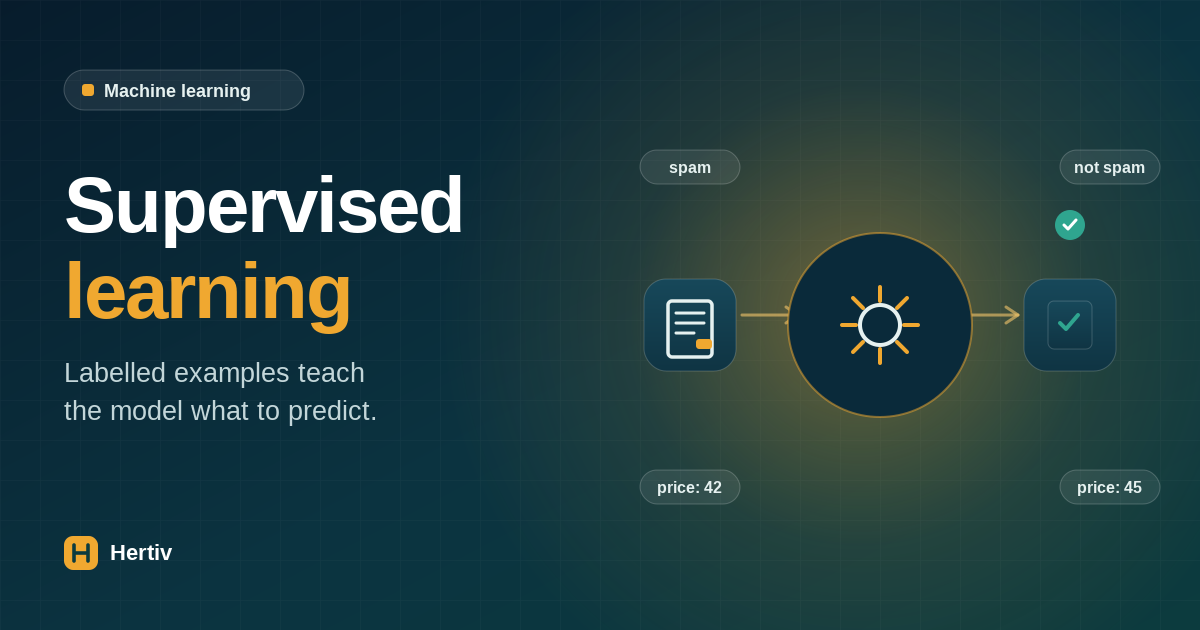
Supervised machine learning is a way of training a model on examples that already carry the right answer, called labels, so it can predict the answer for new examples it has not seen.
The label is the supervision. A spam filter learns from emails marked spam or not spam; a price model learns from houses sold with their sale prices attached; an image tagger learns from photos a person has already tagged. Without labels there is nothing to learn from, which is why labelled data is usually the most expensive part of a supervised project.
| Task | What the label is | What the model predicts |
|---|---|---|
| Classification | Spam or not spam | Whether a new email is spam |
| Regression | Sale price of a house | The price of a house not yet sold |
| Ranking | Which result a user clicked | The order to show new results |
| Sequence labelling | Named parts of a sentence | The parts of a new sentence |
The same pattern runs through all four rows: past examples with known answers teach the model, and the model applies the pattern to new cases.
Classification vs regression: what's the difference?
Classification predicts a category, and regression predicts a number. A model that sorts support tickets into billing, technical or account issues is classifying; a model that predicts how many tickets will arrive tomorrow is regressing.
The difference matters because the two kinds of model are judged differently. A classifier is judged on how often it picks the right category; a regression model is judged on how far its numbers sit from the real ones. Picking the wrong framing — treating a price as a category, for example — gives you a model that answers the wrong question.
How does training with labelled data work?
Training is the process of adjusting the model until its predictions match the labels on the training data. The model starts with rough guesses, the training loop measures how wrong each guess is, and the model shifts its internal settings a little toward the right answer, repeating the cycle many times.
Two habits keep training honest. First, hold out a test set the model never sees during training, and judge the model on that set alone — a model that only looks good on data it trained on has memorised, not learned. Second, watch for labels that leak the answer: a field that only exists after the event you are predicting will make the model look perfect in training and useless in production.
Good labels start with clear rules for what each label means, which is the core of data annotation: the people labelling the data need the same definitions, or the model learns their disagreements instead of the task.
What does a supervised learning project look like, step by step?
A supervised project follows the same sequence whether the model sorts tickets or prices houses. The steps below are the whole project in miniature.
- Define the answer: name the label and the decision the prediction will feed.
- Collect and label the data, with clear rules for what each label means.
- Split the data into training and test sets before any modelling starts.
- Train a simple model first, and record how it scores on the test set.
- Improve the data and the features before reaching for a fancier model.
- Deploy behind a check that watches predictions and catches drift.
The simple model in step 4 is the baseline everything else must beat. Teams that skip it often spend months tuning a complex model that never outperforms a plain one.
Where is supervised learning used today?
Supervised learning is the workhorse behind most machine learning in production, because most business problems come with a history of labelled outcomes. Each one started as a labelled dataset, not as a model. The pattern is the same in each case: a past decision that was recorded, and a new case that needs the same decision.
- Spam and fraud detection, where past messages and transactions carry labels
- Credit scoring and churn prediction, where past repayments and cancellations are the labels
- Medical image triage, where scans carry a clinician's reading
- Demand forecasting, where past sales are the labels for future orders
- Content moderation, where past review decisions train the filter
What these uses share is a labelled past. Where no labelled history exists, supervised learning cannot start, and teams either label data first or choose a different approach. See machine learning use cases in production for where these patterns pay off.
Example (hypothetical): a support team triages tickets
Example (hypothetical): a support team receives 500 tickets a day and routes each one by hand, taking 5 minutes per ticket — 2,500 minutes, or about 42 hours of staff time a day.
A classifier trained on a year of labelled tickets routes 400 of the 500 correctly. The remaining 100 go to a human queue, taking 100 × 5 = 500 minutes, or about 8 hours. The arithmetic is straightforward: 2,500 − 500 = 2,000 minutes saved a day, about 33 hours, and the team spends its time on the tickets the model could not place.
The saving holds only if the labels stay clean: a month of sloppy labelling sends the accuracy down and the queue back up.
What are the common mistakes?
The most common mistakes in supervised learning are data mistakes, not modelling mistakes. The model can only repeat what the labels taught it.
- Training on labels that leak the answer, such as a field recorded after the event
- Judging the model on the same data it trained on, so memorisation looks like skill
- Using a skewed training set, where one label dominates and the model learns to guess it always
- Labelling with vague rules, so two labellers disagree and the model learns the noise
- Shipping the model and never checking whether its predictions still match reality
Fix the data before tuning the model. A cleaner label set usually improves results more than a larger model, and it costs less to build. Teams that need help with the data side can start with machine learning development.
Key takeaways
- Labels are the supervision: the model learns from examples that already carry the right answer.
- Classification predicts a category; regression predicts a number — name the answer first.
- Judge the model on data it never trained on, or memorisation will look like skill.
- A simple model first gives you a baseline every later model must beat.
- Most failures are data mistakes: leaking labels, skewed sets and vague labelling rules.
Frequently asked questions
What is the difference between supervised and unsupervised learning?
Supervised learning trains on examples with known answers, called labels, and predicts answers for new cases. Unsupervised learning works on data with no labels, looking for groups and patterns instead. Most production systems are supervised, because business problems usually come with a labelled past.
How much labelled data do I need?
There is no fixed number: it depends on how complex the task is and how clean the labels are. A narrow classifier can work with a few hundred well-labelled examples, while a broad one may need far more. Start small, measure on a test set, and add data where the model actually fails.
What is a label in machine learning?
A label is the right answer attached to a training example: spam or not spam for an email, a sale price for a house, a category for a ticket. The model learns the mapping from inputs to labels, so the quality of the labels sets the ceiling on the quality of the model.
Why does my model score well in training but fail in production?
The usual causes are judging the model on data it trained on, labels that leak the answer, or training data that does not match production data. Hold out a test set, remove fields that only exist after the event, and check the model's predictions on fresh production cases.
Can supervised learning work with messy data?
It can, but only up to a point: the model repeats whatever the labels taught it, including their errors. Cleaning the labels and fixing vague labelling rules usually improves results more than tuning the model, and it is the cheaper step to take first.
Do I need a data scientist to build a supervised model?
A first version can be built by an engineer with labelled data and a clear target, using standard libraries. A data scientist becomes valuable when accuracy stalls, the data is skewed, or the model must keep working as the data changes over time.


