Staff Augmentation vs In-House Hiring: Which Fits Your Team?
Staff augmentation adds outside developers for a set period, while in-house hiring builds a permanent team. Which fits depends on how long the work lasts.
On this page
Short answer
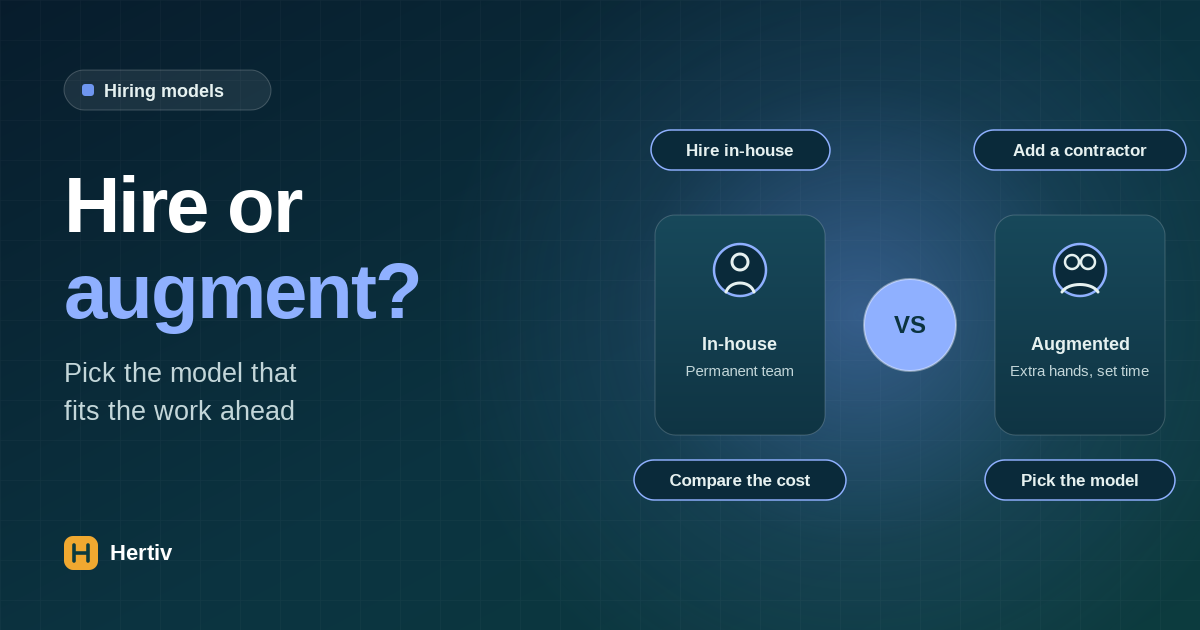
Staff augmentation means hiring outside developers who join your team temporarily, while in-house hiring means employing permanent staff of your own. Augmentation is faster to start and easier to scale down, while in-house hiring gives you more control and keeps knowledge inside the company. The better choice depends on how long the work will last, how rare the skills are, and how much you want to manage the team yourself.
What is staff augmentation and in-house hiring?
Staff augmentation is a hiring model in which outside developers join your team for a set period and work under your direction. They use your tools, follow your process and attend your meetings, but they stay employed by another company. In-house hiring is the opposite: you employ developers directly, they work only for you, and they stay with the company for the long term.
The two models answer different questions. Augmentation answers "how do I get the right skills this month", while in-house hiring answers "how do I build a team that stays". Many companies use both: a small permanent core team plus outside developers who join for busy periods or specialist work.
| Quality | Staff augmentation | In-house hiring |
|---|---|---|
| Who employs them | An outside company | Your company |
| How fast they start | Days to a few weeks | Weeks to months |
| How long they stay | A set period, often 3-12 months | Open ended |
| Who manages them | You, day to day | You, day to day |
| Knowledge kept | Leaves when they leave | Stays in the company |
| Cost shape | Monthly rate per person | Salary plus benefits and tools |
For the basics of the model, see what staff augmentation is.
How do the two models differ in practice?
Staff augmentation and in-house hiring differ most in speed, control and commitment. With augmentation, you can add two developers next week and remove them when the project ends. With in-house hiring, you spend weeks finding, interviewing and onboarding people, and you commit to keeping them after the project ends.
Control is similar in both models, because in each case the developers work under your direction. The difference is loyalty and context. An in-house developer learns your product, your customers and your history over months and years. An outside developer learns the current task, does it well, and moves on. That is fine for a defined piece of work, but it is a poor fit for work that needs deep product knowledge.
Risk also differs. Augmentation shifts the hiring risk to the provider: if a developer is a poor fit, the provider replaces them. In-house hiring keeps the risk with you: a bad hire costs months of salary and management time. On the other hand, a good in-house hire becomes more valuable over time, while a good contractor stays at the same monthly rate.
When does staff augmentation work best?
Staff augmentation works best when the work is temporary, the skills are scarce, or the deadline is fixed. A product launch, a platform migration or a compliance deadline are all good examples: you need extra hands for six months, not forever.
It also works well when you need a skill your team does not have. If your team knows web development but the project needs a mobile developer for one release, hiring a full-time mobile developer makes little sense. An outside specialist fills the gap without a permanent commitment.
Augmentation suits teams that already have strong managers. The outside developers still need direction, code review and clear priorities. If nobody has time to manage them, they will guess, and the work will drift. A team lead who can set tasks and review pull requests each day gets the most from this model.
When does in-house hiring work best?
In-house hiring works best for work that never ends. A core product, a platform your company depends on, or a system that needs constant care all deserve people who stay. Over time, those developers build knowledge that no contractor can match: why a decision was made, which customers depend on a feature, and where the fragile parts are.
It also works best when the team is the product. If you are building a company whose value sits in its people and their shared knowledge, renting that knowledge for a few months at a time is a weak plan. Permanent staff build trust, shared habits and a sense of ownership that short contracts rarely create.
Hiring in-house takes longer, so start early. If you need three developers in six months, begin recruiting now. For the wider comparison with outsourcing, read outsourcing vs in-house development.
How do the costs compare?
Example (hypothetical): a company needs three developers for six months to rebuild its booking system. It compares two options using round, illustrative figures.
With staff augmentation, each developer costs $60 an hour for 160 hours a month, which is $9,600 a month per person. Three developers cost $28,800 a month, and over six months the total is $172,800. There is no recruiting fee and no notice period at the end.
With in-house hiring, each developer earns $8,000 a month in salary, plus $2,000 a month in benefits, tools and office costs. That is $10,000 a month per person, or $30,000 a month for three people. Over six months that is $180,000, plus a one-off hiring cost of $12,000 for recruiting and onboarding, giving a total of $192,000.
On these figures, augmentation costs $19,200 less over six months. But the comparison is not complete: hiring usually takes two months, so the in-house team only delivers four months of work in the same period, while the augmented team starts in week two. Short projects favour augmentation; long ones favour hiring, because the hiring cost is spread over years.
How to choose between staff augmentation and in-house hiring
Choosing between the two models is a short decision process. Work through it before you post a job or call a provider.
- Set the horizon. If the work ends within a year, augmentation is usually the better fit. If it runs for years, hire.
- List the skills. Write down the exact skills the work needs and check whether your current team has them. A single missing skill points to augmentation.
- Check who can manage. Make sure a team lead has time to direct outside developers. If not, fix that first.
- Compare the full cost. Add recruiting, onboarding, benefits and tools to the salary, and compare that with the monthly rate over the real length of the work.
- Decide what knowledge must stay. If the work creates knowledge the company must keep, hire. If the knowledge leaves with the project, augment.
Many teams end up with a mix: a permanent core of three to five developers, plus outside developers for peaks and specialist work. For the related comparison with a dedicated team, see staff augmentation vs a dedicated team.
What are the common mistakes?
The most common mistakes in this choice are hiring for a short job, augmenting without management, and comparing only the headline rate.
- Hiring for a short project. A permanent hire for six months of work leaves you with a salary to pay after the work ends, or a painful exit.
- Augmenting without a manager. Outside developers without clear tasks and daily review produce work that does not fit the product.
- Comparing only the hourly rate. A $60 hourly rate looks expensive next to a salary, until you add recruiting, benefits, tools and downtime.
- Treating contractors as outsiders. If they sit apart from the team, they miss context and make avoidable mistakes. Include them in standups and reviews.
- Letting knowledge walk out. When augmented developers leave, their knowledge goes with them. Ask them to document decisions and hand over before they go.
Key takeaways
- Staff augmentation adds outside developers for a set period; in-house hiring builds a permanent team
- Augmentation starts faster and ends cleanly, while hiring keeps knowledge inside the company
- Short projects and scarce skills favour augmentation; core products favour hiring
- Compare the full cost, including recruiting, benefits and tools, over the real length of the work
- Name a manager for outside developers and make them document decisions before they leave
Frequently asked questions
What is staff augmentation in simple terms?
Staff augmentation means outside developers join your team temporarily and work under your direction. They stay employed by another company, use your tools and follow your process, and they leave when the contract ends. It is a way to add skills and capacity without a permanent hire.
Is staff augmentation cheaper than hiring in-house?
For short work, usually yes, because you avoid recruiting costs, benefits and the salary that continues after the project ends. For work that lasts years, in-house hiring is usually cheaper, because the one-off hiring cost is spread over a long period and salaries are lower than monthly contractor rates.
How long does it take to start with each model?
Staff augmentation typically starts within days to a few weeks, since the provider already employs the developers. In-house hiring usually takes weeks to months, because you must advertise, interview, agree terms and wait out a notice period. Plan hiring well ahead of the deadline.
Who manages augmented developers?
You do. Augmented developers work under your team lead, attend your meetings and follow your process, just like permanent staff. The provider handles employment, payroll and replacement if someone leaves. If nobody on your side has time to manage them, the model will not work well.
Can I mix staff augmentation and in-house hiring?
Yes, and most teams do. A common pattern is a small permanent core team that owns the product, plus outside developers who join for busy periods or specialist work. The core team keeps the knowledge, and the augmented developers add capacity where it is needed.
What happens to knowledge when augmented developers leave?
It leaves with them unless you plan for it. Ask outside developers to document key decisions, write clear handover notes and pair with a permanent team member on important work. A short handover week at the end of the contract protects the team from losing context.


