How Much Does Staff Augmentation Cost?
Staff augmentation usually costs $25 to $150 an hour per engineer, by region, role and seniority. Here is how the price is built and how to budget for a team.
On this page
Short answer
Staff augmentation costs between about $25 and $150 an hour per engineer, depending on where the engineer is based, the role, and seniority. A mid-level developer from Eastern Europe or Latin America typically costs $40 to $80 an hour, while the same role in North America costs $100 to $150. You pay for hours worked, usually with no recruitment or equipment costs on top.
What is staff augmentation cost?
Staff augmentation cost is what you pay to add engineers to your team through a vendor, usually as an hourly or monthly rate per person. The engineer works on your product and follows your process, but the vendor handles hiring, payroll and contracts.
Rates vary widely because they bundle different things: the engineer's pay, the vendor's margin, and sometimes equipment, benefits and account management. A headline rate of $50 an hour can mean very different things depending on what is included, so always ask for the breakdown.
Costs are usually quoted per hour, with a monthly figure based on 160 working hours. A $50-an-hour engineer therefore costs about $8,000 a month. For the wider model, see what staff augmentation is.
What drives the price?
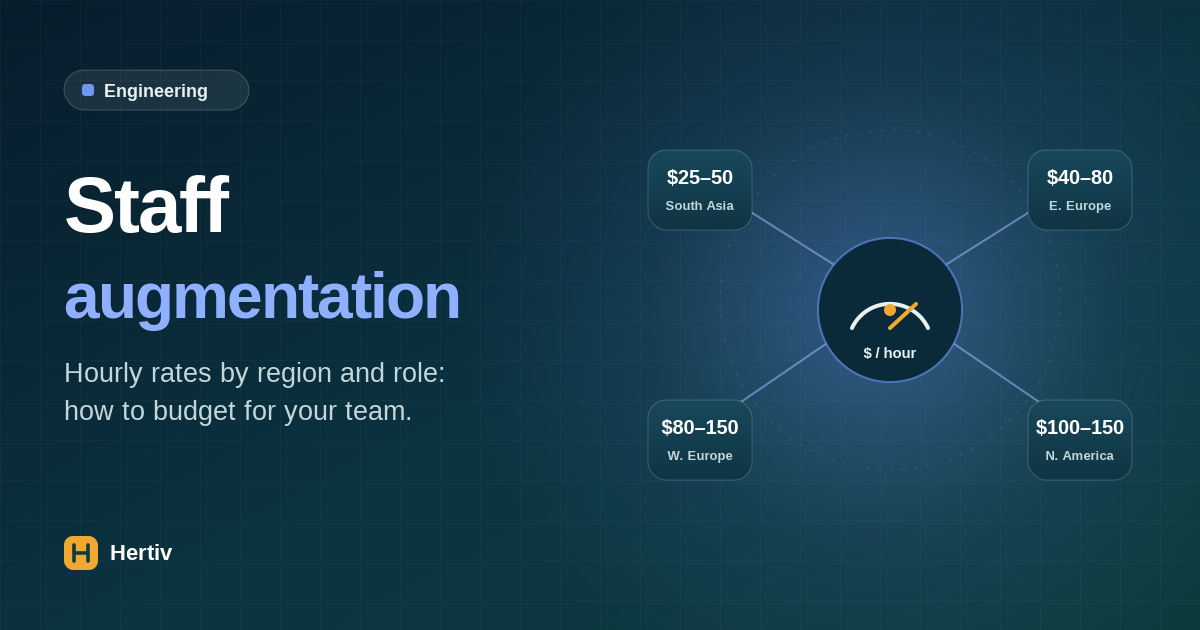
Region is the biggest driver of staff augmentation cost, followed by role and seniority. The table below shows typical hourly rates from published agency guides, labelled as planning ranges rather than quotes.
| Region | Typical hourly rate | Notes |
|---|---|---|
| South Asia | $25–$50 | Large talent pool, time-zone gap for Western teams |
| Latin America | $40–$70 | Time-zone overlap with North America |
| Eastern Europe | $40–$80 | Strong engineering schools, nearshore for Europe |
| Western Europe | $80–$150 | Same time zone, higher pay levels |
| North America | $100–$150 | Highest pay, same working hours |
Role matters too. A QA engineer or designer usually costs less than a data engineer or a DevOps specialist with the same experience, because the market for those skills is tighter. Seniority adds a further step: a senior engineer often costs 40% to 60% more than a mid-level one in the same region.
How do rates differ by role and seniority?
The table below shows typical hourly ranges by role and seniority, again as planning ranges from published guides. The spread inside each cell reflects region: the low end is usually South Asia or Latin America, the high end Western Europe or North America.
| Role | Mid-level | Senior |
|---|---|---|
| Frontend developer | $40–$70 | $60–$100 |
| Backend developer | $45–$75 | $65–$110 |
| QA engineer | $30–$55 | $50–$80 |
| DevOps engineer | $50–$85 | $75–$120 |
| Data engineer | $55–$90 | $80–$130 |
Rates also move with demand. AI and blockchain skills carry a premium over general web development, and niche skills such as smart contract auditing cost more still. When a rate looks far below the range, check what is missing: experience, English level, or the vendor's support. A vendor in a higher-cost region may also charge for a dedicated account manager, which adds a flat monthly fee on top of the hourly rate.
Compare like with like. A $45-an-hour senior in one region and a $45-an-hour mid-level in another are different hires, and the cheaper-looking option can cost more if it needs more review. A staff augmentation versus dedicated team comparison helps when the choice is between models.
How to estimate your monthly cost
You estimate staff augmentation cost by fixing the team shape first, then applying rates, then adding the costs that sit outside the hourly rate.
- List the roles and seniority. Write down each role you need and the level, not just a headcount.
- Pick a region per role. Time-zone overlap matters more for roles that work closely with your team.
- Apply the hourly rate. Multiply the rate by 160 hours for a monthly figure per person.
- Add onboarding time. Budget two weeks at half speed for each new engineer.
- Add your own management time. Code review, standups and mentoring come from your team, not the vendor.
- Compare the total with hiring. A salary plus benefits and recruitment is the honest comparison.
A vendor's margin is usually 20% to 40% of the engineer's pay, which is how the vendor covers recruitment, payroll and management. Ask whether the rate includes equipment, onboarding time and a replacement if someone leaves, because those answers change the real cost.
Example: a three-developer team for six months
Example (hypothetical): a startup needs two mid-level backend developers and one senior DevOps engineer for six months, all from Eastern Europe.
The two mid-level developers cost $50 an hour each. At 160 hours a month, that is $8,000 each, or $16,000 together. The senior DevOps engineer costs $70 an hour, which is $11,200 a month. The team total is $27,200 a month, and $163,200 over six months.
On top of that, the team budgets two weeks of onboarding at half speed and a one-month notice period for any replacement. The headline rate is only part of the cost; the time your own engineers spend reviewing and onboarding is the rest. That time is easy to forget in a budget, but it is real work, and it falls on your most senior engineers.
Staff augmentation vs hiring vs outsourcing
Augmentation sits between hiring and outsourcing. You keep control of the work without the cost and delay of hiring, but you pay a vendor margin and you still manage the people day to day.
| Point | Staff augmentation | Direct hiring | Outsourcing |
|---|---|---|---|
| Control | You manage the work | Full control | Vendor manages the work |
| Speed to start | Days to weeks | Weeks to months | Weeks |
| Monthly cost | Hourly rate, no payroll | Salary plus benefits and tax | Fixed or hourly project price |
| Flexibility | Scale up or down monthly | Hard to scale down | Fixed scope, hard to change |
| Best for | Filling skill gaps fast | Long-term core team | A defined project |
Hiring wins for a core team you will keep for years, because the cost per hour falls once recruitment is done. Outsourcing wins for a fixed-scope project you can hand over. Augmentation wins when you need skills now and want to keep the work inside your team. The staff augmentation companies for startups list is a starting point for finding vendors.
What are the common mistakes?
The most common mistakes in staff augmentation are choosing on hourly rate alone, skipping the trial period, and leaving the engineer without a clear owner on your side.
- Choosing the cheapest rate. A low rate with weak skills costs more in review time and rework.
- Skipping a trial. A two-week trial on real work shows more than any interview or CV.
- No clear owner. Every augmented engineer needs one person on your side who reviews their work.
- Treating them as outsiders. Engineers who are kept out of planning and context produce slower, weaker work.
- Forgetting the exit. Agree notice periods and handover rules before the contract starts.
Key takeaways
- Staff augmentation usually costs $25 to $150 an hour per engineer
- Region is the biggest price driver, then role and seniority
- A $50-an-hour engineer costs about $8,000 a month at 160 hours
- Vendor margin is usually 20% to 40% of the engineer's pay
- Budget onboarding time and your own review time on top of the rate
- Augmentation wins when you need skills fast and want to keep control
Frequently asked questions
What is included in a staff augmentation rate?
The rate usually covers the engineer's pay, the vendor's margin, payroll and contracts. Equipment, benefits and account management may or may not be included, so always ask for the breakdown before comparing two rates.
How many hours a month is a full-time augmented engineer?
Most contracts use 160 hours a month, which is 40 hours a week over four weeks. Some vendors bill 168 hours or use actual working days, so check the month definition when you compare monthly totals.
Is staff augmentation cheaper than hiring?
It is usually cheaper in the first year, because you skip recruitment fees, benefits and payroll setup. Over several years, a direct hire usually costs less per hour, so augmentation is best for needs that may change.
Can I scale a staff augmentation team up or down?
Yes, that is one of its main advantages. Most contracts allow changes with one month's notice, and some allow faster changes. Agree the notice period and any minimum commitment in writing before you start.
What happens if the engineer leaves?
A good vendor replaces the engineer and handles the handover, usually within two to four weeks. Ask about replacement time and whether the vendor charges for the overlap period, and keep documentation current so a replacement can start fast.
Do augmented engineers work my hours?
Usually yes, or with an agreed overlap of several hours a day. Full overlap costs more in some regions, while a partial overlap is cheaper but slows feedback. Agree working hours and response times in the contract.


