What Does It Cost to Build a SoundCloud-Style App?
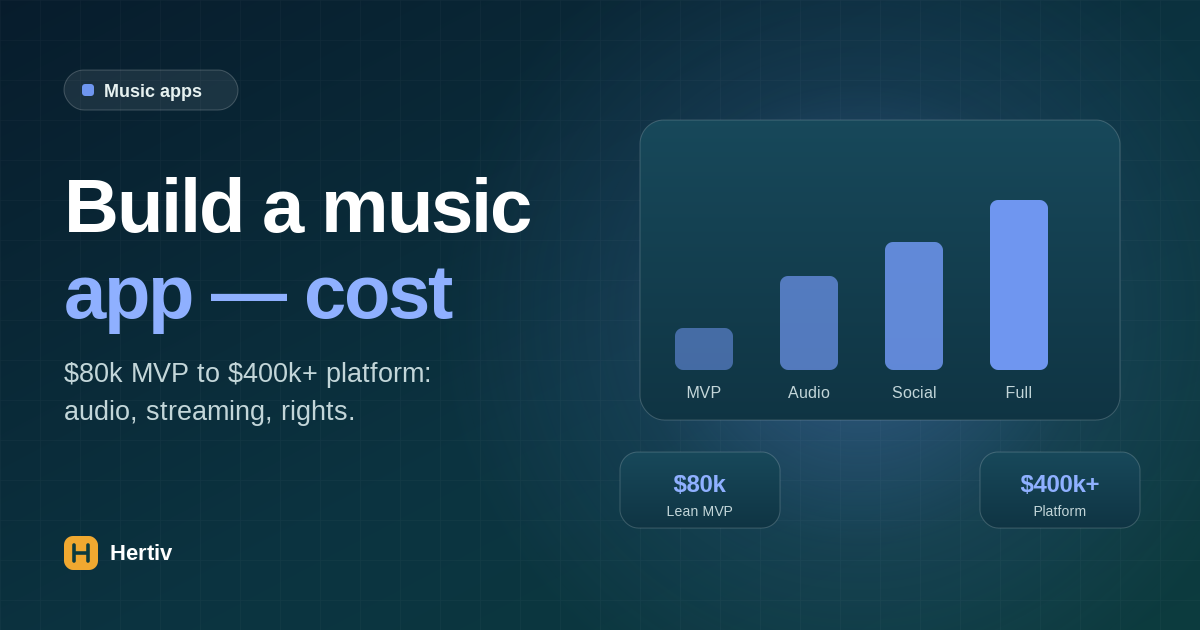
A SoundCloud-style app typically costs from roughly $80k for a lean MVP to $400k+ for a full platform with uploads, streaming, social features and payments.
On this page
Short answer
A SoundCloud-style app usually costs between roughly $80,000 for a lean MVP and $400,000 or more for a production platform. The price is driven by audio upload and transcoding, streaming delivery, social features, rights management and mobile apps.
What drives the cost of a SoundCloud-style app?
The cost is driven mainly by the audio pipeline, the social layer and the number of platforms you ship on. A music-sharing app is not a simple CRUD product: files are large, playback must be smooth, and every track raises storage, bandwidth and rights questions.
The main cost buckets are:
- Audio upload and processing. Receiving large files, validating them, transcoding to multiple bitrates, extracting waveforms and artwork.
- Streaming delivery. Serving audio through a CDN with adaptive quality, plus signed URLs or tokenised access.
- Accounts and profiles. Sign-up, authentication, artist and listener profiles, follows and notifications.
- Social features. Comments, likes, reposts, playlists, feeds and search.
- Monetisation. Subscriptions, payouts to artists, and payment provider integration.
- Rights and moderation. Copyright checks, takedown workflows, reporting and policy enforcement.
- Clients. Web app, iOS app and Android app, each maintained separately.
Each of these scales differently. Upload and streaming are mostly infrastructure and engineering effort; social features are mostly product design and iteration; rights and monetisation bring legal and financial complexity.
A useful mental model is to separate one-off build cost from ongoing run cost. The build is a project; streaming, storage and moderation are monthly costs that grow with usage. For a broader view of early-stage budgets, see how much an MVP costs.
What does each scope level typically cost?
Typical ranges vary widely by team, region and scope. The figures below are conservative typical ranges, not quotes, and should be treated as planning anchors.
| Scope | What it includes | Typical range (USD) |
|---|---|---|
| Prototype | Upload, playback, basic profiles, web only | $30k–$60k |
| Lean MVP | Above plus transcoding, playlists, follows, search | $80k–$150k |
| Full web platform | Social features, feeds, comments, moderation, subscriptions | $180k–$300k |
| Web plus mobile apps | Full platform on web, iOS and Android | $300k–$450k+ |
| Platform with payouts | Above plus artist payouts, rights workflows, analytics | $450k and up |
These ranges assume an external product team. A larger in-house team may shift effort between budget lines but rarely makes the work disappear.
Three things push a project above the range: custom audio processing at scale, complex rights and payout rules, and native mobile apps built alongside the web product. Three things keep it lower: a narrow launch audience, a single platform at launch, and using managed services for transcoding and delivery.
Why is the audio pipeline the biggest cost line?
Audio handling is the part most teams underestimate. Uploading a track is easy to demo and hard to run reliably: files arrive in many formats, connections drop, and playback has to work on weak mobile networks.
A production pipeline usually includes:
- Direct-to-storage uploads. Clients upload straight to object storage using signed requests, avoiding large files passing through your app servers.
- Validation. Checking file type, size, duration and basic integrity before accepting a track.
- Transcoding. Producing several bitrates so listeners on slow connections still get smooth playback.
- Waveform and metadata. Generating waveform images and reading tags such as title, artist and duration.
- Delivery. Serving audio through a CDN with signed URLs and range requests so seeking works.
- Moderation hooks. Scanning uploads for policy issues before they go public.
Each step needs error handling, retries and monitoring. Transcoding is CPU-heavy, so it usually runs as a queue-based worker rather than inside the web request.
If you plan to add AI features later, such as track tagging or recommendations, design the pipeline with structured metadata from the start. The AI product development page covers how these additions are usually staged.
How much do the social and product features add?
Social features are where product scope grows fastest. A feed, comments and reposts sound simple, but each one interacts with notifications, search, moderation and privacy.
Typical feature groups and their relative effort:
- Profiles and follows. Low to medium effort; foundational for everything else.
- Playlists and likes. Medium effort; needs careful data modelling.
- Feeds. Medium to high; a simple chronological feed is much cheaper than a ranked one.
- Comments, including timed comments on the waveform. Medium; the waveform UI adds real front-end work.
- Search. Medium to high; audio search and filtering on metadata needs a dedicated search service.
- Notifications. Medium; email, push and in-app channels each need their own handling.
- Moderation and reporting. High; this is operational as much as technical.
A common mistake is to treat social features as a single milestone. Splitting them into a launch set and a later set keeps the first release focused.
What about mobile apps and web?
Most SoundCloud-style products need at least a web app and a mobile presence. Each client is a separate build and a separate maintenance line.
A practical sequence is:
- Web app first. Fastest to iterate, easiest to test with early users.
- Responsive mobile web. Covers listening on phones without a native build.
- One native app. Choose iOS or Android based on your audience.
- Second native app. Add once the product and retention are proven.
Native apps are usually chosen for background audio playback, offline listening, lock-screen controls and push notifications. If those matter for your listeners, plan for at least one native app in the first year.
Cross-platform frameworks can reduce the effort of building two apps, but background audio and media handling often need platform-specific code anyway. Expect mobile apps to add a meaningful share of the total budget on top of the web platform; see mobile app development for how that work is structured.
What does it cost to run after launch?
Running costs for an audio platform are ongoing and grow with usage. They are usually a monthly line item rather than a one-off project cost.
Main recurring costs:
- Storage. Every uploaded track is stored in several versions after transcoding.
- CDN and bandwidth. Every listen consumes bandwidth; this is the largest variable cost.
- Transcoding compute. Spiky at upload time, can be queue-based or managed.
- Databases and search. Managed database and search services.
- Monitoring and error tracking. Needed from day one.
- Moderation and support. Human review does not disappear when the code is finished.
- Payments and payouts. Provider fees and reconciliation work if you pay artists.
For planning, model costs at a low, medium and high usage level rather than a single number. A platform with a small invite-only audience can run cheaply; public growth changes the picture quickly. This is the same pattern described in how much AI agent development costs, where usage-based services dominate the running bill.
How to prioritise scope before you build
Start with the smallest product that proves people will upload and listen, then expand. Most budget overruns come from launching several feature groups at once.
A workable order:
- Define the core loop. Upload a track, discover it, play it. Everything else supports this.
- Decide the audience. A creator-first tool and a listener-first service need different features.
- Choose one client. Web is usually right for launch.
- Use managed services for audio. Transcoding, storage and CDN can be bought rather than built.
- Defer monetisation. Subscriptions and payouts add legal and financial complexity; add them after retention is proven.
- Plan moderation early. Even a small platform needs a reporting and takedown path.
A short discovery phase before development usually saves more than it costs. The custom software development page describes how scoping and delivery are typically split.
Common mistakes that inflate the budget
Most cost overruns in music app projects come from a small set of avoidable decisions. Fixing them early is cheaper than fixing them later.
- Building the audio pipeline from scratch when managed services exist. Transcoding and delivery are commodities; buying them saves months.
- Launching web and two native apps at once. Each client multiplies testing and release work.
- Ignoring rights and moderation until launch. Takedown and reporting workflows affect data models and admin tools.
- Designing a ranked feed before you have data. A simple feed is enough for launch.
- Skipping observability. Without monitoring, audio failures surface as user complaints.
- Treating hosting as a one-off cost. Streaming bandwidth is a recurring bill that scales with listeners.
Key takeaways
- The audio pipeline (upload, transcoding, streaming) is the largest single cost driver.
- A lean MVP with uploads, playback and basic profiles can be built first; social and monetisation features come later.
- Mobile apps on iOS and Android add significant cost on top of the web platform.
- Rights management, licensing and content moderation are often underestimated.
- Ongoing hosting and CDN costs for audio delivery are a real monthly line item, not a one-off.
- Scope decisions early on matter more than the choice of technology stack.
Frequently asked questions
How long does it take to build a SoundCloud-style app?
A lean MVP with uploads, playback and basic profiles typically takes three to five months with a focused team. A full platform with social features, moderation and mobile apps usually takes nine to twelve months or more, depending on scope and how many clients you ship.
Can I build a music-sharing app without native mobile apps?
Yes. A responsive web app can handle uploads and playback for launch. Native apps become important when you need background audio, offline listening, lock-screen controls or push notifications, which many listeners expect from a music service.
What are the ongoing costs of running an audio platform?
The main recurring costs are storage for uploaded and transcoded files, CDN bandwidth for streaming, transcoding compute, managed databases and search, monitoring, and moderation. Bandwidth usually grows fastest as listeners increase, so model costs at several usage levels.
Do I need music licensing to launch?
If users upload their own original tracks, the platform still needs terms, reporting and takedown processes. Distributing commercial music requires licences from rights holders. Get legal advice early, because licensing affects product design, payouts and moderation.
Should I use managed services for audio transcoding and streaming?
Usually yes for a first version. Managed transcoding, storage and CDN services remove a large engineering burden and let you focus on product features. Build your own pipeline only if you have specific requirements that managed services cannot meet.
How can I reduce the cost of a first version?
Launch on web only, use managed audio services, keep the feed chronological, defer subscriptions and payouts, and limit the first release to a small audience. Each of these removes a significant cost line without weakening the core upload-and-listen experience.


