The SMB AI Playbook: Where Small Teams Start with AI
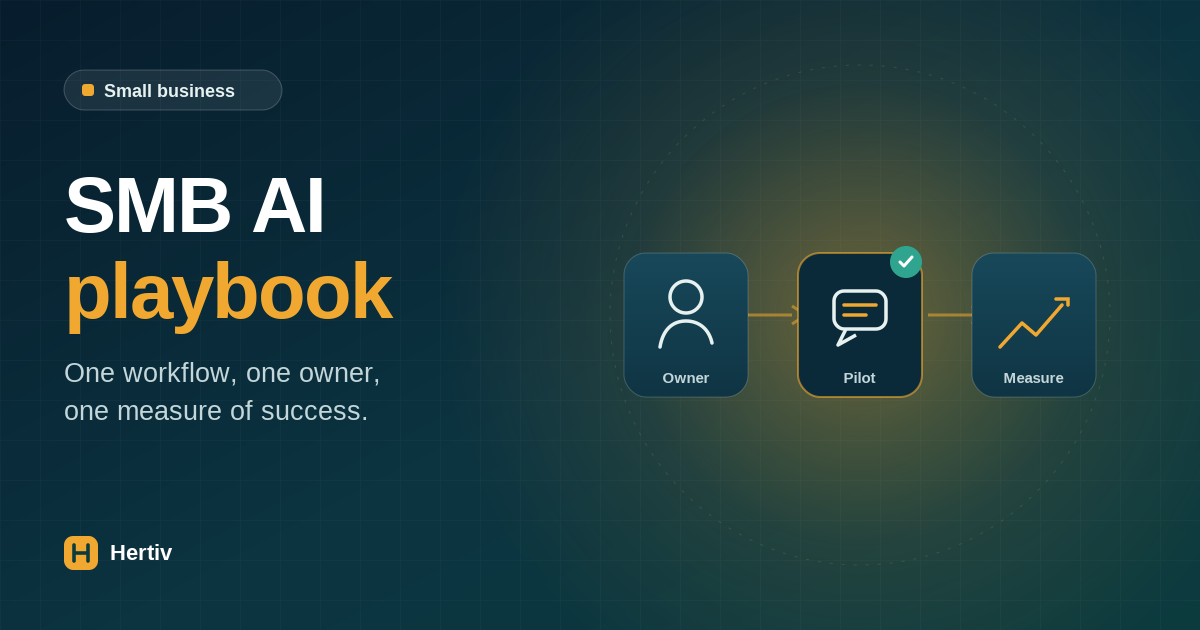
An SMB AI playbook picks one workflow, one owner and one measure of success before any tool is bought. Here is where AI pays off first.
On this page
Short answer
An SMB AI playbook is a short, written plan that helps a small business pick one workflow where AI saves time, assign one owner, and agree how success will be measured before buying any tool. It keeps the rollout narrow: one pilot, one evaluation set, and a human review step, so a team of a few people can ship something useful without hiring specialists or rebuilding systems.
What is an SMB AI playbook?
An SMB AI playbook is a short, written plan that helps a small or medium-sized business decide where AI is worth using, who owns the work, and how success will be measured. It is a plan, not a product: a few pages that name one workflow to automate first, the data it needs, and the review step that keeps a human in charge.
The playbook matters because small teams cannot afford to experiment everywhere at once. A business with ten or twenty people has no spare team to run five pilots, and a failed tool purchase hurts more when the budget is small. A written plan forces the team to pick the single workflow where AI saves the most time and to agree what “working” means before money is spent.
A good playbook fits on a few pages. It lists the workflow, the owner, the data source, the tool, the cost, and the check that decides whether to keep, fix or stop the pilot. If the plan needs a consultant to explain it, it is too long. The rest of this guide walks through each part in order.
Where does AI pay off first for a small business?
AI pays off first where the work is repetitive, digital and already reviewed by a person. If a task is done the same way every week, lives in email or documents, and has a clear right answer, it is a strong candidate. Tasks that need judgement, negotiation or a personal relationship are poor first pilots.
| Workflow | What AI does | Why it fits a small team |
|---|---|---|
| Answering common customer questions | Drafts replies from help pages | Same questions repeat every week |
| Drafting quotes and follow-ups | Builds a first draft from notes | Staff edit instead of writing from scratch |
| Sorting and summarising email | Flags urgent mail and sums up threads | Cuts morning triage to a quick scan |
| Extracting fields from invoices | Pulls dates, totals and line items | Removes retyping from the accounts queue |
| Scheduling and reminders | Books slots and chases confirmations | Fewer no-shows with no extra admin |
| Writing first drafts of listings | Drafts product and service descriptions | One owner edits; nothing ships unchecked |
Start with the row that eats the most staff hours each week, not the one that sounds most impressive. A support inbox that takes an hour a day is a better pilot than a forecasting project that needs data the business does not keep. If the first pilot is customer questions, the patterns in AI chatbot use cases show what works in practice.
What do you need before the first pilot?
Before the first pilot you need three things: a named owner, clean source material, and a way to check the output. The owner is one person who answers for the pilot, even if others help. The source material is the documents the AI will read: help pages, past emails, price lists or templates. The check is a simple rule, such as “every draft is read by a staff member before it goes out”.
Data quality decides the result more than the choice of tool. If the price list has three versions or the help pages contradict each other, the AI will repeat the confusion. Spend the first week tidying the source documents: remove duplicates, fix outdated prices and mark anything that must never be quoted automatically.
You also need a short list of real cases to test against. Twenty past customer questions with their correct answers is enough to tell whether the pilot is improving. Keep the list fixed so each change to the setup can be judged against the same cases. An AI readiness assessment can help a team that is unsure whether its data is ready.
How do you roll out AI in a small team?
Roll out AI in a small team as a short, fixed-length pilot with a decision date, not as an open-ended experiment. A pilot that never ends never gets judged.
- Pick one workflow and one owner. Write down the hours it takes now.
- Tidy the source documents the AI will read. Remove duplicates and fix outdated prices.
- Choose the simplest tool that reads those documents and drafts answers.
- Run it for four weeks with a human reviewing every output.
- Compare the same twenty test cases from before the pilot with the results now.
- Decide: keep it, fix it, or stop it — and write the decision down.
Four weeks is long enough to see real behaviour and short enough to stop cleanly. If the pilot needs a second month, treat that as a new decision, not an extension by default. A short AI proof of concept follows the same shape when the team wants outside help to build the first version.
How do you keep costs and risks under control?
Keep costs under control by starting with tools that charge monthly and can be cancelled, and by writing down the monthly spend before the pilot starts. Avoid annual contracts and per-seat deals until the pilot has proved its value. If a vendor will not quote a price on its own site, ask for it in writing and compare it with the hours the pilot is meant to save.
The main risks are wrong answers reaching customers and staff time spent checking output. Both are handled the same way: nothing the AI writes goes out without a human reading it first, and the pilot owner reviews a sample of outputs each week. Keep customer data inside tools that fit your privacy rules, and do not paste customer details into a free consumer chatbot to save money.
Watch for two quiet costs. The first is the review time: if checking the AI takes as long as doing the work, the pilot has failed even if the output looks good. The second is the tidy-up work: documents drift, prices change and the AI’s answers go stale unless someone owns the source material. Put both checks in the pilot plan.
Example (hypothetical): a 12-person services firm tries one pilot
Example (hypothetical): a 12-person bookkeeping firm spends about 10 hours a week answering the same client questions by email: deadlines, document checklists and fee queries. The owner picks this inbox as the pilot, assigns one senior bookkeeper as owner, and tidies the firm’s help pages and fee list first.
The firm runs the pilot for four weeks. The AI drafts replies from the help pages, and the bookkeeper reviews every draft before sending. In week one the drafts need edits in about half the replies; by week four the drafts need edits in about a quarter. The bookkeeper spends 2 hours a week reviewing drafts instead of 10 hours writing replies, saving about 8 hours a week.
The firm keeps the pilot and moves to the next workflow only after the help pages get a named owner. The lesson is not the tool: it is that the tidy source documents and the review step did the work, and the pilot would have failed without them.
What are the common mistakes?
The most common SMB AI mistakes are starting with five pilots, buying before measuring, and letting the AI answer customers with no review step.
- Starting with a broad assistant instead of one workflow with an owner.
- Buying an annual plan before the pilot proves value.
- Letting AI replies reach customers without human review.
- Skipping the test cases, so quality debates are anecdotal.
- Forgetting to tidy source documents, so the AI repeats old errors.
- Measuring usage instead of hours saved.
A final note: the playbook is a living document. Revisit it each quarter, retire pilots that stopped paying off, and write down what changed. Small teams win with AI by staying narrow, not by keeping up with every new tool. For customer-facing pilots, AI agents for customer support covers the handover and evaluation design in more depth.
Key takeaways
- Pick one workflow, one owner and one measure of success before buying any tool
- AI pays off first on repetitive, digital work that a person already reviews
- Clean source documents matter more than the choice of tool
- Run a four-week pilot with human review of every output, then decide
- Measure hours saved including review time, not just usage
Frequently asked questions
How much does an SMB AI pilot cost?
It depends on the tool, and prices change, so check the vendor's own pricing page for current plans; see vendor site for the latest figures. Most small teams start with a monthly plan they can cancel, and the bigger cost is usually the owner's time to tidy documents and review drafts during the pilot.
Do small businesses need an AI specialist to start?
No. A small team needs one owner who knows the workflow and can judge whether the output is right. The owner does not need to build models; the tool handles that. Outside help is useful for the first pilot, but the owner should stay in-house.
Which workflow should a small business automate first?
The one that takes the most staff hours each week, is done the same way every time, and has a clear right answer. Common first pilots are answering repeated customer questions, drafting follow-ups and extracting fields from invoices.
How do you stop an AI pilot from giving wrong answers?
Nothing the AI writes should reach a customer without a human reading it first. Keep the source documents tidy, test against a fixed list of real cases, and log every output so mistakes can be traced to the document that caused them.
How long should an SMB AI pilot run?
Four weeks is a good default: long enough to see real behaviour and short enough to stop cleanly. Decide in advance what success looks like, then compare the same test cases before and after the pilot instead of judging by feel.
What data does a small business need for AI?
The documents the workflow already uses: help pages, past emails, price lists and templates. They need to be current and consistent, because the AI will repeat whatever they say. Twenty real past cases with known good answers are enough for a test set.


