What to Check Before You Buy SaaS for Healthcare
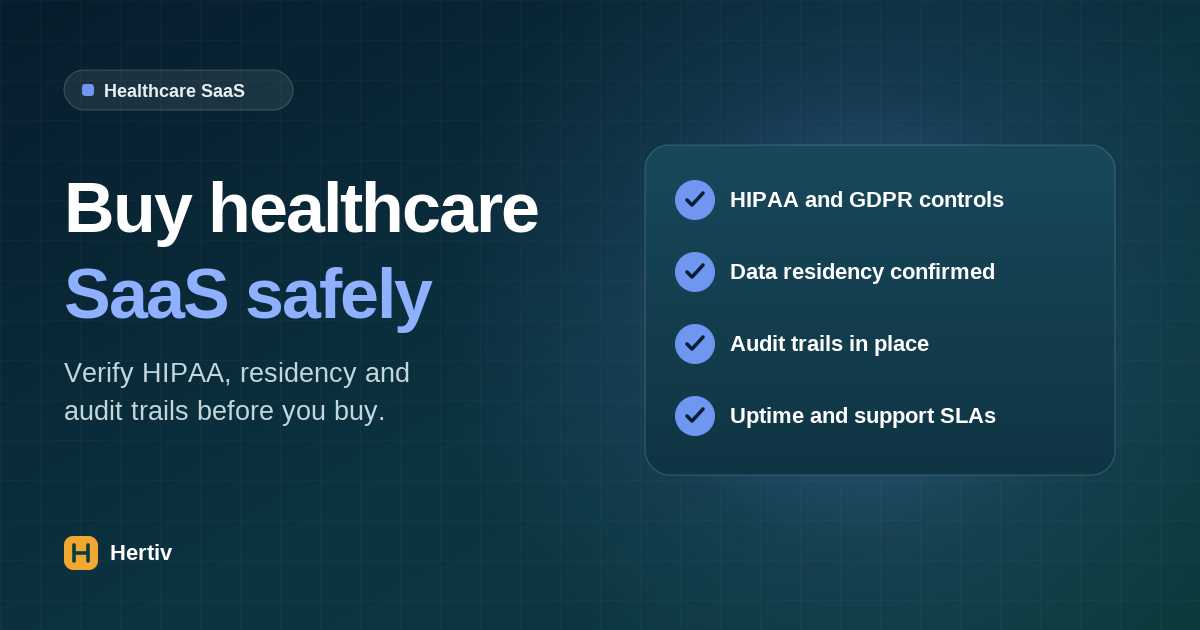
Healthcare SaaS must clear HIPAA, GDPR and FHIR integration checks before it earns a place in your stack. Here is how to evaluate vendors and avoid costly gaps.
On this page
Short answer
SaaS for healthcare means cloud software that handles patient data, clinical workflows or healthcare operations while meeting rules like HIPAA in the US and GDPR in the EU. Buyers should verify data residency, audit trails and interoperability standards such as FHIR before signing.
What counts as healthcare SaaS?
Healthcare SaaS is cloud-delivered software used by providers, payers, health tech companies or life-science teams that stores, processes or transmits health-related data. The category spans clinical tools, scheduling, billing, patient engagement, telehealth and analytics. The defining question is not the product label but whether health data flows through it.
A scheduling app that only stores names and appointment times may sit outside strict health-data rules. A patient portal that shows lab results almost certainly does not. Buyers should map the SaaS against three buckets:
- Clinical data: diagnoses, notes, images, lab results, prescriptions.
- Operational data: staffing, inventory, billing codes, facility metrics.
- Mixed data: most real systems, where operational records link back to identifiable patients.
That mapping drives every later decision: contracts, hosting region, access controls and vendor due diligence. If the vendor cannot explain which bucket their product falls into, treat that as a warning sign. Hertiv's work on AI for healthcare providers and health tech follows the same data-first approach.
Which regulations actually apply to your SaaS purchase?
The rules depend on where you operate and who your users are, not on where the vendor is headquartered. In the US, HIPAA applies to covered entities and their business associates, which generally includes SaaS vendors handling protected health information. In the EU and UK, GDPR and its UK equivalent treat health data as a special category with stricter lawful-basis and security requirements.
Questions to put in writing to every vendor:
- Will you sign a Business Associate Agreement or a Data Processing Agreement?
- Where is data stored and which subprocessors touch it?
- How do you handle breach notification, and within what timeframe?
- Can you delete or return all data on exit, with evidence?
- Which certifications do you hold, and what is their scope?
Sector-specific rules may also apply, such as medical-device regulation if the software influences diagnosis or treatment. Get your legal and security leads involved before the pilot, not after.
How do you check interoperability with existing systems?
Interoperability is where most healthcare SaaS projects succeed or fail. The product may look modern, but if it cannot exchange data with your EHR, scheduling or billing systems, staff will reconcile records by hand. Look for support for FHIR, the modern API standard for health data exchange, and HL7 v2 where older systems still dominate.
A practical check list:
- Interface inventory: ask for a written list of supported interfaces and versions.
- Sandbox test: request access to a test environment and run a real message or API call for a common workflow.
- Mapping effort: confirm who builds the field mapping and who owns it after go-live.
- Error handling: ask what happens when a message fails or arrives twice.
- Volume limits: understand rate limits and batch windows for bulk syncs.
Example (hypothetical): a clinic with three sites wants a patient messaging tool. The vendor supports FHIR but only for read access, so appointment changes must still be keyed into the EHR manually. That hidden workflow costs more staff hours than the licence saves, and only a sandbox test reveals it.
If you need custom connectors, plan them as a separate engineering workstream with clear ownership.
What security controls should you require?
Healthcare SaaS should meet the same baseline as any sensitive-data system, plus a few health-specific checks. Start with encryption in transit and at rest, role-based access, multi-factor authentication and detailed audit logs that record who saw which patient record and when.
Minimum controls to verify:
- Access management: single sign-on support, least-privilege roles, session timeout.
- Audit trail: immutable logs, retention period, export on request.
- Segmentation: tenant isolation if the product is multi-tenant.
- Vulnerability process: how findings are triaged and disclosed to customers.
- Incident history: ask how past incidents were handled, without expecting names.
For teams building or extending a product in this space, a security review early saves rework later. Hertiv's cybersecurity services cover this kind of pre-launch assessment.
How should you run a healthcare SaaS pilot?
A pilot should prove integration, security and staff adoption on a small, real workflow before any broad rollout. Keep it time-boxed and define success criteria in advance so the decision is not driven by enthusiasm.
A workable sequence:
- Pick one workflow with clear start and end points, such as referral intake.
- Agree the data set, including whether real or synthetic patient data is used.
- Connect the system in a test environment and measure integration effort.
- Run the workflow with a small group of staff for a fixed period.
- Review against criteria: error rate, time saved, support tickets, compliance gaps.
- Decide to proceed, extend or stop, in writing.
Example (hypothetical): a pilot with ten staff for four weeks targets a 20% reduction in intake time. If the measured reduction is 8%, the team documents the gap and decides whether process changes or product limits caused it before renewing.
Pilots also expose contract gaps. Check data-use terms for pilot data and confirm deletion if you walk away.
How do you decide between buying and building?
Buy when the workflow is common, the vendor integrates cleanly and the compliance work is already done. Build when the workflow is a differentiator, when integration costs exceed licence savings, or when data rules make external processing impractical.
A simple decision frame:
| Factor | Favours buying | Favours building |
|---|---|---|
| Workflow | Standard, well understood | Unique to your model |
| Integration | Supported interfaces exist | Heavy custom mapping |
| Compliance | Vendor already covered | Data cannot leave your control |
| Time to value | Weeks | Months |
| Long-term cost | Licence plus support | Engineering team plus operations |
Hybrid models are common: buy the commodity layer and build the thin layer that fits your clinicians or members. This is where a SaaS development partner can help scope the custom part without rebuilding what already works.
Common mistakes when buying healthcare SaaS
Most failures come from gaps that were visible before signing but not investigated. These are the patterns worth checking on every deal.
- Treating a security questionnaire as a formality and not reading the answers.
- Skipping the sandbox test because the vendor demo looked smooth.
- Assuming a certification covers your use case without checking its scope.
- Forgetting staff training and workflow change in the budget.
- Signing without a data export and deletion clause.
- Letting a pilot run without written success criteria.
- Ignoring subprocessors that store data in another region.
- Assuming the vendor will handle all interface mapping.
Each of these is cheap to check early and expensive to fix later. A short review with legal, security and clinical operations before the pilot prevents most of them.
Where AI features are part of the product, such as summarisation or triage suggestions, add a review of model outputs and human oversight to the checklist.
Key takeaways
- Confirm which data the SaaS touches: PHI in the US, special-category health data in the EU, or operational data only.
- Ask for a Business Associate Agreement (HIPAA) or a Data Processing Agreement (GDPR) before any pilot.
- Test FHIR and HL7 interfaces against your own EHR sandbox, not a vendor demo.
- Check audit logging, role-based access and encryption at rest and in transit as minimum controls.
- Plan for exit: data export format, deletion proof and contract clauses matter as much as features.
- Budget for integration and change management, not just licence fees.
Frequently asked questions
Is a scheduling app that stores patient names considered healthcare SaaS?
Often yes. If the app links names to appointments, clinicians or conditions, it likely handles identifiable health data and falls under HIPAA or GDPR obligations. Confirm with your legal team and ask the vendor for the relevant agreement before use.
Does a HIPAA-compliant vendor make my organisation compliant?
No. The vendor can support your compliance, but your organisation remains responsible for policies, access controls, staff training and incident response. A signed Business Associate Agreement is a starting point, not proof of compliance.
What is FHIR and why does it matter when buying SaaS?
FHIR is a standard for exchanging health data through APIs. Support for it usually means faster, cheaper integration with EHRs and other systems. Ask which FHIR version is supported and test a real workflow in a sandbox.
How long should a healthcare SaaS pilot run?
Long enough to cover a full cycle of the workflow, often four to eight weeks. The exact length matters less than having written success criteria and a fixed review date before the pilot begins.
What should be in the exit clause?
The contract should specify the export format, the timeframe for returning data, deletion confirmation and support during transition. Without these, switching vendors becomes slow and risky.
Can we add AI features to a healthcare SaaS product safely?
Yes, if outputs are reviewed by a human where clinical decisions are involved, data handling is documented, and model behaviour is monitored. Start with low-risk tasks such as summarisation or administrative triage.


