RPA in Finance: Where Automation Actually Helps
RPA in finance uses software robots for rule-based work like invoice matching and reconciliations. Here is where it pays, where it fails, and how to start.
On this page
Short answer
RPA in finance uses software robots to carry out repetitive, rule-based tasks such as invoice matching, reconciliations and report preparation. It works best on high-volume work with clear rules and structured data, and it frees finance staff for judgement, exceptions and analysis. It does not replace accounting controls or fix broken processes.
What is RPA in finance?
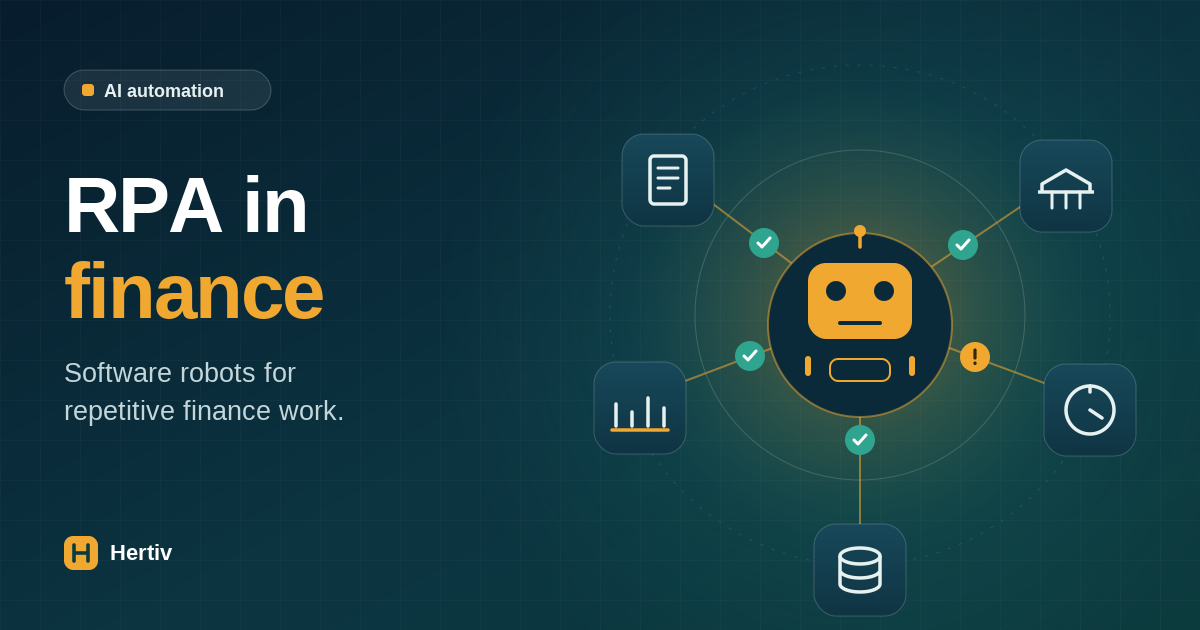
RPA in finance is the use of software robots to carry out repetitive, rule-based finance tasks without human clicks. A robot logs into the same systems a person would, copies data between screens, checks values against rules and files the result, following a script that the finance team defines.
Unlike a system integration, an RPA robot works through the user interface, so it can connect tools that have no API and no shared database. That is why finance teams use it for work spread across an ERP, a bank portal, spreadsheets and email.
RPA is not artificial intelligence on its own. A robot follows rules exactly and stops when the data does not fit. Teams often pair it with document reading and document AI for invoices and forms, but the robot itself makes no judgements.
Which finance tasks suit RPA?
The best RPA tasks share three traits: high volume, clear rules and structured data. A task done hundreds of times a month with the same steps every time is a strong candidate, while a task that needs judgement on every case is not.
| Task | Why it fits RPA | What still needs a person |
|---|---|---|
| Invoice matching | Same three-way check every time | Price mismatches and missing invoices |
| Bank reconciliations | Clear match rules, large volume | Unexplained differences |
| Expense report checks | Policy rules are fixed | Borderline claims and fraud signs |
| Month-end reports | Same extracts and formats monthly | Commentary and review |
| Vendor onboarding | Same forms and checks per vendor | Risk decisions and approvals |
Tasks that change often, depend on free-text emails or need negotiation are poor fits. If the rule cannot be written down in a short checklist, a robot will not run it reliably.
How does RPA work in a finance team?
An RPA setup has three parts. The robot itself runs the scripted steps, an orchestrator schedules robots and keeps the audit log, and a control room lets the team watch runs, pause a robot and handle failures. Most finance teams run unattended robots overnight and attended robots that help staff during the day.
Building a robot starts with process mapping. The team records the exact clicks, checks and decisions for one task, removes steps that add no value, and then scripts the rest. A good rule is to fix the process first: automating a messy process only produces errors faster.
Every robot run leaves a log of what it did, which supports audit and control. That log is one reason finance teams like RPA for regulated work, since each transaction can be traced back to its source data and the rule that was applied.
What are the benefits and limits?
The main benefit of RPA in finance is time. Robots work through the night, do not tire, and handle peaks such as month-end without overtime. Error rates usually fall too, because a robot copies figures exactly instead of retyping them.
The limits matter just as much. A robot breaks when a screen changes, a file format moves or a system is down, so someone must maintain the scripts. RPA also adds no intelligence: it cannot read a supplier's email, judge a credit risk or spot a fraud pattern on its own.
Costs include licences, development time and maintenance, and a robot that runs once a month rarely pays for itself. The business case works when the task is frequent enough that saved hours cover those costs, which is why teams start with the highest-volume tasks first.
Example (hypothetical): automating invoice processing
Example (hypothetical): a finance team processes 2,000 supplier invoices a month, and each invoice takes about 6 minutes to check and enter by hand. That is 2,000 times 6 minutes, or 12,000 minutes, which equals 200 hours a month.
A robot takes over the clean cases, which are about 80 percent of invoices. That removes 160 hours of manual work a month. At a loaded staff cost of $40 an hour, the saved time is worth $6,400 a month.
The robot licence, hosting and maintenance cost about $1,500 a month, and the remaining 20 percent of invoices still go to a person for exceptions. The net saving is $6,400 minus $1,500, which equals $4,900 a month, and the team uses the freed hours for supplier queries and month-end review instead.
What are the common mistakes?
The most common RPA mistakes in finance are automating a broken process, skipping exception handling, and treating robots as a one-off project.
- Automating a messy process. Map and simplify the task first, or the robot will copy every workaround and error.
- No exception path. Every robot needs a clear rule for what happens when data does not match, or invoices pile up unprocessed.
- No maintenance owner. Screens and file formats change, so a robot without an owner stops working within months.
- Weak controls. Robot credentials need the same access reviews and segregation of duties as human accounts.
- Measuring hours only. Track error rates and close times too, since speed without accuracy helps no one.
Teams that already use RPA in other departments can reuse the same platform and skills; RPA in real estate shows the same pattern in a different sector.
For regulated, high-volume work, robotic process automation in healthcare covers similar ground.
How do you start with RPA in finance?
You start with RPA in finance by picking one high-volume, well-understood task and proving the value before expanding.
- List candidate tasks. Rank finance tasks by volume, rule clarity and error cost, and pick one with a clear owner.
- Map the process. Record every step, decision and exception, and remove steps that add no value.
- Run a small pilot. Build one robot for one task and run it alongside the manual process for a month.
- Measure the result. Compare hours saved, error rates and close time against the manual baseline.
- Add controls. Give the robot its own credentials, log every run and review access like any other account.
- Scale in order. Add the next task only after the first one runs reliably for a full month-end cycle.
Finance teams that want agents rather than scripts can look at AI agents for finance teams, which handle tasks that need judgement across documents and systems.
Key takeaways
- RPA fits high-volume, rule-based finance work with structured data
- A robot follows rules exactly and stops when data does not fit
- Fix the process before automating it, or errors arrive faster
- Every robot needs an exception path and a maintenance owner
- Start with one task, prove the saving, then scale in order
Frequently asked questions
Is RPA the same as AI in finance?
No. RPA follows fixed rules step by step, while AI models learn patterns from data and can handle text, images and judgement calls. Finance teams often use both: RPA moves data between systems, and AI reads documents or flags anomalies that rules alone would miss.
Which finance processes should not be automated with RPA?
Avoid processes that change often, depend on free-text emails, need negotiation, or require judgement on every case. Credit decisions, fraud investigation and complex tax work are poor fits because the rules cannot be written down as a short, stable checklist.
How much does RPA cost for a finance team?
Costs vary by vendor and scope, so treat any figure as a planning range and ask vendors for a quote. Expect licence fees, development time for each robot, and ongoing maintenance when screens or file formats change. A robot only pays for itself on frequent, high-volume tasks.
Does RPA replace finance staff?
No, it replaces repetitive clicks, not finance judgement. Staff move to exceptions, analysis, supplier queries and control work that robots cannot do. Teams that plan this shift openly get better adoption than teams that present RPA as headcount reduction.
Is RPA safe for regulated finance work?
Yes, when controls are applied. Give each robot its own credentials, log every run, review access like any other account, and keep segregation of duties so a robot cannot both create and approve a payment. The audit log is one of RPA's strengths in regulated work.
How long does a first RPA pilot take?
A first pilot for one well-understood task usually takes four to eight weeks, including process mapping, build and a month of parallel running. The timeline grows when the process is undocumented or the data is messy, which is why mapping comes before building.


